1. Destroyer: The U-Boat Hunter
  2. News

Destroyer: The U-Boat Hunter News

Contact coming in much more strongly. Demo confirmed


Hello everyone,


Some time has passed since the previous entry, and yet again I think it was a time well spent. With each day, we have more and more of the game up and running, and we are finally approaching the moment when we can show the fruit of our work to all of you.

At this point, we have almost finished setting up our destroyer’s most essential battle stations, and, in the meantime, U-boat AI has become a ruthless and efficient hunter. We are yet to implement escort AI and command system, as well as multiple U-boats, but gameplay on the tactical and operational levels is already here, and is becoming stronger with each iteration. We now have a small merchant formation and a single U-boat attacking it, but even in this small scenario, there is so much going on that I guess it is safe to say that the full game is going to be an exciting challenge.

With the above in mind, it is my pleasure to announce that we will be releasing a playable demo of the game at the upcoming June Steam Festival. That’s right! If everything goes according to plan, you will be able to embark on your first hunt in about three months’ time from now.


Of course, there is still a tremendous amount of work to be done. Does the game already look as good as we would like it to? Of course not - the graphics are gonna be so much better once we finish. Are all the functionalities and gameplay mechanics in place and working? Well, yes and no, because while the core systems are functioning, there is still some work to be done in terms of streamlining and smoothing things out. But, is it playable, fun, and realistic? Well, I would say that we are definitely getting there!


Therefore, while the demo may not present the game’s full potential and may still have a few rough edges here and there, we will do our best to bring you an experience that will show what we have achieved so far and how we approach the subject altogether. We hope that you will be impressed by our first offering and that your feedback will guide us on how to refine the experience and bring you the best surface attack simulator to date!

https://store.steampowered.com/app/1272010/Destroyer_The_UBoat_Hunter/

Dev Diary: Sonar Room Update

Hello!

While you could read my thoughts on the TRR in the last devlog, at that point we still didn’t have too much to offer in terms of eye candy.

Since then, however, our work on the sonar room as a whole has progressed considerably, and we can finally show you an almost ready QGB sonar stack, as well as the TRR itself.


Some of you will probably notice that the sonar console has changed considerably since the release of the cinematic trailer, and that would be 100% correct. Truth be told, we were under immense pressure to release that trailer ASAP, but thankfully we were able to complete our research and find the most appropriate sonar model for 1942, which would be the QGB searchlight sonar that you can see in the pictures.


It had a number of interesting features that I will most probably discuss in the next devlog, but I think you have had enough of my rambling by now, so I am going to let the screenshots speak for themselves.

Hope you like them!

https://store.steampowered.com/app/1272010/Destroyer_The_UBoat_Hunter/

Dev Diary: The Tactical Range Recorder

Hello everybody,

We are beginning our work on the Sonar Room, which means that I can once again share a few (hopefully interesting) facts about the equipment contained therein. I guess it doesn’t come as a surprise that there is a sonar, but perhaps a little less obvious is the other station you will find there, namely the Tactical Range Recorder. This hugely important device was introduced in 1942 and was of great help to destroyer crews in making accurate attacks against submerged U-boats. And, since I shared a few different sonar details in the previous devlog, then, for a change, I guess I could say a word or two about this long-forgotten piece of technology. If you ask me, this is some real WW2 archaeology right here 😉
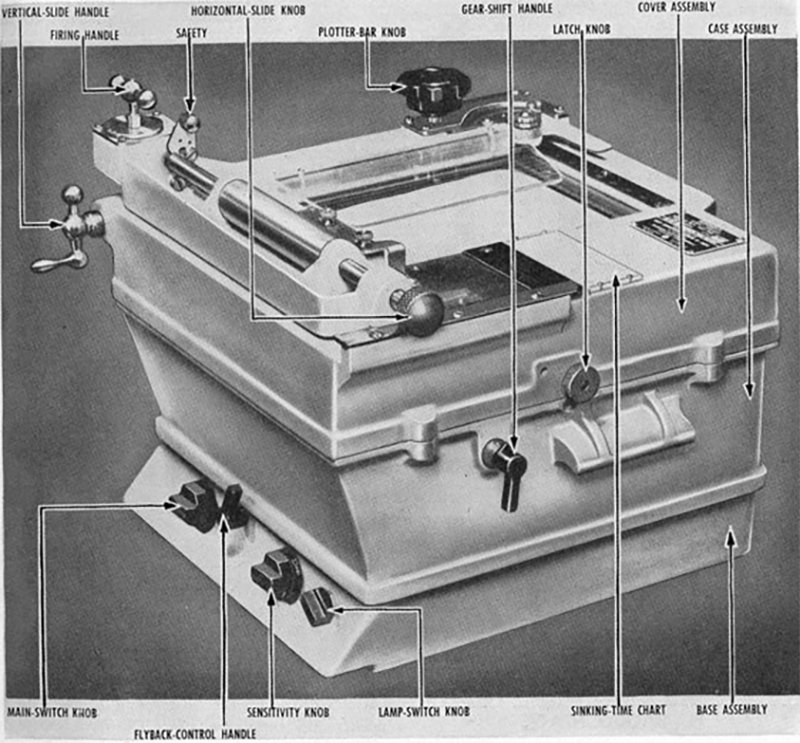


The Tactical Range Recorder measured the so-called ‘range rate’, i.e. the speed at which the distance between an anti-submarine ship and its submerged target would close during an attack approach. It had a mechanism that could translate the sonar’s echo into electric impulses that energized a stylus which, in turn, marked the current distance on a special kind of paper that was rolling through the device. The result was a line graph which, when interpreted using different settings of the device, would indicate the best moment to fire a depth charge barrage.

The paper was rolling downwards, while the stylus was moving from its starting left-side position to the right, marking distance to target on a horizontal scale and then returning to its initial position. As the destroyer was approaching the target, the diagram would eventually shape into a straight diagonal line - the heavier it was leaning left, the faster the distance was closing. A key element of the operator’s job was to properly rotate the transparent plexiglass piece (called the ‘plotter bar extension’) with parallel lines marked on it, so that the angle of those lines (including the all-important ‘firing line’) would match the angle of the line graph. If this alignment was correct, the perfect time to launch the barrage would be signalled by the graph crossing the firing line.
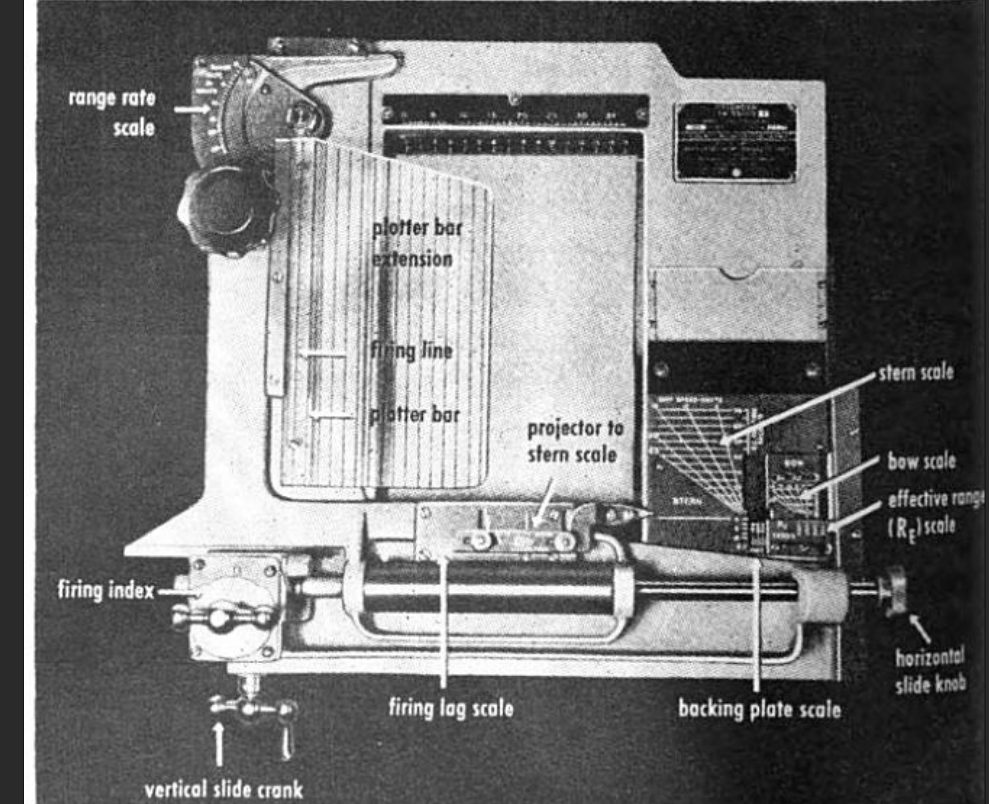


There were, of course, tons of other adjustments to make on the TRR, but we are not going to burden you with all of those (simply because there’s quite a lot of them!). What you will need to do, however, is to set the depth of the depth charge explosion and adjust the angle of the plotter bar extension, so that the lines marked on it align parallelly with the range-rate graph. It may sound simple, but with the rest of the operation on your mind, it will be more than enough to wrap your head around.

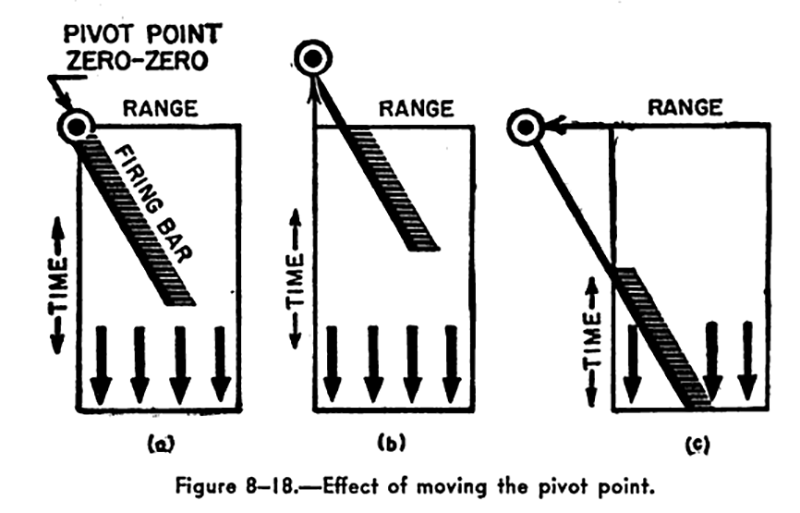
In short, all those minute settings influenced the arrangement of the plexi’s hinge against the “window” through which the paper was moving. The “zero-zero” point was in the top left corner of the window, while different scales allowed the operator to adjust the position of hinge, thus correcting time (vertically) or distance (horizontally). This was done based on variables such as the expected depth of the U-boat, own ship’s speed, or even the distance between the sonar transceiver and the ramps which the depth charges were dropping from. Especially for a new player, that would be immensely challenging, so the game won’t require you to do it all by hand (although, at some point, we may opt for a ‘hardcore’ mode... Who knows, right?).


Therefore, as always, we will be focusing on the very essence of the operator’s work. Keeping track of the graph for a while will allow you to align the plotter bar extension correctly, and once the graph goes beyond the firing line, it is time to fire! If you execute the above instructions correctly, then together with proper planning, plotting, and captaining, your chances of scoring a hit will rise exponentially! And, above all, with its fluorescent markings on the paper, the scales around the ‘window’, and all the moving elements, the TRR is simply a cool piece of gear! Perhaps our version doesn’t look like much yet, but once we manage to get all the textures and lighting into place, it will look like a proper sci-fi targeting device straight out of the forties.

[previewyoutube][animacja] [/previewyoutube]

And, come to think of it, each time I try to explain how it works to a new person, I always use the analogy of the X-wing targeting computer that Luke Skywalker used in the famous Death Star trench run.

Funny as it may seem, this explanation always works like a charm 😉

https://store.steampowered.com/app/1272010/Destroyer_The_UBoat_Hunter/

High five!


Hey there!

We wanted to thank you all for casting your votes for us in the IndieDB contest. And yes, we are very proud to announce that we came fifth in the 2020 Indie of the Year Awards, in the “Best Upcoming” category with our game Destroyer: The U-Boat Hunter!

It’s all thanks to you! Players choices matters and you’ve proved it. Thank you! High five!

Wish you all the best,
Iron Wolf Studio S.A

https://store.steampowered.com/app/1272010/Destroyer_The_UBoat_Hunter/

Dev Diary: News from the frontline

Hello everyone,

I would like to apologize for the recent drop in activity as far as devlogs are concerned, but, as you might expect, we are working around the clock to make Destroyer a reality. However, I have recently managed to find a few minutes in my busy schedule to let you know how things are and what we are working on. And that is, at present, the question of depth charge attacks carried out by our escort vessels in the game.

Before the invention of the so-called ‘ahead-thrown weapons’ (such as the Hedgehog, the Mousetrap, or the Squid), escort vessels primarily attacked submerged U-boats by firing a barrage of depth charges. To carry out a successful attack, the escort had to detect a submerged U-boat using sonar, the crew had to calculate the optimal dropping point and time, and finally carry out the attack.

Because of how the sonar operated in the forties, escort vessels would always lose contact with the attacked U-boat during the last stage of the attack approach. In 1942, a surface vessel would lose sonar contact with the U-boat at a distance of approximately 175 yards, which would force it to execute the last stage of the approach blindly, relying solely on the previously obtained data. I’m sure you can remember the quick intercept calculation from our gameplay trailer, and a depth charge attack requires a similar, yet even more detailed plot in order to maximize the chance for a hit due to the aforementioned technological shortcomings.

What is more, the final phase of approach was crucial, because it gave the U-boat a brief window during which it could attempt to change course unbeknownst to the escort crew and sneak out from the kill zone. If the U-boat evaded too early, the change of course would be (hopefully) noticed by the sonar operator. If, on the other hand, the U-boat executed the maneuver too late, there wouldn’t be enough time for it to escape from the area of attack before the depth charges went off. Therefore, the best moment for the U-boat’s evasive maneuver was as soon as the sonar lost contact as a result of the escort approaching. Anything too early or too late after that would severely limit the chances of the U-boat sneaking out unscathed.

Below you can see two diagrams showing how the sonar beam was shaped and how the DRT plotter would calculate the right place and time for firing the barrage, based on the previously obtained U-boat’s movement parameters:


As you can see, the escort vessel had the highest chance of hitting the target when crossing the U-boat’s course ahead of its bow, and firing the barrage between 60 and 90 seconds before the U-boat would reach the dropping point (as we have to take into consideration the time required for the depth charges to drop to the assumed depth).


However, the hardest part came after the attack itself, because having lost contact, and without an immediate confirmation of the attack’s success or failure, there were numerous considerations for the Captain and the rest of the escort crew to make.

Those, however, will be discussed in our next devlog.

Stay tuned!

https://store.steampowered.com/app/1272010/Destroyer_The_UBoat_Hunter/