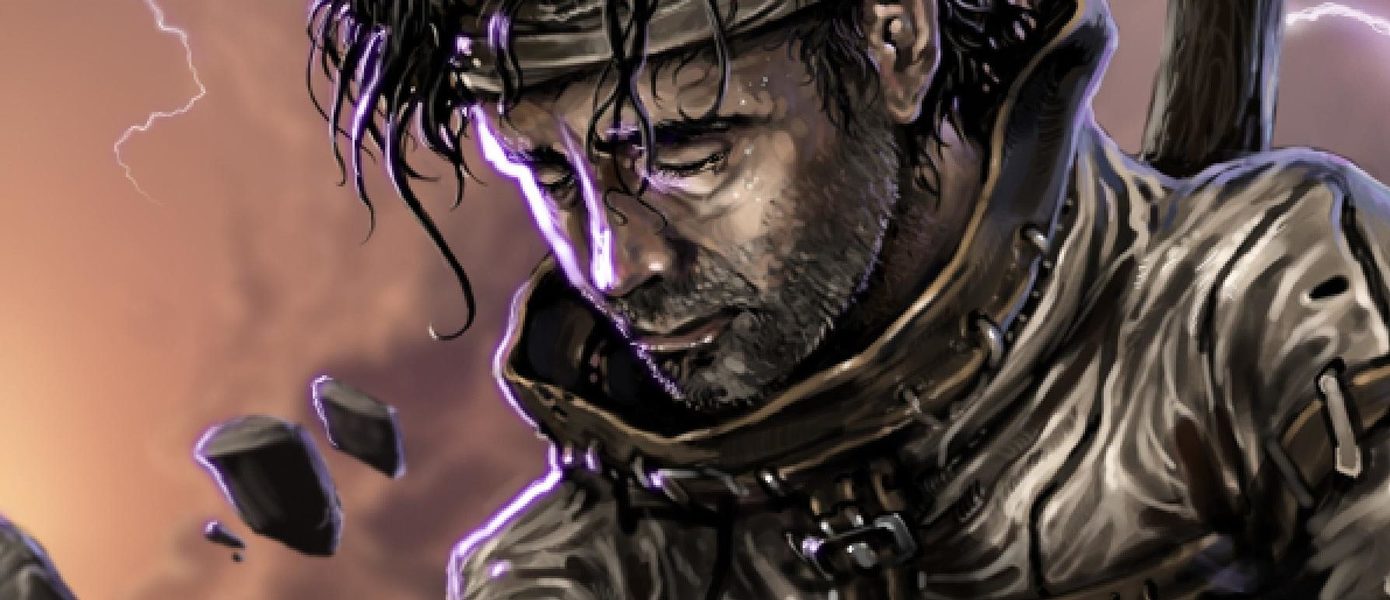
Strangeland: Cracking the Code
Many of the development posts about Strangeland have focused on the personal experiences and values that shaped the game. In today’s post, I want to talk about a more practical side of game development: how I was able to make the 25-year-old Adventure Game Studio (AGS) engine bring Victor’s art and audio and Mark’s design and writing to life. Some of what I’m going to discuss are features that players of Strangeland will see, hear, and notice. But much of the work was subtle or even invisible because one of the most important things is for the software to get out of the way while the player is experiencing the game. I’m as proud of these accomplishments as I am of everything else that went into the game, and for those who are interested in the technical aspects of making games, I hope this will provide some inspiration and insight.
[h2]Audio Engine[/h2]
Many players have said very kind things about the amazing soundscape that Vic and our voice actors created. But this was only possible by completely overhauling AGS’s default audio engine.
As anyone who has bought the soundtrack or listened carefully has noticed, Strangeland has a huge number of relatively short musical tracks. The music changes from exploration to dialogue, and even sometimes within dialogue. Because of frequently changing musical tracks, we needed crossfading to avoid unpleasant cuts from one track to the next. But AGS did not support custom crossfading; instead, you would have to use one of AGS’s limited sound channels.
The problem is, Strangeland uses a very large number of sound layers to achieve its rich soundscape: music, ambient sound effects, active sound effects, dialogue, etc. can all be playing at the same time. When I dedicated a channel to crossfading, the result was that some other audio (perhaps a sound effect, perhaps a voice over line) could get cut off. It was impossible to predict when this would happen.
The easy solution would be to cheapen the soundscape. But with a project so personally important to Victor and Mark and myself, cheap fixes were not fixes at all.
So I took the hard solution: finding and integrating a cross-platform audio engine. I settled on SDL Mixer and after about a week of work, I managed to get it working in AGS.
Around the same time, I was playing the game Celeste, and I was very impressed by its use of a low-pass filter. It struck me that we could use that to good effect in Strangeland, particularly in combination with a blur visual effect when the inventory is open. It actually took me about a month to get the filter working right. It’s a small thing that players may not notice. The point is not for them to notice it, but to feel it, and I think it adds to the feeling of immersion and even dream-like quality of Strangeland. To my knowledge, it’s the first use of a low-pass filter in any AGS game. You can hear for yourself here:
[previewyoutube][/previewyoutube]
[h2]Savegame System[/h2]
By default, AGS saves games by dumping all of the system memory associated with the game into a file, and restores games by moving that data back into memory. In a way, this is a very reliable system because it makes sure that nothing gets lost in saving and restoring. But it has serious flaws.
The worst flaw, in my opinion, is that if you update the game in a way that changes how it handles memory, old saved games will break. As a result, most AGS games on Steam are only rarely updated, and the updates tend to be fairly minor (to avoid breaking saved games). We did a few small patches and two large updates to Primordia, and when we did the large updates, many players were frustrated because even though the game was now much better, they had to start from scratch. I spent a lot of time making custom saves for these players so they could resume where they left off.
But this leads to the second problem: AGS games actually use a lot of system memory. Even if they look like adventure games from the 1991, they use RAM much more liberally. Saved games for Primordia, Unavowed, or Technobabylon can be as large as 20 megabytes. This makes them a pain to send or backup. During development, that means it’s a hassle for testers to send me saved games when they encounter a bug.
That isn’t the only problem with large save files, though. When saves get that large, even on a fast hard-drive there is generally a small FPS drop when you save. Because we wanted an autosave for Strangeland, that meant that every time you entered a room, the fading effect and audio would skip slightly. My dear neurotic friend Mark sent me roughly 1,000 emails complaining about this.
And the problem got even worse for Strangeland. As you know, Vic does many very large, even full-screen animations. Loading these into memory is not instantaneous, which means that if we load the animation in real-time, there can be a very slight FPS drop there, too. Naturally, Mark complained about this as well. I solved the problem by precaching the animations when the game loads, where the player will not notice a short hang. But now,