Devblog #42 - The German Rifleman and his equipment
Hello soldiers,
Today is November 11th - Remembrance Day. Also known as Poppy Day, this memorial day is observed by Commonwealth members since the end of World War One. A special day to remember those who have fallen in their line of duty. Other non-Commonwealth countries started to follow this tradition and have their Remembrance Day on November 11th.
In Isonzo (and our other games), you’re able to participate in 2 minutes of silence and be rewarded with a special medal afterwards. Additionally we have enabled Film Memoir mode for all for a limited time.
 Lest We Forget
The Rifleman is a familiar class in Isonzo already. With the introduction of the German faction as a playable country, they will fill a similar role to the riflemen of both the Italian and Austro-Hungarian factions. The differences here will of course be equipment/uniforms, and the weapons with which they will be armed with.
[h2] On top [/h2]
Like the other nations, Germany did not enter the Great War with a metal helmet.
The German soldiers would usually be seen wearing either a, nowadays, famous Pickelhaube or Feldmütze – a soft cap. The Feldmütze of 1910 had a large red band and piping. Later models of this cap had these removed, as many nations throughout the course of the war thought bright colours don’t work well with modern warfare. Before the 1917 pea green Einheitfeldmütze – a band of canvas was introduced, with a view to masking the bright red colour of the Feldmütze. Other versions of this cap were also available for specialist troops like Jaeger and Pioneer troops – these having different colour piping/bands. The caps had 2 roundels (Kokarden) one being the Imperial roundel and the other roundel signifying which German state the soldier belonged to.
 Different versions of the Feldmütze in Isonzo
Another famous headgear of the German army is the Stahlhelm. Germany followed the French and swiftly adopted a metal helmet to try to combat the horrors of trench warfare. Although expensive to produce, they were superior to the Entente helmets, as they provided a thicker shell thanks to the stamping process. The helmet came with several aspects, such as a soft liner and strap to keep the helmet in place, and vent holes to deal with heat. During World War One, several variants were produced, combined with different color schemes. In 1918 a formal way of camouflaging the Stahlhelm was applied and introduced, though it wasn’t unlikely to see soldiers trying to mask their helmet with mud and clay on the field.The Stahlhelm would gain infamy throughout the Great War and beyond. Germany would recycle many of their WW1 items of equipment or create new variants based on these, as the world headed towards the Second World War.
With the introduction of chemical warfare in WW1, a gas mask was of great importance for any soldier. The German soldiers were equipped with the 1917 Lederschutzemaske. This was an improved variant of the previous German gas mask (Gummimaske), which saw issues in both material shortages and performance against newer gas types. The leather mask was superior in protection but unfortunately not as efficient in its fit, especially problematic for soldiers with beards. This gasmask would be carried in the M1916 gas mask canister (Bereitschaftsbüchsen), which contained spare lenses and filters. This can commonly be seen worn on the back or front of German troops, with the Lederschutzemaske also being worn in an alert position if a gas threat was imminent.

[h2] The belt equipment [/h2]
As with most military uniforms throughout history, the belt plays a pivotal role in a soldier’s equipment. May it be for carrying spare ammunition, bladed weapons, rations, the Great War saw soldiers of all nations carry several pieces of vital equipment on their belts.
The German belt famously had a depiction of the Imperial crown with the slogan “GOTT MIT UNS” (God with us) though other variants of this were produced depending on the soldier's regional origin or his rank.

Common items that the German troops carried on their belt are the following:

[h2] On the back [/h2]
German soldiers wore two main styles of pack throughout the Great War. A Tornister, complicated and not best suited to trench warfare, and a simplified Assault Pack (Sturmgepack) – which forfeited capacity for simplicity.
The Tornister M1895 was made from calf skin or horsehide, and was standard issue at the outbreak of the war. It would see use throughout the war but would be slowly outdated, with later versions of this pack being made from Ersatz (a substitute/replacement) materials. It contained equipment that didn’t fit into the bread bag, for example tent accessories, ankle boots and other everyday items. Usually, the Mantel (greatcoat) was wrapped around the pack itself and the Mess Tin (Kochsgeschirr) is commonly seen being attached to the pack as well.
 The two different kinds of packs
The Assault Pack (Sturmgepack), became a popular replacement to the Tornister and full marching order loadout. It contained far fewer pieces than the Tornister, mostly consisting of the greatcoat, a shelter tarp/blanket and the mess tin, wrapped tightly and held in place with straps. This was a popular setup for assault troops or troops not expecting to see prolonged frontline activity.
[h2] German Weaponry [/h2]
During WW1, each nation participating invested heavily in trench mortars. Some were small enough to be hosted easily within the trenches themselves. Others were situated behind the front lines and lobbed obscenely sized shells. Arms manufacturer Rheinmatall designed the infamous 7.58cm Minenwerfer in 1909, after the mortar's successful resurgence during the Russo-Japanese war of 1905.
The Minenwerfer, literally meaning ‘mine thrower’, was a rifled muzzle loading mortar design , having dual hydraulic cylinders at either side of the barrel to help absorb recoil. Originally limited in its flexibility, the 1916 model n.A (neuer Art) had a 360 degree range of fire and a better range of elevation. A well-practised crew could fire up to 45 rounds per minute with a trained mortar crew.

The Minenwerfer will fulfil a comparative role to the Lanciabombe Bettica and 9cm M14 Minenwerfer of the other Italian and Austro-Hungarian forces.

[h2] Caporetto teaser [/h2]
As you can tell, we’re working hard on the Germans and the Caporetto map! Its release is getting closer! We can’t share any release date with you, for now, so be sure to keep an eye out for our announcements here, in the Discord and social media for when we do (alongside other news).
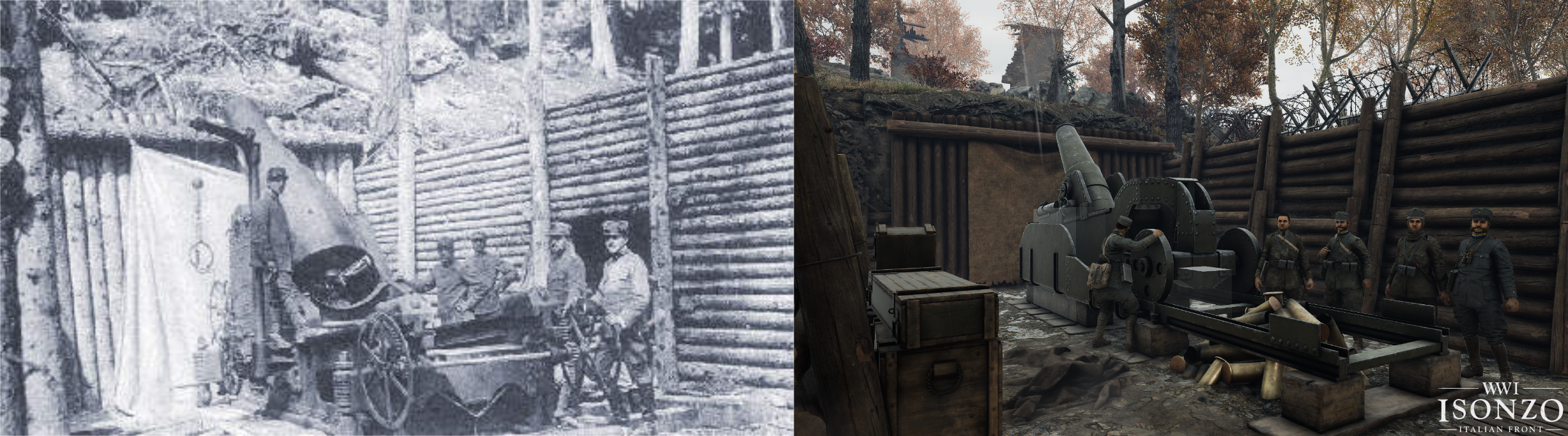
 Deep trenches
And here’s the full image of last week’s guessing game ! They are concrete fireport shields, which you’ll see in Isonzo as well!

[h3] See you next week soldiers [/h3]
Today is November 11th - Remembrance Day. Also known as Poppy Day, this memorial day is observed by Commonwealth members since the end of World War One. A special day to remember those who have fallen in their line of duty. Other non-Commonwealth countries started to follow this tradition and have their Remembrance Day on November 11th.
In Isonzo (and our other games), you’re able to participate in 2 minutes of silence and be rewarded with a special medal afterwards. Additionally we have enabled Film Memoir mode for all for a limited time.
Lest We Forget The German Rifleman
The Rifleman is a familiar class in Isonzo already. With the introduction of the German faction as a playable country, they will fill a similar role to the riflemen of both the Italian and Austro-Hungarian factions. The differences here will of course be equipment/uniforms, and the weapons with which they will be armed with.
[h2] On top [/h2]
Like the other nations, Germany did not enter the Great War with a metal helmet.
The German soldiers would usually be seen wearing either a, nowadays, famous Pickelhaube or Feldmütze – a soft cap. The Feldmütze of 1910 had a large red band and piping. Later models of this cap had these removed, as many nations throughout the course of the war thought bright colours don’t work well with modern warfare. Before the 1917 pea green Einheitfeldmütze – a band of canvas was introduced, with a view to masking the bright red colour of the Feldmütze. Other versions of this cap were also available for specialist troops like Jaeger and Pioneer troops – these having different colour piping/bands. The caps had 2 roundels (Kokarden) one being the Imperial roundel and the other roundel signifying which German state the soldier belonged to.
Different versions of the Feldmütze in Isonzo Another famous headgear of the German army is the Stahlhelm. Germany followed the French and swiftly adopted a metal helmet to try to combat the horrors of trench warfare. Although expensive to produce, they were superior to the Entente helmets, as they provided a thicker shell thanks to the stamping process. The helmet came with several aspects, such as a soft liner and strap to keep the helmet in place, and vent holes to deal with heat. During World War One, several variants were produced, combined with different color schemes. In 1918 a formal way of camouflaging the Stahlhelm was applied and introduced, though it wasn’t unlikely to see soldiers trying to mask their helmet with mud and clay on the field.The Stahlhelm would gain infamy throughout the Great War and beyond. Germany would recycle many of their WW1 items of equipment or create new variants based on these, as the world headed towards the Second World War.
With the introduction of chemical warfare in WW1, a gas mask was of great importance for any soldier. The German soldiers were equipped with the 1917 Lederschutzemaske. This was an improved variant of the previous German gas mask (Gummimaske), which saw issues in both material shortages and performance against newer gas types. The leather mask was superior in protection but unfortunately not as efficient in its fit, especially problematic for soldiers with beards. This gasmask would be carried in the M1916 gas mask canister (Bereitschaftsbüchsen), which contained spare lenses and filters. This can commonly be seen worn on the back or front of German troops, with the Lederschutzemaske also being worn in an alert position if a gas threat was imminent.
[h2] The belt equipment [/h2]
As with most military uniforms throughout history, the belt plays a pivotal role in a soldier’s equipment. May it be for carrying spare ammunition, bladed weapons, rations, the Great War saw soldiers of all nations carry several pieces of vital equipment on their belts.
The German belt famously had a depiction of the Imperial crown with the slogan “GOTT MIT UNS” (God with us) though other variants of this were produced depending on the soldier's regional origin or his rank.
Common items that the German troops carried on their belt are the following:
- Ammunition pouches or “Patronentaschen”.
The model 1909 cartridge pouch was standard issue to the German army. The leather was often blackened, and the pouch would take 20 rounds (4 x 5 round G98 clips) in each compartment. The soldier would typically sport two off these pouches, one left and one right, providing a total of 120 rounds of ammunition. - Bread Bag (Brotbeutel ) and Flask (Feldflasche ).
Worn on his right hip, this is where a soldier would keep his rations and other personal equipment. The bag itself was made of canvas and attached to the belt using canvas straps. Additionally, the flask could be attached to the bread bag. The bread bag also had a set of straps which troops often used in place of the Tornister straps to hook to each cartridge pouch.
- Shovel/carrier (Spaten mit Spatentasche) & Bayonet (M.1898/05 Seitengewehr).
This short handled entrenching tool was carried on the belt as part of a combined piece along with the bayonet. This provided a relatively easy to access point from which the shovel could be drawn and the bayonet was immediately at the soldiers waist. An offshoot of the traditional sword knot the Troddel would often be found knotted around the bayonet frog. This knot could have different meanings; which company a soldier belongs to, his rank, as well as his state (for example, Prussian non-commissioned officers would have their own knot style).
[h2] On the back [/h2]
German soldiers wore two main styles of pack throughout the Great War. A Tornister, complicated and not best suited to trench warfare, and a simplified Assault Pack (Sturmgepack) – which forfeited capacity for simplicity.
The Tornister M1895 was made from calf skin or horsehide, and was standard issue at the outbreak of the war. It would see use throughout the war but would be slowly outdated, with later versions of this pack being made from Ersatz (a substitute/replacement) materials. It contained equipment that didn’t fit into the bread bag, for example tent accessories, ankle boots and other everyday items. Usually, the Mantel (greatcoat) was wrapped around the pack itself and the Mess Tin (Kochsgeschirr) is commonly seen being attached to the pack as well.
The two different kinds of packs The Assault Pack (Sturmgepack), became a popular replacement to the Tornister and full marching order loadout. It contained far fewer pieces than the Tornister, mostly consisting of the greatcoat, a shelter tarp/blanket and the mess tin, wrapped tightly and held in place with straps. This was a popular setup for assault troops or troops not expecting to see prolonged frontline activity.
[h2] German Weaponry [/h2]
During WW1, each nation participating invested heavily in trench mortars. Some were small enough to be hosted easily within the trenches themselves. Others were situated behind the front lines and lobbed obscenely sized shells. Arms manufacturer Rheinmatall designed the infamous 7.58cm Minenwerfer in 1909, after the mortar's successful resurgence during the Russo-Japanese war of 1905.
The Minenwerfer, literally meaning ‘mine thrower’, was a rifled muzzle loading mortar design , having dual hydraulic cylinders at either side of the barrel to help absorb recoil. Originally limited in its flexibility, the 1916 model n.A (neuer Art) had a 360 degree range of fire and a better range of elevation. A well-practised crew could fire up to 45 rounds per minute with a trained mortar crew.
The Minenwerfer will fulfil a comparative role to the Lanciabombe Bettica and 9cm M14 Minenwerfer of the other Italian and Austro-Hungarian forces.
[h2] Caporetto teaser [/h2]
As you can tell, we’re working hard on the Germans and the Caporetto map! Its release is getting closer! We can’t share any release date with you, for now, so be sure to keep an eye out for our announcements here, in the Discord and social media for when we do (alongside other news).
Deep trenches And here’s the full image of last week’s guessing game ! They are concrete fireport shields, which you’ll see in Isonzo as well!
[h3] See you next week soldiers [/h3]
 The signing of the Armistice
 The Unknown Soldier


