1. Espiocracy
  2. News

Espiocracy News

TactiCon: Espiocracy Streaming on the Store Page

Hi everyone! In celebration of the TactiCon steam event, Espiocracy will begin streaming in-development gameplay footage on the store page Sunday night.

Visit TactiCon here: https://store.steampowered.com/sale/tacticon2023

https://store.steampowered.com/app/1670650

Dev Diary #43 - Events 📰

What's happening / TLDR: Developer diaries introduce details of Espiocracy - Cold War strategy game in which you play as an intelligence agency. You can catch up with the most important dev diary (The Vision) and find out more on Steam page.

---

If you search Wikipedia for the genre of Espiocracy, "grand strategy game" (GSG), you won't find an article with such title. Instead, you will be redirected to "wargames", focused on military strategy, "that include Risk". It is probably the only description of Risk as a grand strategy wargame on the entire internet. In an interesting parallel - perhaps authored by like-minded people - this article unapologetically invents proprietary takes as much as the (actual) genre itself.

GSGs are famous for their unusual gameplay with multi-layered maps, spreadsheet menus, dense tooltips, and a plenitude of popup events. The last feature is where much of history, storytelling, flavor, DLCs, and modding happens in the genre.

Initially, Espiocracy implemented events typical for GSGs. However, during two years of development, these turned out to be too detached from mechanics, negatively impacting gameplay flow, lowering replayability, and even subtly encouraging lazy takes on the history. The table has been flipped (for some time, the main build had completely no events) and after many iterations, the game arrived back at a fundamentally different approach to events.

Now, instead of random external triggers that conclude in a popup interrupting gameplay, events in Espiocracy highlight mechanical changes in the world. They do not disrupt main strategic gameplay, do not uncontrollably descend on the player, and do not feature ad hoc decisions that give arbitrary modifiers. It's no coincidence that two weeks ago we explored reports - while reports are about objective rundowns of continuous & wider situations, events focus on more immersive representation of punctuated & local changes in the world.

To achieve this, the notion of global random events has been dropped entirely. Instead, events work in three precise frameworks.

[h2]Contextual Events[/h2]

As the history unfolds around the player, contextual events communicate significant developments in the world. They are purely descriptive and celebratory, intending to slightly enrich spreadsheets and maps with (alt-)historical texts and graphics.

The very first contextual event welcomes the player on March 5th, 1946:
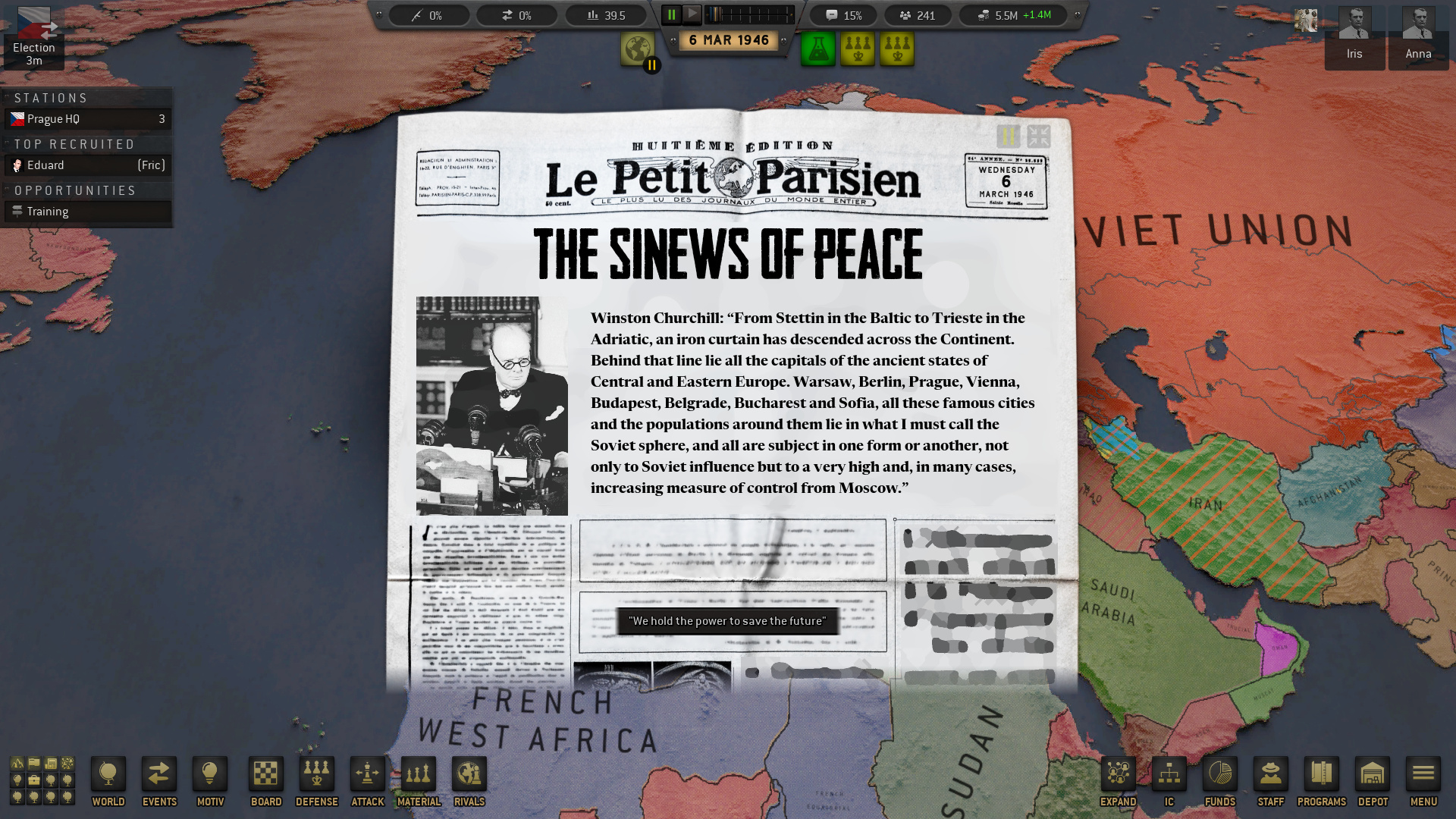


Similar newspaper template is also used for changes in the world that are critically important for the player (= usually involve player's country) such as new wars, unifications, divisions, or... pulling off landing on the Moon.
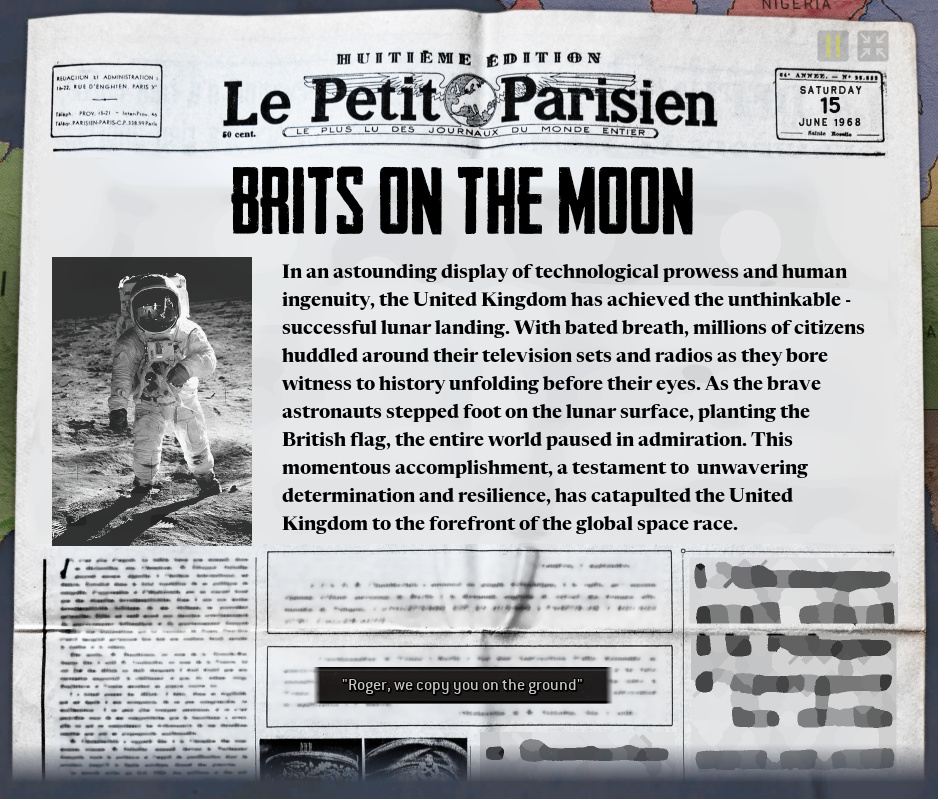


Text of contextual events is prepared in multiple versions: one universal variant with replaceable nouns/adjectives, and other variants written for historical or very probable alt-historical variants. In the case of landing on the Moon, the event has special texts for American and Soviet landings, while all the other variants (including the above screenshot) are more generic.

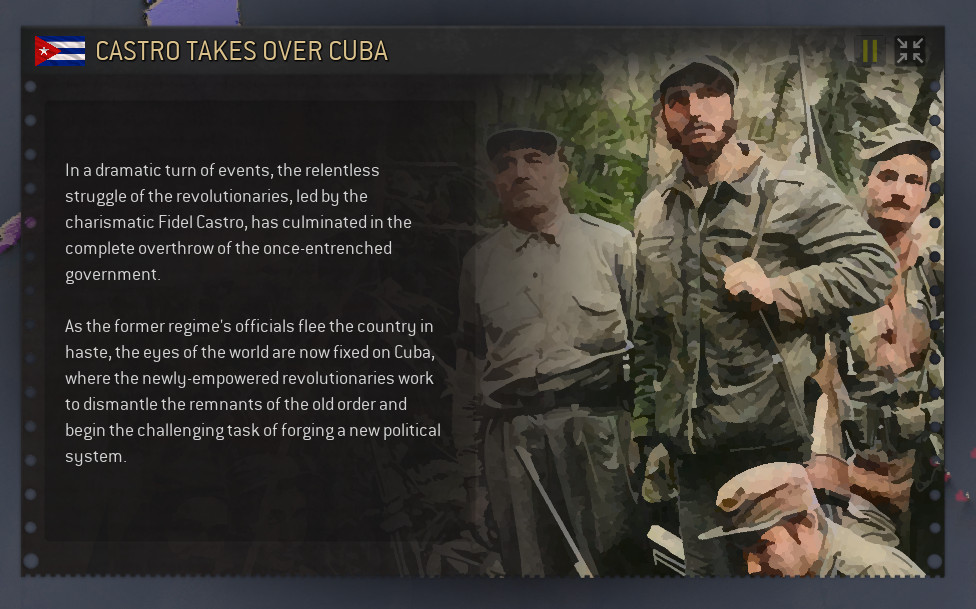
Changes less important than landing on the Moon but still judged as important enough to surface to the player, the game uses a teletype layout that has been previously featured in a few dev diaries. Examples of such events include the beginnings or ends of regional conflicts, paradigm shifts, deaths of important actors such as Stalin, important political changes in relevant countries, and so on.


[h2]Narrative Events[/h2]

In a natural next step after reactive and mostly generic events described above, narrative events are active (they can cause small changes in the world) and precise (always tied to a specific local entity). They contribute to flavor of a particular country, an actor, or other entities (e.g. a paradigm), sitting firmly in the realm of (plausible) history, and bridging the gap between mechanics - which are never deep enough - and fascinating details that made us all fall in love with history.

In a process not far from classic GSG events, narrative events have a chance of happening at specific points defined by time and/or arising conditions. They can (but do not have to) modify their subject in a clear & limited manner: only by adding or removing traits.

As a long-standing example of such an event, take a look at an interesting detail about uranium mines in Czechoslovakian Jachymov that made it to the game:
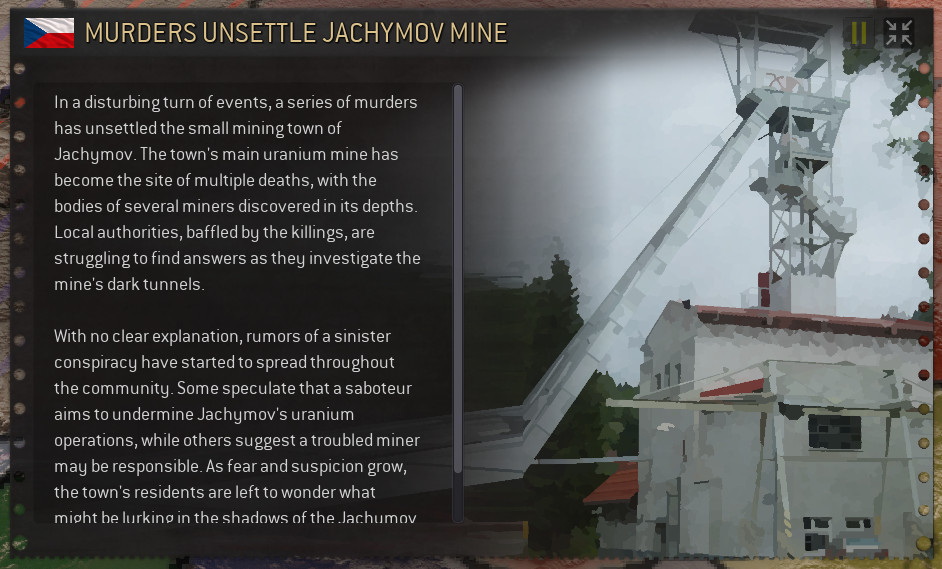


This event is exclusive to "Jachymov Mine" actor, can happen with a total chance of 40% (20% check in 1946, 20% check in 1947), it subtly modifies the situation by adding a "recently disrupted" trait (which may for instance influence ongoing operations around this important target) and is sourced from real events around the mine (and will be further iterated upon n times).

[h2]Random Encounters[/h2]

The next step, after working with history, leans more into the intersection of espionage, history, and the map. Unlike previous categories, random encounters directly interact with the player. They constitute meaningful discoveries, procedurally and regularly planted on the map, that can be unearthed by nearby operatives and stations of any player. In a way, these are an incentive to explore the map as passing through a particular city may be enough to pick up an interesting encounter there.

The details of planting are a bit convoluted and still in the process of working out but players can roughly expect encounters tied to regions, political systems, or local environment. Examples include discovery of WW2 documents, meeting a stranger in bar that leads to an opportunity, or even ability to pull off classic RPG-ish robbery on the road.

[h2]Final Remarks[/h2]

Currently, player attention is managed directly by a set of interaction and importance scores (eg. you'll get Jachymov events after interacting with the mine) compared to the measure of how busy is the player (eg. active x operations in parallel means fewer events). This solution will definitely evolve further to include notifications and other elements competing for player's attention and hence was not explored yet in a dev diary.

This was brief overview of general approach to events. We will definitely return to them, perhaps even individual categories, in the future.

The next dev diary will be posted on May 26th.

If you're not already wishlisting Espiocracy, consider doing it

https://store.steampowered.com/app/1670650/Espiocracy/

There is also a small community around Espiocracy:


---
"That's too coincidental to be coincidence" - Yogi Berra

Dev Diary #42 - Reports 📃

What's happening / TLDR: Developer diaries introduce details of Espiocracy - Cold War strategy game in which you play as an intelligence agency. You can catch up with the most important dev diary (The Vision) and find out more on Steam page.

---

Tom Clancy used to say that he loves research more than writing. Indeed, there is something deeply captivating in piecing together data, context, and meta-commentary to understand a topic. Development of Espiocracy is supported by an unhealthy amount of such work, including megabytes of excerpts found in online discussions on history, espionage, and games. If you posted clever takes on grand strategy games, there's non-zero chance that your comments are somewhere in my files, and perhaps even contributed to the reasoning behind the game, like this opinion:

"At its core, any grand strategy game is essentially a simulation of government, or perhaps business, operations. But pretty much all of them lack what even the smallest modern government offices have: robust reporting, metrics, tools the boss can use to get a quick and accurate view"


In a meta-meta-take, the player in Espiocracy is equipped with automatic research tools: dynamic reports. More than just a summary of data on the evolving game world, a report takes on some of the roles that would be traditionally implemented by popup events in the usual grand strategy games. In yet another iteration on gameplay in strategy games, reports will use extract and present data to systematically build the narrative, highlight interesting stories, and provide meaningful decisions - while remaining under full control of the player.

[h2]Opting in[/h2]

Players can opt-in to receive reports on any selected entity:


Unlike classic pins (and other attention management tools in strategy games), this is not a feature designed solely as a UI shortcut for power users. Instead, players start by default with a set of starred entities and categories, such as their own country or domestic political changes. Gameplay and its pacing is designed for people who use reports from day zero to make sense of thousands of actors, constantly changing political situation, and many other revolving doors of the Cold War and beyond.

[h2]A report[/h2]

After starring an entity, the game begins to provide regular reports following a simple self-referential trajectory: the first report is usually an introductory summary, and then subsequent reports regularly paint the landscape of changes (comparing changes between the last and current report). If the subject has an end, e.g. an election, there is also a final summary. Rough example:


This clear way of following events in the game is currently prepared for crowded parts of gameplay (such as the composition of actors) and significant historical processes (e.g. conflicts, decolonization, nuclear race). In the future, it can be elegantly expanded to other parts of the simulation, and modded to, say, highlight data judged as more relevant by players.

Reports, in addition to the pure descriptive role, can be also directly actionable - they can present checkboxes that will launch precise actions:


As a rule, these are not exclusive to reports (they are available in other parts of the UI) and instead play the role of guidance for beginners or shortcuts for more advanced players.

[h2]Onboarding, Assistance, Dynamics[/h2]

Player starting a new campaign is welcomed by a few initial reports: on the state of the country, on the intelligence community, on imminent risks and opportunities. They usually contain recommendations that can delegate the staff to deal with not obvious mechanics which are already important in 1946 such as lobbying for improved border control or laundering illicit funds inherited after WW2. Moreover, additional guiding hand is planned in the form of assisting reports that regularly detect (and explain!) the most popular failures and recommend appropriate actions.

Reports are slightly gamified to diegetically separate them from pure UI tools. Every report requires a few days from one staff member (spending an operative in terms of game economy), which means that very small intelligence communities can naturally afford fewer reports than larger ones. On the opposite side to this cost, I'm also experimenting with report-exclusive gains such as increasing tactical intelligence or identifying new opportunities, consistent with the analytic work of staff behind the reports.

Last and least, all reports are stored in the archive where you can trace back events of previous conflicts or even use them to get up to speed when loading up a save after a break.


[h2]Final Remarks[/h2]

The next dev diary, "Events", will be posted on May 12th.

If you're not already wishlisting Espiocracy, consider doing it

https://store.steampowered.com/app/1670650/Espiocracy/

There is also a small community around Espiocracy:


---
"Chairborne Division" - nickname for Research and Analysis branch in OSS

Dev Diary #41 - Intelligence Programs 🏗️

What's happening / TLDR: Developer diaries introduce details of Espiocracy - Cold War strategy game in which you play as an intelligence agency. You can catch up with the most important dev diary (The Vision) and find out more on Steam page.

---

Why do we play video games? David Bellavia, recipient of the Medal of Honor for the Battle of Fallujah, recently wrote that young people are "wasting the treasure of life on games". Players, however, are largely immune even to the most scathing words from the most decorated person because they don't seek validation in the first place - the point, instead, is to pursue any fantasy in the comfort of own screen, regardless of external judgment. Paradoxically, this critique reflects perhaps the most important facet of games: freedom. We play them because we can and want to.

Freedom propels much of the development of Espiocracy. Linear choices, build orders, or rigid rule-based strategies are constantly and iteratively replaced by dialing up player agency, kicking doors between mechanics, and making gameplay more varied.

One of areas that recently received such treatment was spy gear described in DD#24. Today, wiser by a year of development, we'll take a look at its new form.

[h2]Intelligence Programs[/h2]

Instead of choosing the most optimal minor spy gear such as lipstick gun or poison umbrella, you can now launch intelligence programs that significantly influence gameplay. Depending on the size of intelligence community, the player can run in parallel 1 to 5 programs. Some players already start with ongoing or finished programs - for instance, the British player can instantly use the fruits of Bletchley Park, the American player has still active Venona Project, and the Soviet player has active poison laboratory.

Programs are divided into technical and operational.

[h2]Technical Programs[/h2]

Technical programs develop advanced devices or methods, which can be used in operations or rolled out on the map. Examples include:

  • radioactive tracking (such as codename Cloud in Stasi), radioactive lockpicking, nuclear backpacks
  • poisons and BCW (currently: mustard gas, tabun, sarin, novichok counterpart, ricin, botulinum, anthrax)
  • spy planes (such as U-2 and SR-71), satellites, balloons
  • special platforms (such as Glomar Explorer)

Their availability depends scientific and technological paradigms mastered by local actors and level of capabilities in the intelligence community. More than pure tech tree, programs follow the path sketched out in DD#24: acquisition of secrets, illegal experiments, interesting contacts, genius inventors, and cooperation with industry/academia. The last point sometimes escalates even to the level of influential actors, where, for instance, developing a spy plane may require convincing local military leader.

[h2]Operational Programs[/h2]

Operational programs are de facto continuous operations without precise target, objective, or location on the map. Categories include:

  • mass surveillance (mail interception, sampling typewriters, tapping telephone switchboards, surveillance state up to Stasi levels of 1 source per 7 citizens, and so on)
  • controlling public opinion (from press censorship to great firewall in the late game)
  • decryption and interception
  • field programs (e.g. systematically breaking into embassies)

Ability to launch them is tied not only to technologies and capabilities - some of them depend on external events. Much like Venona Project started to exploit duplicated one-time pads in NKVD, ability to pursue other programs is sometimes creatively tied to arising opportunities (e.g. censorship enabled by a war in the region).

[h2]Standard Development[/h2]

Standard (and less standard) spy gear has been moved to the background where it's now autonomously developed by every intelligence agency. Free program slots contribute to the pace of this process, which means that not running a program for some time is also a decision contributing to gameplay.

Under this umbrella, Espiocracy now can feature many more flavorful tools of espionage. Beyond acoustic kitties and explosive lumps of coal mentioned in DD#24, the menagerie now extends to all staples of spycraft: invisible ink, sophisticated bugs, miniature cameras, ingenious communication devices, even to the point of late-game malware and wipers. Development of spy gear regularly enriches intelligence community with new devices which then can be used in operations or sold to other players. Particular drops in the rain of such item is partially randomized, mirrors technological development from 1946 to 2022, and can be indirectly influenced by capabilities and operations (e.g. conducting assassinations leads to inventing new types of concealed weapons).

[h2]Final Remarks[/h2]

The build undergoes deeper reshuffling work, hence no screenshots this time. The next dev diary, "Reports", will be posted on April 28th.

If you're not already wishlisting Espiocracy, consider doing it

https://store.steampowered.com/app/1670650/Espiocracy/

There is also a small community around Espiocracy:


---
"The project was considered fantastic by the realists, unethical by the moralists, and downright ludicrous by the physicians" - Stanley Lovell in a preliminary report on truth drug, 1942

Dev Diary #40 - April 1st Special 🥸


Someone already typed it in: https://replit.com/@rafgro/NANOESPIOCRACY

Context for younger fellas: https://whynowgaming.com/the-rise-and-fall-of-type-in-games-listings/