1. Espiocracy
  2. News

Espiocracy News

Dev Diary #52 - Sections đŸš

What's happening / TLDR: Developer diaries introduce details of Espiocracy - Cold War strategy game in which you play as an intelligence agency. You can catch up with the most important dev diary (The Vision) and find out more on Steam page.

---

Hello there!

Espiocracy always have had stormy relation with intelligence operatives. Does a grand strategy game need such individuals at all? How should they intersect with nations and large organizations? Where is the balance between irrelevant storytelling vessels and overwhelming hero units?

Their design & implementation varied wildly over time, from detailed Football-Manager-like top operatives (DD#9) all the way to abstract resource-like pools of people (DD#32). Many iterations later, we arrive at the obvious staple of strategy games...

[h2]On-Map Units[/h2]

The game gives you sections: on-map units of 8+ intelligence officers working mostly on the same task and in the same place.


Recognizing that the cliché trope of lone rockstar spy does not fit the game, Espiocracy finds inspiration in real-world teams such as GRU's Unit 29155, Mossad's Kidon, CIA's Special Activities Division, countless crews in intelligence outposts, units of special operations forces, and even police sections (since many players in Espiocracy partially control local police).

At the same time, sections retain individual personality both in identification - usually through most-skilled operative - and action.


Individual officers have different tradecraft (general 0-100 skill), roles, and can be responsible for logically solitary tasks, such as a recruitment pitch at a meeting (note, however, that the entire recruitment operation is executed by the whole section: analysis, observation, counterobservation, way out in case of an ambush, and any other step taken into account by operational simulation).

[h2]Geography[/h2]

Sections are based in intelligence structures - usually the HQ or a station - from which they autonomously execute background espionage activities, such as developing low-level agents, and from which they can move to execute player's orders. In an interesting Cold War twist, as units on the map, sections usually do not traverse the world province by province and instead can just fly from one nation to another. (Naturally, there are exceptions, for instance infiltration through a green border or... insertion by a submarine.)


Traditional role of distance here is taken over by a granular intelligence environment. To fly in without falling immediately into counterintelligence observation (which would preclude doing anything of substance), a section primarily uses regional covers.


A cover is developed over time by a station working with the region (where region usually equals a continent). "With" instead of "in" is used here deliberately because geographically the game implements the intelligence/political concept of "centers of gravity" - deep connections between countries that transcend distance. France, for instance, is the center of gravity for many African countries...


...and therefore you can establish a station in Paris to work on the African direction. Returning to flights and covers, your operatives may develop African covers in Paris and have - in the faithful logic of espionage - good reasons to fly from Paris to an African country without raising much suspicion.

That is, if local counterintelligence landscape permits it.


Countries differ in terms of counterintelligence capabilities, which in turn influences what a section needs to travel. Easier landscape may require no cover at all, while more severe situations may require more than one cover, bribes, certain level nation-specific local intelligence, or even agents on the ground paving the way.

The landscape is affected both by external factors - it's easier to avoid surveillance in war-torn Europe or among late-game crowds in the air - and internal decisions - from Cold War Kenya famously having just a few MI5 officers, all the way to creating police-state like modern North Korea which is inaccessible to almost all intelligence agencies in the world.

[h2]Activities[/h2]

All major espionage tasks are implemented by a section. Usually, its tradecraft directly contributes to the outcome:


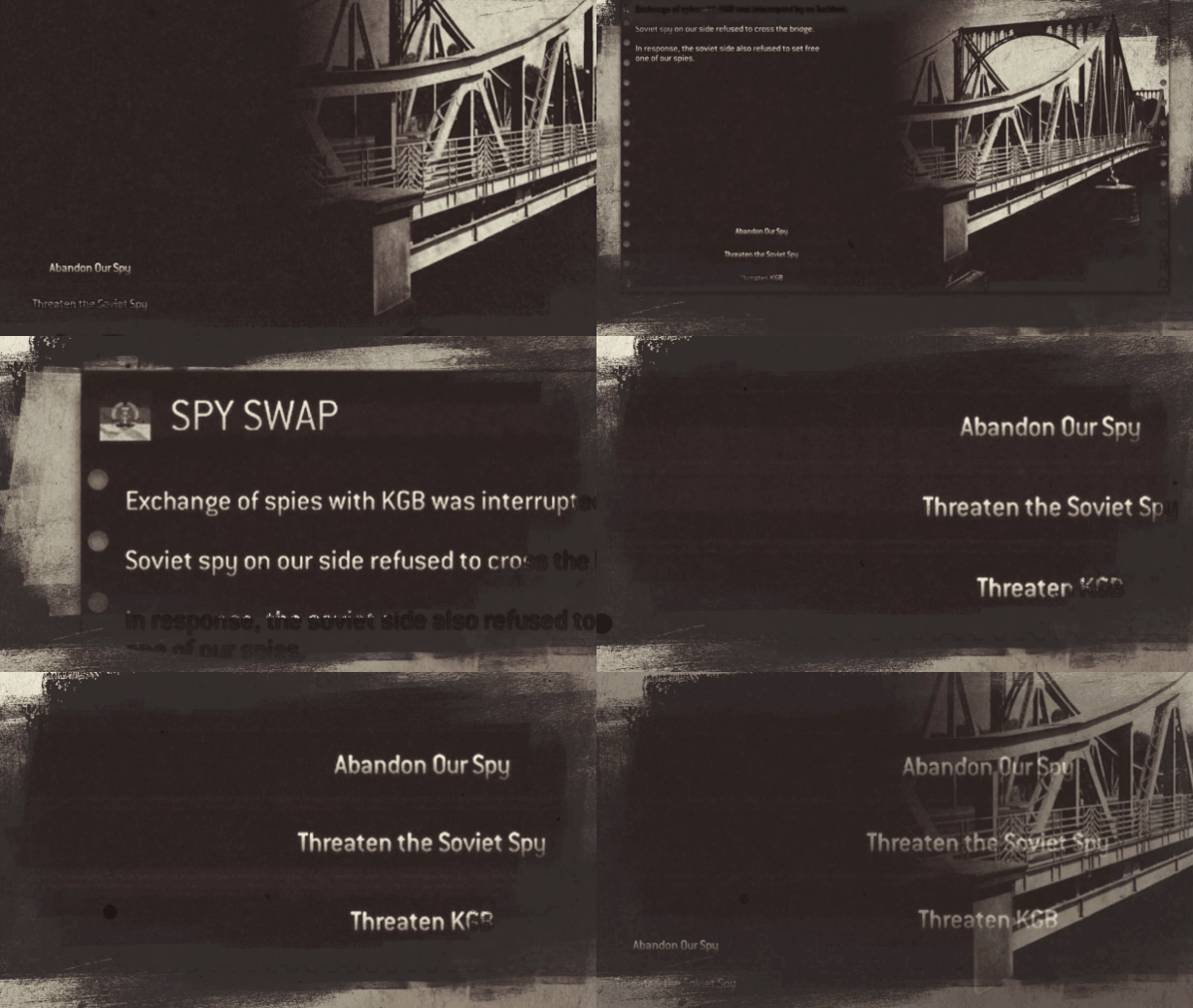
In many cases abroad, activities (especially: operations) become duels between attacking and defending (counterintelligence) sections. Involved teams and officers are directly affected by any gunfight, murder, arrest, expulsion, spy swap, and so on. True to the resilience of intelligence agencies, the damage is usually temporary - any officer can be replaced and tradecraft often can be regained over time. Moreover, officers themselves undergo a standard cycle of life: move between sections, leave the intelligence community, retire, or... become a turncoat.

Moles in intelligence agencies are recruited directly inside sections. Such a spy gives direct insight into the section's orders and intelligence. This is especially useful when a mole is in a section tasked with counterintelligence against player's operations - like in the case of Kim Philby working in the Soviet department of MI5.

[h2]Behind The Scenes[/h2]

â–ș Meta-dynamics are in the works. Hiring, firing, purges, scouting, borrowing, various special types (not only special forces but also for instance a K-9 section) - all of these undergo iterations to elicit as interesting gameplay as possible.

â–ș Comparison to units suggests a few standard questions. Can you stack sections? Partially yes, multiple sections can usually crew the same structure (with caveats such as bilateral quota on embassy staff), but also partially no, because some activities (such as an intelligence operation) are limited to a single section. Can you wipe out a section? Yes, a well-prepared ambush is enough. You can also nuke them out of this world. How many sections a player has? Roughly 1-30. How much micromanagement is there? While the design of this game does not operate on such subjective terms (micro is often just a synonym for grind; in that case, I can safely say that the game avoids grindy gameplay), sections are intended to act as an expansion of player's agency, a set of tools that before/after usage is semi-autonomous.

â–ș Speaking of embassy staff, diplomatic covers underwent quite a few iterations in the game, and will probably evolve a little bit more. In the context of this dev diary, currently regional covers are usually non-official (= not diplomatic, arrested officers may be prosecuted) unless they are used in a country with established intelligence station and official diplomatic relations (which is not obvious in game's timeline, for instance East German player won't have diplomatic relations in many places around the world).

[h2]Final Remarks[/h2]

The next dev diary will be posted on May 3rd!

---

If you're not already wishlisting Espiocracy, consider doing it

https://store.steampowered.com/app/1670650/Espiocracy/

There is also a small community around Espiocracy:


---
"Cover, dear boy, next to godliness" - John le Carré

Espiocracy Infiltrates Digital Tabletop Fest 4: Roll of the Dice

Espiocracy is participating in Digital Tabletop Fest: Roll of the Dice, hosted by Auroch Digital.

This annual festival celebrates tabletop-inspired games and the dedicated game studios that make them. From March 7th to March 11th, you'll find demos, previews of upcoming titles, panels from developers, and game discounts too.


Here's a title for those of you who play rogues and other shadowy characters in tabletop games.


Espiocracy is our upcoming grand strategy game based on the Cold War, where you personally lead an intelligence agency from one of seventy-four playable countries. Intrigue and subterfuge are the tools used to stage coups, influence elections, and wage proxy wars.

Command operatives, re-write, and skirt the edge of nuclear brinkmanship.

Wishlist Espiocracy now and lead your agency in 2024.

https://store.steampowered.com/app/1670650


Dev Diary #51 - Diplomacy

What's happening / TLDR: Developer diaries introduce details of Espiocracy - Cold War strategy game in which you play as an intelligence agency. You can catch up with the most important dev diary (The Vision) and find out more on Steam page.

---

Welcome back!

Today we will explore diplomacy, an absolute master of the Cold War, and a supremely important subject for Espiocracy.

(It's probably the last large mechanical topic in the diaries before we dive back into minutiae and AARs, which means that this diary is in the older heavier style. Also, linguistic disclaimer: "diplomacy" here includes many elements of wider international relations, following standard vocabulary of political games, and to avoid confusing references to "IR".)

Diplomacy in strategy games is usually implemented by personifying countries: giving them attitudes/opinions on one another, the ability to insult, offer gifts, trade favors, or enter almost-marriage-like alliances. This model is rooted in board games where every faction is indeed a human player who has real opinions on other players. However, as we travel further away from the roots, it makes less and less sense. In the case of Espiocracy, with 150+ countries in the Cold War (and beyond), complex frequently changing governments, and the player playing as an intelligence community - this model simply would not work. I know because I implemented it by default three years ago...

Many iterations of research / prototypes / playtests later, we are finally pretty close to really solid diplomatic gameplay in Espiocracy.


Keeping the unusual player persona at the center of mechanics, this model allows the player to interact at every stage with all the existing elements of diplomacy, not only in their own country but also in many other countries around the world!

[h2]Cooperations and Conflicts[/h2]

The game completely drops abstract opinions/attitudes between nations. In many - most interesting - cases of the Cold War, it was not possible to reduce relations between two countries into a single opinion value. Take for instance stormy relations between France and the UK in the early Cold War, where both countries worked towards NATO and the EU, while at the same time they were sabotaging each other in Africa, the Middle East, and Asia.

Following this and many other historical examples, countries in Espiocracy have multiple ongoing mutual cooperations and conflicts over defined subjects.


Cooperation or a conflict is the middle matrioshka doll of diplomacy.

Inside, it contains individual international actions. They are both defined by and dictate the depth of a relation. Two countries in new economic cooperation do not trust themselves enough to establish free trade - first, they have to pave the way with investments, loans, imports, and other less significant actions. Conversely, a diplomatic conflict does not (usually) begin with severed diplomatic ties, and instead crawls through overtures such as canceling diplomatic events or expelling diplomats.

While a plethora of actions can be managed through more general relations, a plethora of relations can be managed through more general...

[h2]Diplomatic Structures[/h2]

Real-world diplomacy loves structures, protocols, frameworks, and everything in between. This fact is subtly represented in a few strategy games but, as if bound by murky "opinion" parameters and people universally rolling their eyes at the word "policy", this aspect seems like a missed opportunity. In my humble opinion, similarly to nuclear brinkmanship, diplomatic structures make a fantastic game-building clay!

Espiocracy implements main tools of diplomacy as a way to start / define / end multiple cooperations or conflicts in one sweep, with possible extension to details such as emphasis on particular actions or exchanging actions belonging to two different subjects.

Non-exhaustive ordered (from the least important to most important) list includes:

  • Implicit Alignment, eg. anti-communist countries cooperated to quell communism by default
  • Informal Deals, eg. East Germany sent weapons to Arab states during the Six-Day War, and in exchange, they recognized the sovereignty of the GDR
  • Retaliations, eg. a set of countries ended military cooperation with Russia after the annexation of Crimea
  • Bilateral Treaties, including Alliances but usually more ambiguous, eg. the Finno-Soviet treaty of 1948 with its complexity (Finland partially traded independence, mainly by being obligated to reject the military cooperation with the West, in exchange for neutrality that would stop the USSR from coercing Finland into future Warsaw Pact... kind of)
  • Collective Treaties, eg. post-WW2 peace treaties, NATO, Warsaw Pact
  • Special Relationship, eg. USA and UK
  • Coalitions, usually a temporary structure to jointly wage a conflict, eg. a coalition of 42 states for the Gulf War
  • Policies, meta-decisions about cooperations or conflicts which do not have to target specific countries, eg. Hallstein Doctrine (in game mechanics it's closer to a policy than a doctrine) in which West Germany refused to engage in diplomatic relations with any country that recognized East Germany
  • Doctrines, powerful sets of global meta-decisions available only to significant figures from significant countries, eg. Truman doctrine pledging support for democracies against authoritarian threats


In addition, diplomatic structures have meta-dynamics: they can evolve into waves (eg. a wave of retaliations where even smaller countries can retaliate in the shade of international crowd), their proclamation or modification can become a significant event on its own that is met with a diplomatic reaction (classic case of Warsaw Pact forming 5 days after West Germany joined NATO), their implementation may be ceased, a policy may expire due to impracticality of enforcement, and so on.

[h2]Staccato of Interactions[/h2]

Diplomacy in the game advances, similarly to the real world, one contact at a time. Rich tools of inter-governmental communication - intermediaries, contact groups, summits, visits, letters, phone calls - define the pace, basic availability, and evolution of relations (eg. Czechoslovak attempts to form a local security pact contributed to the formation of Warsaw Pact), and most importantly: a large layer of diplomats who are influenced by intelligence agencies.

The ability to pursue these interactions (and all other diplomatic actions) is primarily tied to diplomatic weight - a parameter rooted in the general position of the country (State Power Index), modified further by independence, legitimacy of the government, recent diplomatic successes, international credibility, and actors directly responsible for diplomacy. By partially decoupling material and diplomatic position, it allows nations to diplomatically punch much above their weight... or become unreliable unwanted partner even despite superpower status.

This is where a casus belli, the good old staple of strategy games, comes in. Grave actions (such as an invasion) have a high weight threshold, often higher than achievable diplomatic weight. However, it can be lowered by an expanded Cold War variant of casus belli: a "diplomatic justification". Weaker nations can prepare sophisticated justifications against a targeted nation, often in secret coalition with other nations. For instance, the "unification" claim was not enough for North Korea to invade the south, both historically and in the game, and instead, the invasion was preceded by two years of uprisings, complicated negotiations in Moscow and Beijing, and finally a month of calls for elections, conferences, and peace talks. On the other hand, heavy-weight nations or leaders may follow "might makes right". Justification can be presented post-factum, much like Brezhnev vaguely explaining the invasion of Czechoslovakia a month after it was executed, or hand-waved, similarly to Lyndon B. Johnson's communication around the invasion of the Dominican Republic.

Following deeper the rabbit hole of Cold War diplomacy, the game also features international incidents. These constitute an inherent cost of many actions, for instance, deployment of a naval group (which can run into mines or a shoot-out with vessels from another country), a nuclear test (fallout risks), a space launch (falling rockets and satellites), and many espionage activities. An incident at best may be settled through deconflictive actions and at worst may escalate into an international crisis.

[h2]International Crisis[/h2]

A crisis in the game is a rare named event, with a limited lifetime and participants, punctuated by a string of confrontations. In a way, it's a diplomatic war.

Crises can originate not only from incidents but also from significant enough actions (across many mechanics) that involve significant enough nations. Berlin Blockade and Cuban Missile Crisis are classic historical events represented primarily as international crises in the game. For more examples, you can consult the fantastic International Crisis Behavior database which has been an indispensable help in the development.

When a crisis begins, belligerents enter a cycle of (usually fast) turn-by-turn escalations and deescalations, with high risk and high gain, which sooner or later have to end in a resolution.


The chart above hints at the current implementation but details are subject to larger changes. If you are familiar with game theory (as a mathematical field, eg. the famous prisoner's dilemma), you may suspect that this kind of mechanic can be surprisingly difficult to implement in a satisfying way. That is true, this two-player game inside a game can collapse into spectacular opposites of what was intended (eg. a countdown to war instead of a diplomatic stand-off). Hence, this section is limited to communicating mainly the intent, without burdening you with methods of achieving the intent, as they will certainly evolve.

[h2]Behind The Scenes[/h2]

â–ș Gifts and insults can rarely happen in the game, on the fringes of diplomacy. The former relies on local traits of a country giving it special types of gifs available (eg. panda diplomacy), and the latter can be executed by actors trying to gain domestic clout (eg. Reagan calling the USSR an "evil empire").

â–ș There's not a single "national interest" mentioned in the dev diary because this mechanic was retired due to its very repetitive redundant nature. As it turned out, views (especially combined with the tools described above) are more than enough to motivate actors.

â–ș How does this system fit into schools of thought in international relations? If we can argue that classic (opinion-based) implementation of diplomacy is closest to the constructivist school, then diplomacy in Espiocracy is in a very small fraction constructivist (when individual actors overwhelm foreign policy) and mostly stays in a superposition between liberal (eg. states often mutually dependent, international frameworks, internal interest groups) and realist (eg. power politics, interest-driven rational decisions, states acting as coherent units) approaches.

[h2]Final Remarks[/h2]

The next dev diary will be posted on April 5th!

---

If you're not already wishlisting Espiocracy, consider doing it

https://store.steampowered.com/app/1670650/Espiocracy/

There is also a small community around Espiocracy:


---
"Much of the diplomatic traffic of Third World states was vulnerable to cryptanalysts in both East and West. On the eve of the 1956 Suez crisis, the British foreign secretary, Selwyn Lloyd, formally congratulated GCHQ on both the ‘volume’ and ‘excellence’ of its decrypts ‘relating to all the countries of the Middle East'" - Christopher Andrew in "The Secret World"

Christmas Special 🎄

What's happening / TLDR: Developer diaries introduce details of Espiocracy - Cold War strategy game in which you play as an intelligence agency. You can catch up with the most important dev diary (The Vision) and find out more on Steam page.

---

Today we return to the tradition of Christmas Eve with micro-AAR (after action reports) from casual Espiocracy gameplay. Welcome to the second installment!

We play as Argentinian SIDE, starting on March 6th 1946.


Unlike many countries at the start of the game, Argentina was not directly affected by WW2. Instead, the nation underwent an essentially bloodless coup which ended the reign of Ramon Castillo and paved the way to presidency of Juan Peron. (In this run, pre-game simulation already resolved the election which historically happened in June 1946).

Our starting position, however, suffers from other disadvantages. For instance, Argentina has only a few scientific and technological paradigms mastered. Out of useful new paradigms, SIDE suggests government subsidizing development of penicillin and rocket engines. For now, electronic dreams, not to mention participation in the nuclear race, are far beyond our reach.


We will tackle the problem head-on: by prioritizing electrification and industrialization in the state budget.


Intelligence-wise, we are in relatively remote place but thankfully we our operatives speak Spanish which makes expansion into many countries much easier.


Chile is our first direction of expansion, an almost obvious choice, given rocky history of relations between Chile and Argentina, active diplomatic disputes, and very long border which gives plenty of opportunities to covertly infiltrate the second country. In addition to expanding in Chile, we will slowly get a hold over domestic power centers, starting with local catholic church.


Let's check for a moment what happens on the other side of the world...


Civil wars spreading in Iran, China, and Indonesia!

On the home front, we conduct more operations against domestic actors. Here, we will recruit a family member of an Argentinian writer in exchange for employing said person at an influential organization.


In the meanwhile, civil wars spread to Mongolia.


And mainland China is overrun by communist forces in 1947, rather early.


A few months (and domestic operations) later, we may be ready for more offensive operations on Chilean ground. The first, pretty tame venture is discovered by local DINA just three days after the launch:


A series of other failed operations and increased external pressure on our counterintelligence apparatus lowered trust of local government in our capabilities - which is directly translated into available funds - from initial 47% to 40%.

However, Peron consolidates his power and establishes de facto dictatorship which cynically increases the need, bringing funding almost to the starting level.


While we carry out further operations and Spanish-themed expansion (such as a station in Lima), our neighbor undergoes a coup.


This event contributes to tensions in the region and Chile becomes our diplomatic adversary. New tools, "border build-up" and "invasion", become available.


In Peru, Belaunde becomes the president. The name rings some bells... as it turns out, in earlier days of Lima station, we acquired an opportunity to subvert him!


Although we don't have practical ability (or motivation) to execute such operation, we can sell it for pretty high price on the black market:

Disabled because I was too excited and sold it before taking the screenshot

We could launder illicit funds but it's more efficient to just steer them into another wallet, here through establishing cooperation with a Peruvian political leader.


Slow and reasonable expansion in our part of the world brings first results: solid increase of State Power Index.


Electronic and nuclear future is a tad closer.

---

Dev Diary #49 - International Organizations 🌐

What's happening / TLDR: Developer diaries introduce details of Espiocracy - Cold War strategy game in which you play as an intelligence agency. You can catch up with the most important dev diary (The Vision) and find out more on Steam page.

---

Good design of any product, counterintuitively, sometimes shouldn't be about the end result and instead should focus on the process of making it.

The Empire State Building was built in less than a year and one of the main principles behind its design was... schedule for trucks with concrete. It may be compared with the World Trade Center towers which, despite superior technology, took a decade and went far over budget to complete. While architects of the first building organized the site around trucks arriving every minute (!), the director of the second project prioritized the end result and "continually fought against compromising his architectural vision in the face of various practicalities" (more).

Game development resembles a construction site. In this context, there are mechanics that may be good for the game - and desired by the players - but which will also encourage poor or lazy code, slow down progress, or even contribute to development hell.

Having observed the development of a few mods trying to make a game out of the Cold War and modern times, I can risk a hypothesis that one of such areas is a detailed international organization, especially the United Nations. It's a graveyard of good intentions. There are endless structures, actions, details, ripple effects, and edge cases that may be really fun to read about. You could make entire games about a large room in New York or Brussels. And the players! There is always a subset of people very passionate (and vocal) about these organizations. Even in the case of this diary, folks started speculating on "what new mechanics will be revealed".

The answer is: none. Espiocracy, deliberately, uses already existing mechanics to capture the soul of international organizations. Funky details may be slowly added in the form of accumulated content (or mechanically after the release) but I intentionally avoid any deeper implementations for the sake of good design.

[h2]Control and Member States[/h2]


The game features the most influential organizations in the framework of actors.

Primary gameplay around them is focused on control. Standard actors by default have full control over their actions. For instance, many players begin with full control over their actor agencies...


...which then can be chipped away by other entities, as shown in the previous diary, and in the following example of a Soviet player controlling a Polish player:


In contrast, international organizations usually have minimal control over their actions - with exceptions such as ICJ launching investigations - and the rest is distributed between member states.


These are usually not equal. Different levels of control approximate diplomatic prowess, participation in the Security Council, or the role of the USA in NATO and the USSR in the Warsaw Pact (or observer members with nil control). As with any other actors, control gates access to proposing and ordering actions. Proposed action, depending on its details, may be further proceeded through debating-voting mechanics borrowed from governments of Espiocracy.

Types of actions depend on the subtype of the organization. Examples include:

  • Statehood-Defining (eg. UN): legitimize invasion, propose border changes, establish trust territory, call for elections
  • Legal (eg. ICJ): settle a dispute, set up an international criminal tribunal
  • Military (eg. NATO): invade, conduct exercises, share nuclear weapons
  • Regional (eg. EU): integrate economies, fund less developed countries, agree on military action
  • Common Interest (eg. BRICS): promote common views, coordinate responses

[h2]Global, Dynamic, Spyable[/h2]

In addition to evolved control mechanics, influence takes here slightly different angle:


Global influence of international organizations stems mainly from legal prerogatives and the participation of member states. Typically for actors, internal life of the organization reflects and influences the external world. United Nations - or any other organization - may evolve during a campaign into a much more influential or much more toothless entity through natural actions such as taking in powerful members or catastrophically failing in a mission (eg. the IRL death of Secretary-General in Congo in 1961).

Naturally, the dynamic nature lends itself also to the set of international organizations. All of them may be dissolved, new ones may be established through a single decision or from a series of summits, organizations may create subsidiary organizations (eg. the UN creating ICC in reaction to events analogous to war crimes of the 1990s), members may join, leave, be expelled, and so on.

Finally, let's take a brief look at more unusual espionage beats associated with international organizations:

  • A HQ with diplomats from many countries is naturally a hotbed for espionage
  • Membership gives access to good covers for operatives, allowing them to infiltrate HQ and target other members
  • For the host country, it creates interesting gameplay of both the easiest access to many useful targets and of harsh reality of dealing with a nest of spies in the homeland

[h2]Final Remarks[/h2]

This was a brief diary, unlike the AAR coming on December 24th - stay tuned!

---

If you're not already wishlisting Espiocracy, consider doing it

https://store.steampowered.com/app/1670650/Espiocracy/

There is also a small community around Espiocracy:


---
"Protocol, alcohol, and Geritol" - Adlai Stevenson, US ambassador to the UN, about diplomacy (1967)