1. Universe Sandbox
  2. News

Universe Sandbox News

Surface Grids & Lasers | Dev Update #7


GIF: Lasering away the ice on Earth.

Here’s our round seven update on the development status of Surface Grids and Lasers. If you haven’t seen them yet, check out Dev Updates #1, #2, #3, #4, #5, and #6.

We hope you’ve been enjoying the new galaxies we added in Update 23. We still have another round of improvements and bug fixes planned for galaxies, but we’re proud of what we released and we’re shifting our excitement back to Surface Grids & Lasers.

A primer on Surface Grids for anyone not familiar:
It’s a feature we’re developing for Universe Sandbox that makes it possible to simulate values locally across the surface of an object. In effect, it allows for more detailed and accurate surface simulation and more dynamic and interactive surface visuals. It also makes it possible to add tools like the laser, which is essentially just a fun way of heating up localized areas of a surface.

Keep in mind this is a development log for a work-in-progress feature. Anything discussed or shown may not be representative of the final release state of Surface Grids. Read: Surface Grids & Lasers are not yet available in Universe Sandbox! There is no release date yet, but we hope to have them available by the end of the summer (by October).
 
Gotta See It to Believe It

In the past few weeks, our graphics developer, Georg, has been taking the visual foundation that was built into the last version of Grids and plugging it into the new model.

This includes 1) getting the basics down for the shaders handling different materials and phases, from water to snow to molten silicate 2) getting all of Earth’s vegetation in the right spots 3) adding lighting, including effects for diffusion and specular and rim lighting for solar and atmospheric effects 4) and adding normal mapping.

The normal mapping creates the effect of bumps and ridges, or in other words elevation changes for things like mountains and crater rims. For a lot of visual effects, we often start with more exaggerated settings then dial it back and tweak it until we reach a more realistic appearance. In the screenshots below, the bumps are very pronounced and make for surface features that wouldn’t be discernible when viewing from space. While it’s not realistic and we plan to tone it down for the default setting, we are considering exposing this value and letting anyone set it to however they prefer.
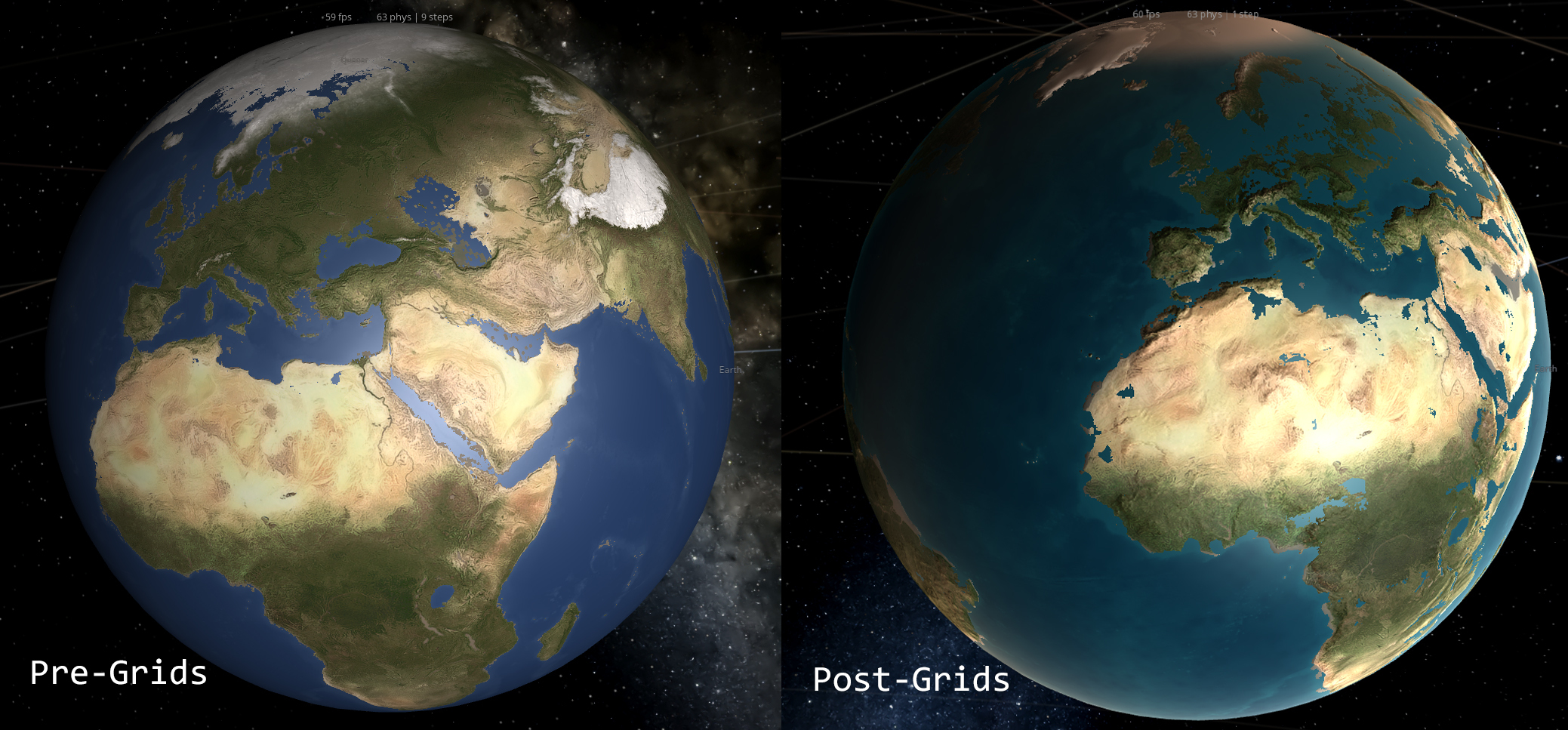

 
Please note that you can safely ignore the incorrect water levels right now. We’re well aware that Europe is completely flooded and we’re working on a fix (even if it may be an accurate representation of what human-caused climate change will do to Earth...).

This visual foundation now works for planets with known heightmaps, but it will eventually be applied to all procedurally generated objects. So whether you’re lasering Earth or a randomly generated rocky planet, you’ll see the nice lighting and normal mapping.

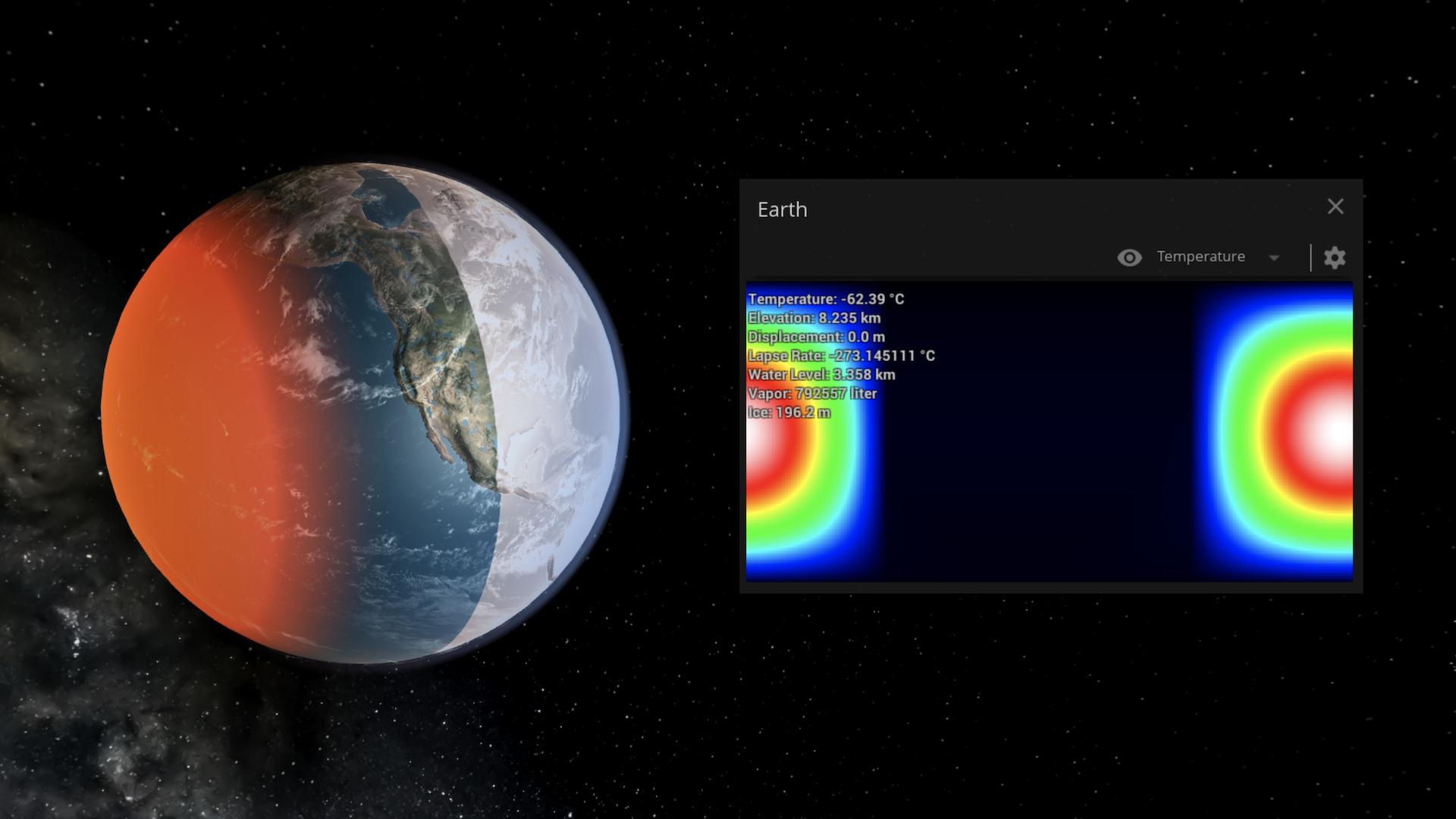
Graphics for Surface Grids are definitely still incomplete, but everything is coming together nicely. The screenshot below shows a tidally-locked, near-Sun Earth that is frozen on the far side and molten on the near side (note: the edges look especially “clean” now because it doesn’t yet include additional visual noise from blurring, blending, and randomness).


Lasers!

We haven’t shared much about lasers yet, so let’s fix that. Before, lasers were hooked up to the data side of things, so you could see its effects in the data map, but that was about it. Now that we have the visual foundation described above and can see the effects of temperature on the planet itself, playing around with lasers just got more interesting.

We recently added a radius setting that multiplies the area of effect (the laser visual itself is not yet affected by this). So whether you want to melt the whole ice cap or you want to carve your name, you can do it.

In the case of the GIF shared at the top of the post (and maybe I’m just hungry right now), this reminds me most of decorating a cake. Especially the part at the end where I do away with careful decoration and just throw a bunch of icing (er, lasering?) on the top.

We often see debates in the Universe Sandbox community about these lasers -- some say they’re unrealistic and not a good use of development time, and others will stop at nothing to get their hands on them.

To the first, naysaying side we say this: Yeah, lasers like this don’t exist (at least, not yet). But… what if they did? Universe Sandbox has always been about realistic simulation of fantastical scenarios, and we think this fits very nicely into that. As for development time, lasers are a tiny fraction of the larger work on Surface Grids. They’re essentially a nice side-effect of having a system like Grids that can simulate localized surface properties, much in the same way Grids will allow us to add basic life simulation in the future as well.

And to the laser fanatics we say this: Yeah, they’re fun. Thanks for your patience!

What’s Next

There are a few higher-level things we want to get working, like being able to locally deposit water and having vapor flow connected to axial tilt. And then there are some must-fix issues like proper water level on Earth and proper phase-handling for Venus (it shouldn’t look like it’s covered in liquid water, right?). There’s also more visual work to do with blending materials and phases and handling procedurally generated objects.

So we’re a long way from the starting gate, but we’re not quite in the final stretch yet. It may be fair to say we’re at the point that was described all the way back in the second dev update: “... often times the longest and most challenging part of development comes later, when we’re tweaking, polishing, finding and fixing bugs, and making sure all the complexities of the fully fleshed out model play nicely with each other and the rest of the simulation.”

We’re definitely interested in making experimental builds available to the community in the future, before we’re ready for a full release. We’re not ready to say when these will come yet, but we hope they’re not far away.

As always, thanks for your patience and support while we work on this next big, complex feature for Universe Sandbox!
 
Join our Discord: https://discord.gg/us
Future Price Increase for Universe Sandbox

We want to give everyone a heads-up that we plan to increase the price of Universe Sandbox in the near future. It's at least a couple months away still, but we wanted to give as much advance notice as possible.

Don't own Universe Sandbox yet? Get it for 33% off in the Steam Summer Sale
http://store.steampowered.com/app/230290/

How much?

We plan to raise it from USD $24.99 to $29.99.

Localized prices on Steam will be raised accordingly.

If you already own Universe Sandbox, there will be no charge and you'll receive updates as usual as we continue development in Steam Early Access.


When?

Probably by the end of the summer (by October 2019).

It may take longer, we don't have an exact date yet. We plan to raise the price on the same day that we release our next major update featuring Surface Grids & Lasers. We don't know when this will be released yet, but we're aiming for the end of the summer. If it takes longer to get the update out, then the price increase will be delayed as well.


Why?

To support continued development of Universe Sandbox.

We love Universe Sandbox and we want to keep working on it, making it better and better for the foreseeable future. It's why we're hiring to expand our team, and it's why we got rid of the "2" in our name so now we're just Universe Sandbox. We're in it for the long haul. The extra resources will help us continue to develop new, awesome features and expand to new platforms like mobile and console, ultimately reaching more and more people.

We appreciate everyone who has supported Universe Sandbox so far. We couldn't have done it without you.


On sale now!

Universe Sandbox is currently 33% off in the Steam Summer Sale.

We'll definitely be on sale again in the future, but with the price increase, this may be the lowest price for Universe Sandbox for a while.


Stay up-to-date with the latest Universe Sandbox news!
Sign up for our newsletter

Join our Discord

Or just keep your eye on the announcements here on Steam.

Beyond the Milky Way | Update 23

June 28: Update 23.0.1 is a small patch to fix an issue with tidal heating.

This update adds brand new galaxies that are much more interactive, accurate, and varied, making it easier than ever to create and customize on a galactic scale.

Three Types of Galaxies

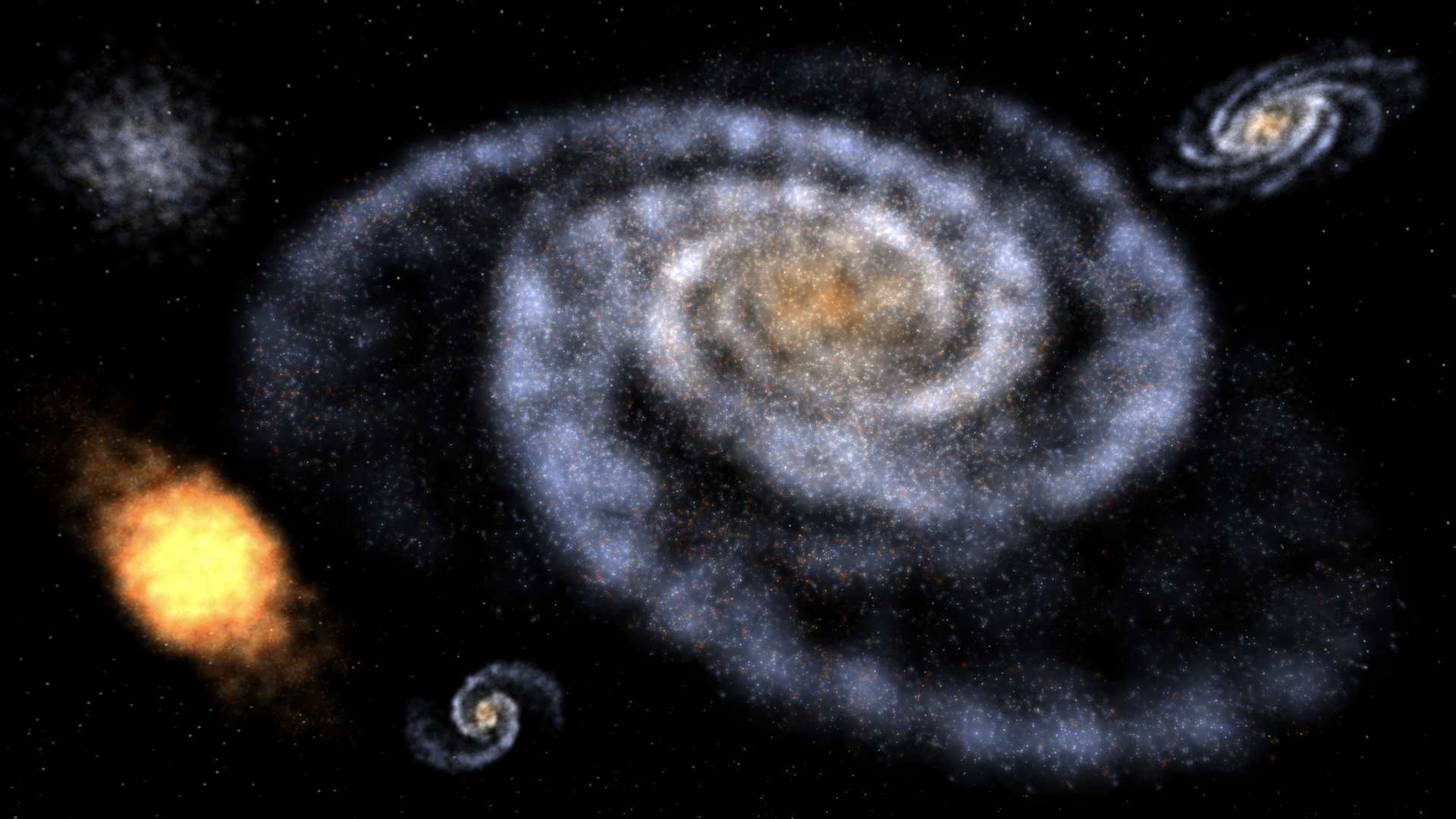
Use the Add tool to procedurally generate a Spiral, Elliptical, or Irregular galaxy and add it to any simulation. Or select from galaxies like the Milky Way, Andromeda, or IC 1101, one of the largest known galaxies.

Accurate, Data-Driven Motion & Visuals

The motion and shape of the galaxy are now determined by its type and properties. You'll also see red-yellow elliptical galaxies where the stars are older and bluer spiral arms where the stars are younger and hotter.

Full Customization

Adjust standard properties like mass and radius plus unique galaxy properties like the number of spiral arms and amounts of dust and gas.


Learn more about the new galaxies:
Home > Tutorials > 11 - Exploring New Galaxies

Or get started with the included galaxy simulations:
Home > Open > Galaxies tab

Check our a full list of What's New in Update 23
 

Surface Grids Lasers | Dev Update #6


GIF: A "heatmap" of vapor amounts shifting on Earth.

Here’s our round six update on the development status of Surface Grids and Lasers. If you haven’t seen them yet, check out Dev Updates #1, #2, #3, #4, and #5.

This will be a smaller update than usual because we’re focusing our efforts on the last sprint for the new galaxies we’ve been working on. We hope you won’t have to wait long for their official release, but if you’re feeling impatient, you can check them out by opting into the experimental version.

A primer on Surface Grids for anyone not familiar:
It’s a feature we’re developing for Universe Sandbox that makes it possible to simulate values locally across the surface of an object. In effect, it allows for more detailed and accurate surface simulation and more dynamic and interactive surface visuals. It also makes it possible to add tools like the laser, which is essentially just a fun way of heating up localized areas of a surface.

Keep in mind this is a development log for a work-in-progress feature. Anything discussed or shown may not be representative of the final release state of Surface Grids.

Set Phases to Accurate

Our last dev update focused on the upcoming galaxies, but at the end we mentioned how Jenn, astrophysicist and Universe Sandbox developer, was working on vapor flow for the Grids model. We also joked that the challenging part here is creating this “accurately and performatively without single-handedly developing Weather Simulator 2020.” Unfortunately, the joke is all too real!

That doesn’t mean we are actually developing a complex weather simulator, but there is nonetheless complexity. While developing the vapor flow model, Jenn has been doing her homework with research into fluid systems and geophysics (if you’re looking for some light reading, you can check out Lectures On Dynamical Meteorology, Geophysical Fluid Dynamics, and An Introduction to Planetary Atmospheres).

The first part of vapor flow is determining what exactly is vapor; this is done by phase tracking, which determines what phase each material is in, based on temperature and elevation. For water, vapor is its gas state, then we need to see where it’s headed from there -- whether it’s evaporating or condensing at the dew point, depositing, if it should be boiling away completely, etc. If it’s remaining as vapor, then the model accounts for a few factors to move it around: there are the prevailing winds which vary by latitude, are affected by planet rotation, and cause east-west movements (as seen in the GIF at the top), and there are temperature differentials from thermal flows and elevation that cause north-south movement (still a work in progress).


Image: The “heatmap” shows vapor amounts (not vapor flow), where red is higher amounts and blue is lower. The poles are both much drier, and because there’s much less evaporation over land than oceans, you can see some outlines of the continents.

We want to stress that this is necessarily a very simplistic model, largely limited by its low resolution and the amount of memory we can allocate for this single component of Grids. There are lots of things missing that make this very different from more complex weather simulations -- there are no vortices, so there won’t be anything like hurricanes, it is only a 2D simulation with no layers through the vertical dimension, and it’s fairly low resolution.

But we hope to use this data for the resulting local vapor amounts to have rough approximations for clouds, ice caps (for Mars, this effect happens with CO2 vapor flow), and for the future implementation of basic life simulation (vegetation), it could affect growth in dry and wet areas.

Loading…

In our last post, we also mentioned Chris’s work on saving and loading with Grids. This component of the feature obviously isn’t as interesting as, say, lasers, but at the same time, it’s essential to get it right and it’s another good representation of challenges on the edges of new feature development.

Here’s a shortlist of some of the questions and challenges that doesn’t even get into the technical weeds: How can we deal with file type and size limits for different platforms, like Steam Workshop, mobile devices, etc.? How can we maintain file size for fast, background autosaving and quicksaving? How can we get it to play nicely with previously saved simulations with objects that didn't have all of the Grids data?

We had similar saving and loading questions with the new galaxies: What should happen if you load simulations that had the old galaxies? They won’t look and function the same. Should we change their shape and motion to use the new model, or should we preserve appearance? Is it okay to change sims on Steam Workshop that are very popular?

Saving and loading is something we all hope just works seamlessly and shouldn’t be something the player ever has to think about -- which are both telltale signs that there is little room for bugs, errors, and bad user experience (UX). Thankfully, we have answers to all of these questions!

What’s Next for Grids

We’re hoping to make some good progress again on the visual side of Grids, rendering all of that wondrous data into some nice planet graphics. We’ve been recruiting our graphics developer, Georg, to work on some other projects (like the now so gorgeous galaxies), but it’s time for Grids attention again.

Thanks for reading! We'll be back in two weeks with another update on development. And hopefully before that, we’ll have our next big update with new galaxies.


Galaxies Grids | Dev Update #5


For this developer update, we’re going to take a little break from looking at our work on Surface Grids & Lasers to turn our attention on the upcoming new galaxies (these are a work-in-progress and are not yet available in Universe Sandbox).

You can check out Dev Update #1, Dev Update #2, Dev Update #3, and Dev Update #4 for a more in-depth look at Surface Grids & Lasers.

Keep in mind this is a development log for work-in-progress features. Anything discussed or shown may not be representative of the final release states for these features.


A Whole New World (of Galaxies)

We’ve been saying for a while now -- and the community has been making sure to regularly remind us -- that the state of galaxies in Universe Sandbox has not been so good. There was a pretty good looking preset simulation for a Milky Way & Andromeda Collision, but when it came to adding any type of galaxy to another simulation, you were left wondering why they all looked like the same amorphous blob, why they were difficult to work with, and what exactly all those red dots were.

Case in point, here’s a Milky Way added to a simulation with the old galaxies:


And here’s a new Milky Way:


We hope you agree this is a massive visual improvement. But there’s more than just beautification happening. Here are the major parts that make up the new galaxies:

1. Black holes & nebulae

  • A galaxy is a combination of a black hole and a number of surrounding nebulae (each of which represents a group of stars)


2. Individual, editable properties

  • Select and edit properties for black holes, individual nebulae, or the whole galaxy
  • Each includes typical object properties like mass, radius, rotation, position, velocity, etc.
  • Unique whole galaxy properties include galaxy type (elliptical, spiral, and irregular), elliptical B/A ratio, spiral number of arms, and pitch angle


3. Accurate motion

  • Orbital elements of the nebulae are set by galaxy type and determine overall motion

    • Nebulae positions and velocities change as galaxy type and type-related properties (B/A ratio, pitch angle, etc) are edited
    • Galaxies in isolation will retain proper motion and shape over time
    • Galaxies perturbed by massive bodies (like another galaxy or an isolated, supermassive black hole) become irregular type galaxies


4. Data-driven visuals

  • Nebulae have a Gas Fraction property that represents the ratio of gas (the material available for making stars) to stars as well as an average temperature property
  • Combined, these properties result in red/yellow elliptical galaxies, bluer spiral arms, and a visible increase in blue star production in colliding galaxies
  • Nebulae also have a Dust Fraction property that represents the ratio of dust (opaque material) to gas and stars (luminous material); dust traces spiral arms and blocks light from the galaxy when viewed edge-on

Here's a GIF showing editable properties and the different visuals for different types of galaxies.


5. Procedural generation

  • Create a randomly generated spiral galaxy, elliptical galaxy, or irregular galaxy


6. Support for trails & orbits

  • Show trails or orbits for individual nebulae, which provides insight into realistic galaxy motion


7. No more dark matter

  • Proper dark matter simulation is very complicated and we weren’t satisfied with its implementation in our last galaxy model
  • In the future we’ll have a more in-depth explanation of this in a blog post from Erika, Universe Sandbox astrophysicist and developer behind the new galaxies


The Future of Galaxies

We’re very happy with the status of galaxies right now. Before we can release them, there are some minor changes we need to make with the interface and other miscellaneous areas around the edges, and we still need a round or three of testing and bug fixes. But the simulation itself is in great shape.

When it comes to simulation features in Universe Sandbox, though, we almost never consider them a done deal. There are always improvements we have in mind for making them more realistic, performant, and fun to experiment with.

After the initial release of these new galaxies we’ll likely take a break from them for a bit. But here are some improvements and additions we’d love to explore more in the future:

  • Barred spiral galaxies
  • Visual representation of accurately-timed supernova flashes
  • Values to show estimated numbers of stars in nebulae and total values in galaxy groups
  • Randomization parameters for more “natural-looking” galaxies
  • Run as fluid/SPH (smoothed-particle hydrodynamics) simulation


Surface Grids Sidebar

We’re hyped on galaxies and hope you are, too. Fingers crossed that the last stretch of finishing out this feature goes smoothly and quickly!

But of course, we’re also still working on Surface Grids & Lasers, so here’s a small update on those features:

Chris has been working on the saving and loading system for Surface Grids. This is a little less straightforward than it had been for saving and loading objects and simulations, due to the sheer amount of data that can be included with a lot of objects using the new Grids system.

Jenn has continued with making an accurate water vapor model, with the challenge of creating this accurately and performatively without single-handedly developing Weather Simulator 2020.

Georg has been applying his shader magic to galaxies and helping with proper rendering for Universe Sandbox on Magic Leap. Now that the graphics work for both of those are mostly finished, he’s got his eye on Surface Grids again as he continues to shape water data and heightmaps to get nice looking coastlines on Earth and other planets.

Stay tuned for another announcement about an opt-in version of Universe Sandbox that includes these new galaxies -- we need to squash some of the nastier bugs still, but we’re getting close.

Join us on Discord!