Universe Sandbox 2023 Retrospective

We’ve got a lot planned for 2024, including a massive graphics upgrade, collision and cratering improvements, getting Universe Sandbox on mobile devices (iOS & Android), and more! We’ll go into more exciting details in our upcoming 2024 Roadmap post, but first, let’s reflect on some achievements from 2023.
[h2]1[/h2]
[h5]Spherical cow[/h5]
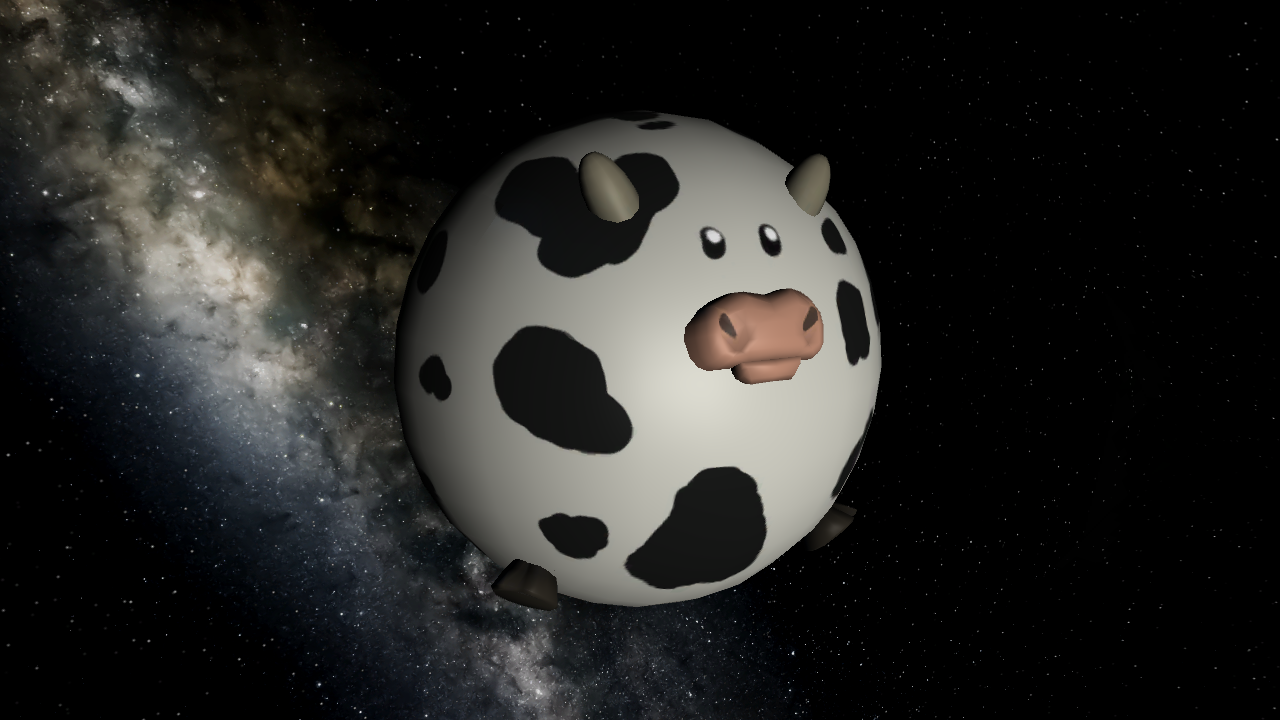
We added one new human-scale object last year - a spherical cow. A spherical cow refers to a joke that when physicists want to make a problem easier to handle, they sometimes simplify it so much it’s no longer realistic.
[h2]4[/h2]
[h5]Significant updates to Universe Sandbox[/h5]
- A Comet, an Asteroid, and a Planet Walk into the Solar System | Update 32.2 | March 2023
- Added a spherical cow and many simulations including the green comet C/2022 E3 (ZTF) passing by Earth.
- Added a spherical cow and many simulations including the green comet C/2022 E3 (ZTF) passing by Earth.
- Grand Collision Unification | Update 32.3 | June 2023
- Combined our two previous collision models for more realistic shockwaves, heating, and overall destruction.
- Combined our two previous collision models for more realistic shockwaves, heating, and overall destruction.
- Gravity Simulation Upgrade | Update 33 | August 2023
- Overhauled our gravity simulation to increase accuracy, stability, and performance to run simulations even faster.
- Overhauled our gravity simulation to increase accuracy, stability, and performance to run simulations even faster.
- Terraforming | Update 34 | December 2023
- Added 8 new materials (for a total of 12), including oxygen and carbon dioxide, to realistically simulate, construct, and terraform planets and atmospheres.
- Finally simulating the lakes of liquid methane on Titan.
- Added 8 new materials (for a total of 12), including oxygen and carbon dioxide, to realistically simulate, construct, and terraform planets and atmospheres.
The Gravity Simulation Upgrade and Terraforming were major milestones from our 2023 Roadmap post.

[h2]8[/h2]
[h5]New materials[/h5]
We added
- Helium
- Carbon dioxide
- Oxygen
- Sulfur dioxide
- Methane
- Nitrogen
- Argon
- Ammonia
Alongside the existing materials, silicate, iron, hydrogen, and water to Universe Sandbox. Now you can terraform planets and simulate atmospheres more realistically than ever.


[h2]36[/h2]
[h5]New simulations and guides added to Universe Sandbox[/h5]
Check out the 31 new simulations, including the Bombard Moon with Materials (below), and 5 new guides, including Terraforming Mars and Searching for Supermassive Black Holes, under
Home > Open
and
Home > Guides

[h2]727[/h2]
[h5]Highest number of concurrent users in Universe Sandbox[/h5]
Easily surpassing the previous highest number of 648 on December 24, 2021. January 30, 2023 must have been a great day to cause celestial havoc.
[h2]2,336[/h2]
[h5]Positive Steam reviews in 2023[/h5]
We’re truly amazed and humbled that we are rated “Overwhelmingly Positive,” both recently and all-time on Steam. Over 96% of all reviews we’ve received are positive.

[h2]2,405[/h2]
[h5]New code commits, or changes, made to Universe Sandbox through GitHub, the platform we use to maintain and manage our code[/h5]
The most code commits occurred during the week of December 3, right before Terraforming | Update 34 was released, with 87 commits. A single commit can be a simple typo correction or a whole new feature

[h2]9,757[/h2]
[h5]Discord users on our server[/h5]
It’s great to see your constructive discussion and creations on our server, which has grown by almost 20% in the last year. 10,000 is so close, let’s hit 12,000 this year! Join us on Discord.
[h2]15,747[/h2]
[h5]Simulations shared in the Universe Sandbox Steam Workshop in 2023[/h5]
That's more than 43 simulations shared every single day! There are over 50,000 total simulations shared on the Steam Workshop for you to explore and be inspired by.

[h2]25,326[/h2]
[h5]Files uploaded on our team messaging app, Slack, in 2023[/h5]
That’s more than 3 times as many as last year, including screenshots and videos of features in progress, log files for resolving issues, and images of bugs, like those below.
 A moon bounces off a planet instead of colliding with it while testing new collision physics (new collision physics are work in progress).
 Experimenting with new graphics rendering technology made Earth a bit lumpy (don’t worry, it’s a sphere again).
[h2]56,466[/h2]
[h5]Messages sent on Slack in 2023[/h5]
Giant Army has been entirely remote since its founding in 2011, and with 13 team members across 4 continents and 6 time zones, messaging on Slack is how we get most of our work done.
[h2]592,638*[/h2]
[h5]Times the ‘Welcome to Universe Sandbox’ guide was played in 2023[/h5]
Whether you’re a new player or just wanted a refresher, we hope you enjoyed learning about the beauty of our universe. And how to destroy it.

[h2]1,005,262*[/h2]
[h5]Times the Planetscaping tool was used in 2023[/h5]
The Planetscaping tool became even more powerful with the ability to add individual materials. Seeing the passion and attention to detail you all put into customizing planets is fantastic.

[h2]1,380,778*[/h2]
[h5]Times supernovas went off in Universe Sandbox in 2023[/h5]
Astronomers estimate there will be 1 supernova in the Milky Way every 100 years. They also think there are about 100 billion galaxies in the universe. Assuming all galaxies have a similar number of supernovas, about a billion occur each year.
We got about 1% of the way there in 2023. Turns out that even with everybody working together, recreating everything happening in the universe is hard.

[h2]6,265,426*[/h2]
[h5]New simulations created in Universe Sandbox in 2023[/h5]
That’s about one new simulation created every 5 seconds.

[h2]31,394,000+[/h2]
[h5]Views of Universe Sandbox videos and shorts on YouTube[/h5]
Getting an exact view count of every YouTube video that featured Universe Sandbox in 2023 is almost impossible, but we think this is a reasonable estimate (the actual number is larger). We appreciate every video posted and are glad so many people enjoy them!
Check out two of our most prolific YouTubers, Space Chip and Neptunian Guy.
 * Due to a change in our analytics system, we have extrapolated 2023’s numbers based on the total increase in player activity on Steam.
[h2]What's Next?[/h2]
We’re already working on a major graphics upgrade, getting Universe Sandbox on mobile devices (iOS and Android), overhauling the framework that Universe Sandbox is built on, and more! Be on the lookout for more details in our 2024 Roadmap post.
[previewyoutube][/previewyoutube]
Collisions and surface simulation already run smoothly in Universe Sandbox on mobile devices. This video was taken before Terraforming | Update 34. Universe Sandbox on mobile will have the same features as on desktop.
[h2]And Most Importantly[/h2]
Thank you. All of your kind words, feedback, and excitement inspire us to continue our mission of creating a realistic, interactive simulation of the amazing universe we find ourselves in. We believe that giving people the power of unlimited creation and destruction is the best way to discover its awesomeness.
We’re able to keep improving Universe Sandbox year after year because of your support, and we are truly grateful. There is so much more we want to bring to Universe Sandbox, and we can’t wait to do it.
The Universe Sandbox Team
Dan, Chris, Georg, Jonathan, Rappo, Mat, Jacob, Erika, Brendan, Anders, Brent, Pavel, and Conrad


 Before
 After
After


 The Composition tab shows material properties, including total mass, the percentage and mass in each phase (solid, liquid, and gas), and more. This feature and interface are a work in progress.
 Titan with realistic lakes of liquid methane in turquoise at its poles. The Liquid Depth Data View shows the depth and location of the methane lakes.
 Phase diagram for water shows what phase water has at different temperatures and pressures. The Freezing and Boiling points are the temperatures at which water freezes and boils on Earth, and the triple point shows at what temperature and pressure water can exist as a solid, liquid, and gas at the same time. A
  The phase diagram for water to be implemented in Universe Sandbox. This diagram has been simplified compared to the scientific phase diagram for water above for performance. It has also been edited for clarity.
 This graph shows the calculated density of Earth based on depth (or radius, 0 km being the core and 6,371 km the surface) in our in-game model (top) compared to a scientific model of Earth’s density (bottom; from A. M. Dziewonski, D. L. Anderson (1981). "
 The cut-away view of Earth shows the individual materials (upper left), temperature (bottom), and phase (upper right) of each material from the inside out. We can see the model of Earth’s interior in Universe Sandbox has a very hot, solid iron core, a layer of molten liquid iron above it, and a layer of hot, solid silicate that cools as it gets closer to the crust.
 Planetscaping materials onto the surface of a blank planet while they flow together. As the simulation speed increases, the liquid methane, nitrogen, and sulfur dioxide start to evaporate, creating opaque atmospheres above their liquid surfaces. Planetscaping materials and the Planetscaping tool interface are works in progress.
 Ceres, a dwarf planet in the asteroid belt, collides with Earth. The surface heating on impact causes the ocean to boil, creating an opaque patch of atmosphere above the impact region. The small fragments colliding with Earth push the atmosphere upon entry, creating holes and dense shockwaves that create ripples in the atmosphere.
 Planetscaping gaseous oxygen into Earth’s atmosphere creates an opaque area that expands outwards. Adding materials to planet atmospheres and the Planetscaping tool interface are works in progress.
 Many small moons orbit close to Earth, colliding with each other and Earth. Collisions with Earth cause superheated patches of ocean to evaporate and transfer the material from the small moon to Earth.
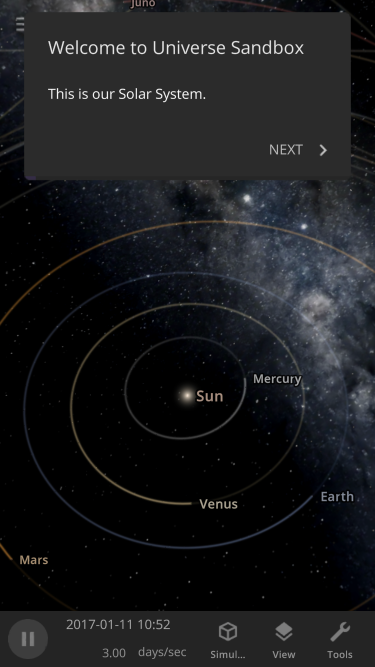 Making our user interface work in portrait mode is an added challenge when adapting it for small screens.
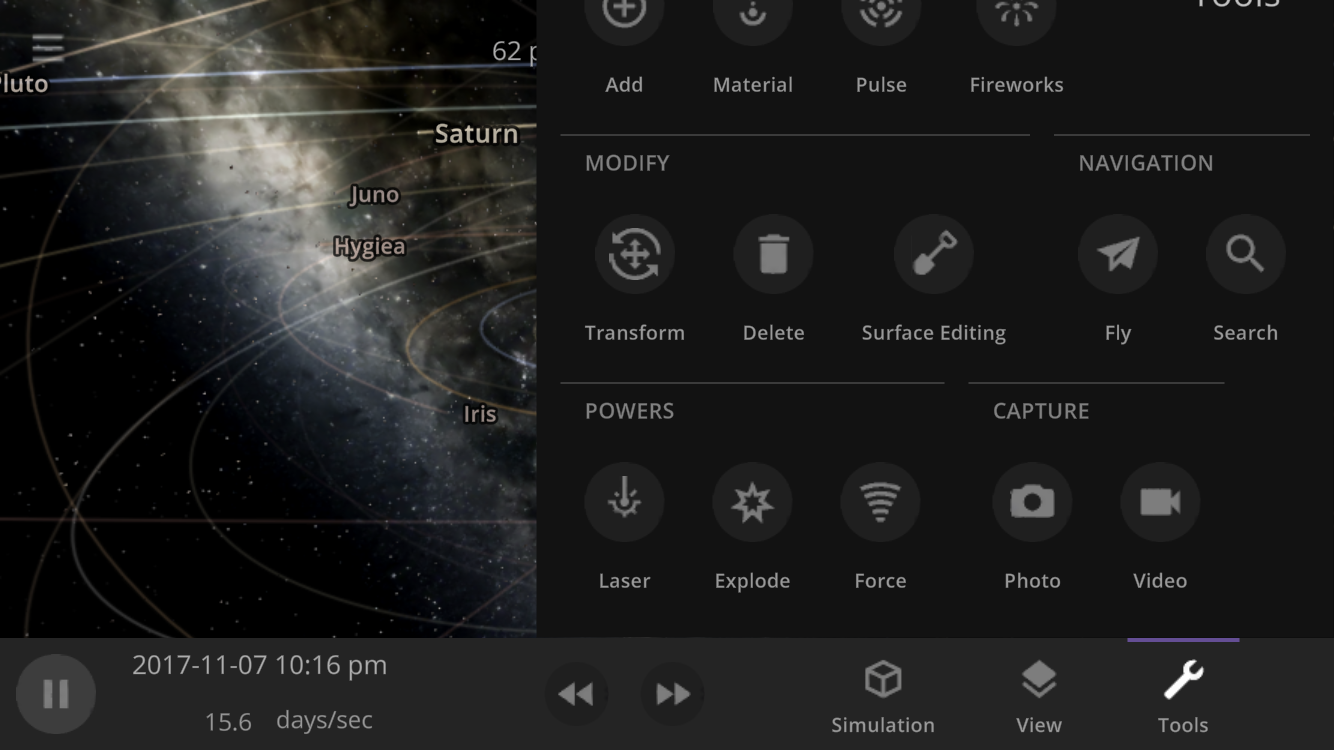 Dynamically resizing panels (this tool panel is cut off) and automatically moving the center of your view so you can always see what you're looking at (moving the Sun hidden behind the tool panel to the empty space on the left) is just one example of the user interface work we still need to do. This is a work in progress.
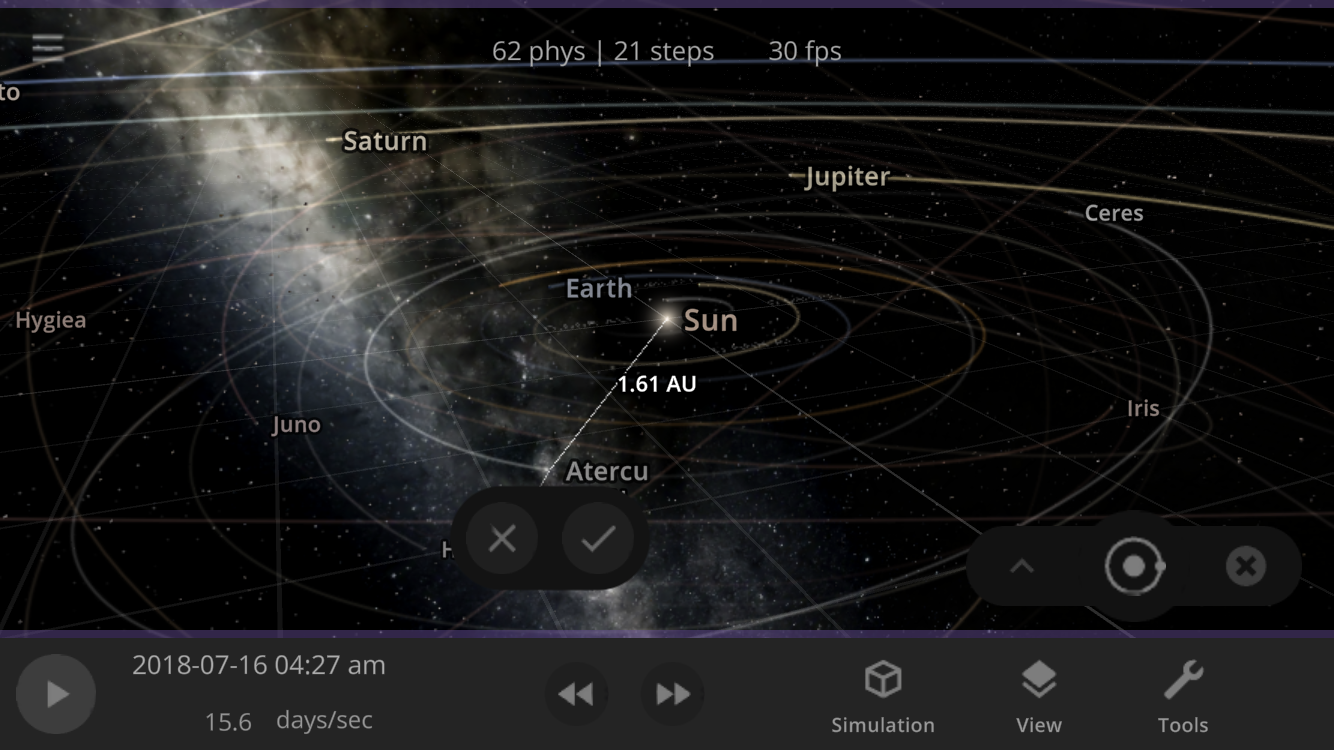 One new design we have is a step to confirm placing an object, helping it end up where you want it. This is a work in progress.