1. Europa Universalis IV
  2. News

Europa Universalis IV News

Masters of Universalis PDXCON2019


As part of #PDXCON2019, we’re going to be hosting a second Masters of Universalis tournament!

This will be live-streamed at twitch.tv/paradoxinteractive from 11:00 - 14:00 CEST on Sunday 20th October.

If you’re attending the convention, you’ll have the chance to go through the open qualifier and win your spot in the live-streamed finals.

At the EU4 booth on Saturday, you’ll be able to measure yourself against the challenge below, set by the dev team.

The two highest achieving contestants will qualify for the semi-finals, which began at 11:00 CEST on Sunday 20th.

Our two champions will square off against the reigning Master of Universalis, Florryworry, and the current runner-up, Taureor.

The winner of these two contests will contest the Grand Final to emerge as the Master of Universalis!

Dev Diary: More Imperial Incidents

Today's Dev Diary by neondt


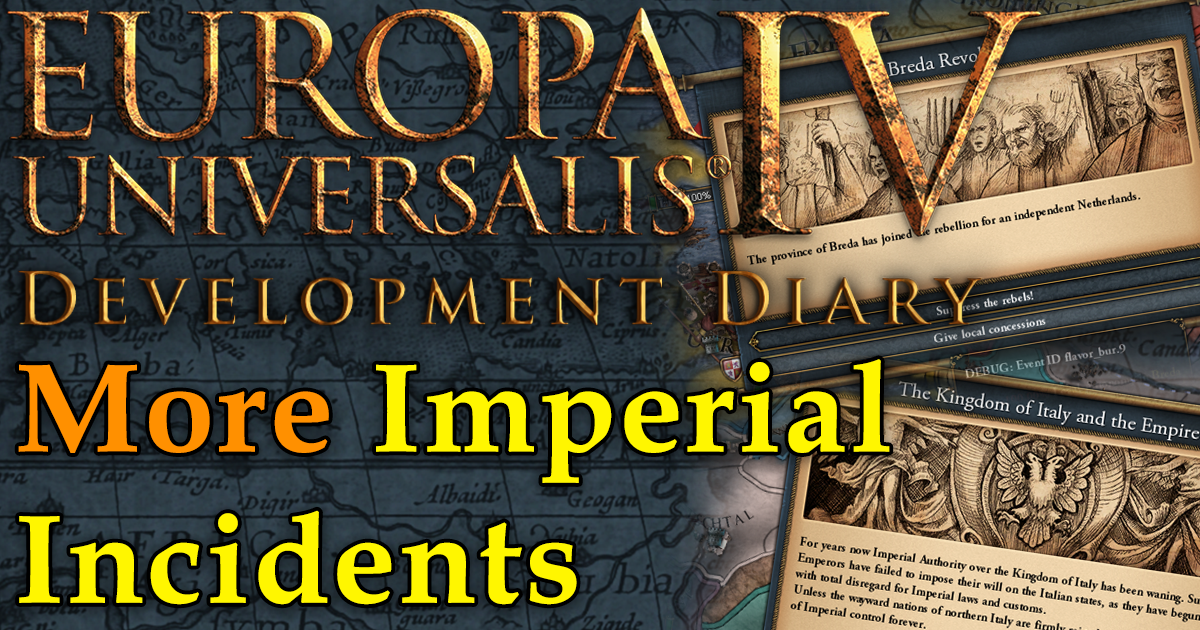
Good morning once again, and welcome to today’s dev diary. Following on from last week, I’ll be covering a couple more Imperial Incidents, this time focusing on our reworked Dutch Revolt and Shadow Kingdom.

Another reminder in case you’ve forgotten how Imperial Incidents work:

DDRJake said:

“The other thing for us to look into today are Imperial Incidents. One thing we wanted to do was to make the Empire feel alive and rife with bickering princes. To that end, we have rolled some existing occurrences throughout EU4 and History, as well as many others, into a system that has the HRE both create and react to issues in Central Europe and the immediate vicinity.

When the conditions are ripe, an Imperial Incident can trigger for the Empire. All member states will be informed of the incident, and it will prominently be displayed in the HRE interface. The Emperor will then have 6 months to make a decision on the incident, with wide-ranging knock-on effects.”


Let’s start with the Dutch Revolt. You’ll be pleased to hear that this is no longer represented as a potentially endless series of events spawning hundreds of thousands of separatist rebels in your Lowlands provinces. We’ve instead opted to use the Disaster system to constrain the time-frame for when these rebellions crop up. Most conditions should be relatively familiar: don’t have any of the Lowland culture (now including Frisian!) as your primary culture, own at least 5 provinces in the Lowlands region with Dutch/Flemish/Frisian culture, don’t have your capital in the Lowlands region, etc.

We do however have a new set of conditions: there must also be some kind of existing cultural or religious tensions in your Low Countries provinces. In practice, this means owning Low Countries provinces that do not have your religion or have a culture that is not accepted in your nation.

When these conditions are true, the Dutch Revolt Disaster will begin ticking for your nation. When the Disaster fires a large number of rebels will spawn in some of your Low Countries provinces and of said provinces will get extra Unrest until the end of the Disaster. Events will give you the option of fighting additional rebels or granting high autonomy to your Lowlands provinces.

The Disaster ends when one of these sets of conditions is true:
  • The Disaster has been present in your country for 20 years, there are no rebels in your provinces, and you have at least 1 Stability

  • The Netherlands exists

  • You own less than 5 Dutch/Flemish/Frisian provinces in the Low Countries region


If at any point during the Disaster you own at least 5 provinces that are Dutch/Flemish/Frisian culture and either controlled by rebels or 90% autonomous, the Dutch Independence event fires and you’ll find yourself in a bloody war. Not only will the Netherlands be spawned from all appropriate provinces, but an Imperial Incident will begin and all of your rivals will be invited to support the new Dutch state in their quest for self-determination. These events will now directly call your rivals into the independence war rather than simply creating an alliance that is unlikely to be useful for the Netherlands during the initial war, which gives them much more of a fighting chance.

The Dutch Revolt Imperial Incident gives the Emperor a chance to intervene, assuming that the Dutch are not revolting against the Emperor and that the Netherlands are part of the HRE. The Emperor has three options:
  • If the Emperor chooses to support Dutch independence, they are called into the independence war (assuming that it is still ongoing), become an ally of the Netherlands, and get a significant opinion boost with the fledgling nation.

  • If the Emperor chooses not to intervene in the conflict, they lose some prestige and send a clear message that the Empire cares not for the Dutch cause. The Netherlands will leave the HRE after the independence war has concluded.

  • If the Emperor chooses to suppress the Dutch revolt, the Emperor will gain an alliance with the former overlords of the Dutch, and again the Netherlands will leave the Empire after the war is over.


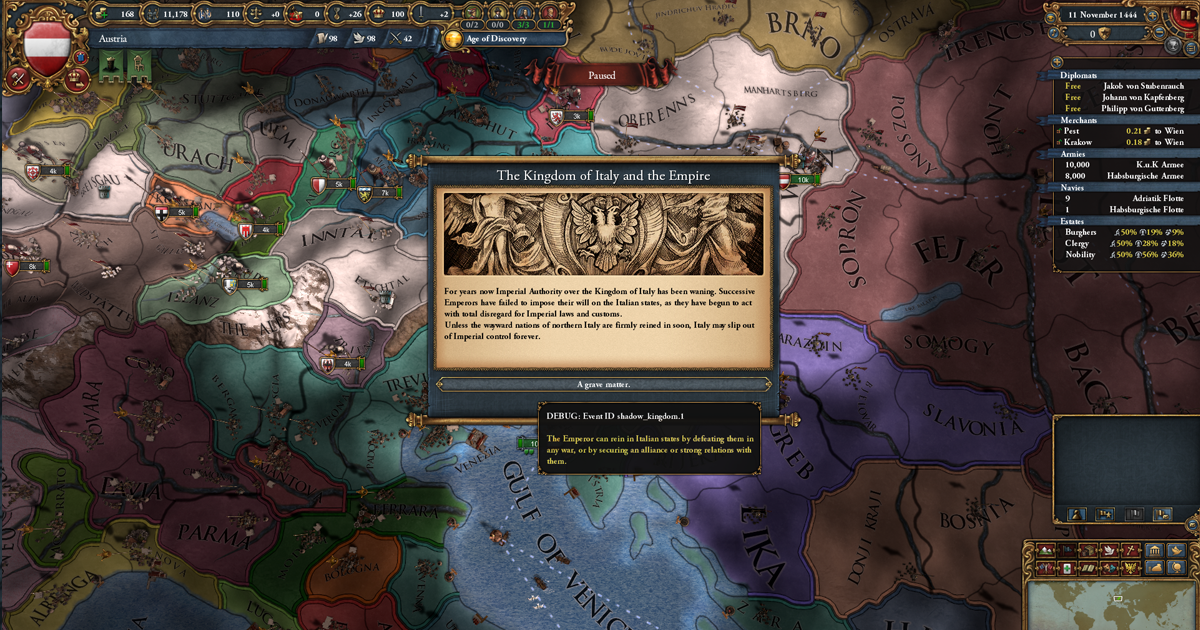
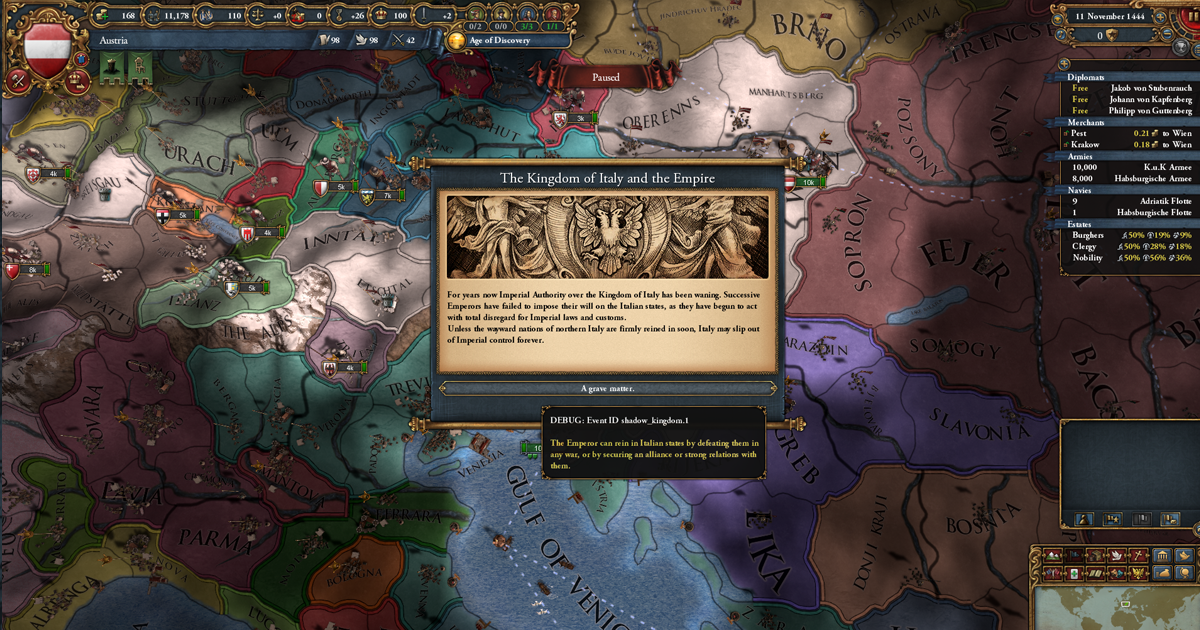
We’ve also taken another look at the Shadow Kingdom event chain that leads to Italy leaving the Holy Roman Empire. In the past this has set a challenge to the Emperor to force Italy into the Empire often through strange and obscure means. In the European update we’ve turned it on its head; you’ll now need to rein in the Italian Princes that are already in the Empire but who are slipping away from Imperial rule. The Emperor gets an event near the beginning of the game about this state of affairs and what must be done to avert a total loss of control in Italy.

An Italian state is considered “reined in” after it has lost a war (any war) against the Emperor or if it has very good relations with the Emperor. We’ll be displaying which nations are at risk of abandoning the Empire in the HRE interface.

Some time around the 1460’s, an Imperial Incident begins for the Emperor in which he has two options:
  • Continue attempting to rein in the Italians: this begins a timer for the Emperor to attempt to rein in as many Italian states as possible. The risk the Emperor takes here is that failing to hold to this promise will incur a greater penalty to Imperial Authority than simply abandoning Italy early on.

  • Abandon Italy: all of Italy will be removed from the Empire immediately at the cost of 20 [numbers subject to change] Imperial Authority and 10 Prestige.

    If the Emperor attempts to keep Italy within the Empire, they’ll get a follow-up event after 20 years. Italian Princes that were in danger of leaving, if any remain, will leave the Empire and the Emperor will incur a penalty to Imperial Authority for each Prince that leaves.If the Emperor has succeeded in reining in every Italian state they’ll gain 25 Imperial Authority, the Italian Princes will remain in the Empire, and certain future Incidents will be unlocked or barred due to your actions.

    That’s all for this week! As you can see the Imperial Incidents system has given us a great excuse to go back and revisit some of the game’s oldest and most impactful content, and what I’ve talked about today is far from all we’ve done in this regard. Have a good week, and for those of you attending PDXCON, I’ll see you there!


Dev Diary: Imperial Incidents

Today's Dev Diary by Neondt


Good morning, and welcome to today’s dev diary! As Jake foretold last week, today I’ll be talking about some of the Imperial Incidents coming in next year’s big expansion.

For those of you who have forgotten or for some reason do not read our dev diaries with fervent religiosity, this is what an Imperial Incident is:

DDRJake said:

“The other thing for us to look into today are Imperial Incidents. One thing we wanted to do was to make the Empire feel alive and rife with bickering princes. To that end, we have rolled some existing occurrences throughout EU4 and History, as well as many others, into a system that has the HRE both create and react to issues in Central Europe and the immediate vicinity.

When the conditions are ripe, an Imperial Incident can trigger for the Empire. All member states will be informed of the incident, and it will prominently be displayed in the HRE interface. The Emperor will then have 6 months to make a decision on the incident, with wide-ranging knock-on effects.”


These Incidents give us the opportunity to both revisit old content and to design something new. Last week Jake gave a description of the reworked Burgundian Inheritance (which we might revisit in more detail in the future). Today I’ll show off two new event chains and their associated Incidents: The King in Prussia, and The Great Peasants’ War.


Prussia is no longer awarded a shiny Kingdom-rank crown simply for existing. An independent Prussia must establish itself as a relevant power before it has the opportunity to claim its crown. After this event fires, the Imperial Incident begins and the Emperor must decide on how to proceed.
  • If the Emperor decides to elevate Prussia to an Imperial Kingdom in the fashion of Bohemia, they will lose 10 Imperial Authority but greatly improve their relations with Prussia. This will also anger any electors that have rivalled Prussia.

  • If the Emperor decides to accept the historical compromise - that the monarch may call himself “King in Prussia” but not “King of Prussia” - the effect is similar but reduced. The Electors will not be angered but Prussia will be only mildly grateful to the Emperor.

  • If the Emperor refuses to acknowledge any Prussian monarch bearing the title of “King”, Prussia must make a decision between their Kingly crown or their status as an Imperial Prince, potentially being ejected from the Empire. This will greatly anger both Prussia and its Elector allies.


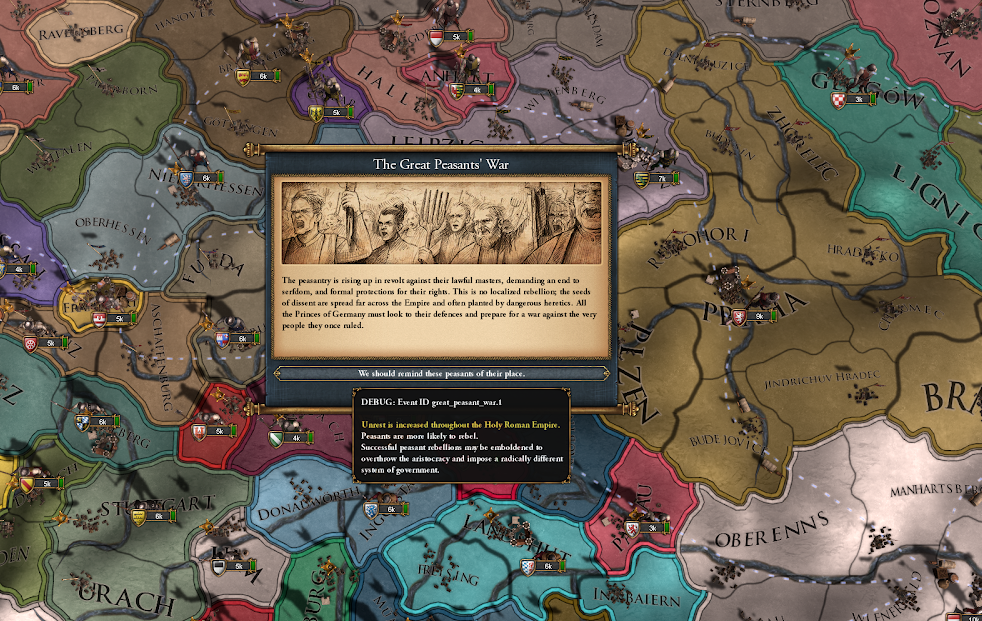
The Great Peasants’ War was a time of great upheaval in the Holy Roman Empire. Driven by religious, economic, and social woes the oppressed masses rose up across Germany against their feudal masters. This event can happen prior to the League War, which is delayed until this conflict is resolved. National unrest is increased throughout the Empire, peasant rebels are more likely to spawn, and countries that break to peasant rebels may become a Peasant Republic. While the Great Peasants’ War rages on, the game will track the success of the rebels throughout the Empire. After several years have passed and the dust has settled, the Emperor must make a resolution:
  • [Available only if the rebels are not highly successful] If the Emperor chooses to crush the rights of peasants, the Noble estates across the Empire will become more loyal and more powerful. This effect is reduced if the rebels are moderately successful.

  • If the Emperor chooses to grant concessions to the peasantry and enforce their rights, the Noble estates across the Empire will not only lose Influence but also some of their Land Share. The strength of this effect depends on the success of the rebels. This will mean that Princes of the Empire have more Crown Land, but they will also collect less taxes due to their concessions to the peasantry. If the rebels are highly successful, nations in the Empire will continue to become Peasant Republics when breaking to peasant rebels even after the Great Peasants’ War ends.


We have a lot more Incidents left to talk about: in the unspecified future I’ll talk about such Incidents as the Dutch Revolt and the Shadow Kingdom. For now though that’s all I have to say, I hope you all have a great day and that you return for next week’s dev diary!

1.29.2 Hotfix live!

Greetings!

Today we're releasing another hotfix addressing a number of issues following the Manchu Update and the accompanying Paradox Launcher.


Changelog:

- Solved issue with Linux Players not being able to start the launcher due to graphical settings
- Remove in-game outdated mod warning, the Launcher itself will now display this warning
- Fixed crash on monthly tick with 1.28 saves in 1.29
- More information regarding hardware used for the game will be written in system.log for debugging use
- Removed failing launch option for rollback vedrsions of EUIV

Previous Updates:
1.29.1 Full Changelog 1.29 Full Changelog

If you experience any of the above issues after the patch - or bugs not mentioned here - please head to our bug report forum here: https://pdxint.at/2QIVlG8

Reports here are an invaluable part of our process and are much appreciated!

Dev Diary - HRE Reforms

Today's Dev Diary from DDRJake

Good day and welcome to this week's Dev Diary for EU4. While we're still ironing out a few remaining issues with the 1.29 Manchu release, it's time to set our sights back on the upcoming European Update and accompanying DLC.

Today let's talk about the HRE. Earlier in the year, I touched on the Empire, and want to expand a bit more on what you can expect to see and do with Germany and friends in 1.30. As we've said before, much of the HRE mechanically exists in the game, and has continued to exist in its current form, as it does a great job of bringing relative rigidity to central Europe, and a good bulwark to an otherwise overly formidable French or Scandinavian threat, or more terrifying indeed, Ottoman invasion.

To that end, 1.30 will still have the Holy Roman Empire's base mechanics in their glory, save some smaller Quality of Life changes (such as no longer adding provinces to the Empire individually). The meat and potatoes of what you can expect in Early Modern Germany come by way of HRE Reforms and Imperial Incidents

Firstly, the reforms available for the Holy Roman Empire have been split into general reforms, Decentralisation reforms and Centralisation reforms. Some will look familiar to a seasoned HRE player. Others, less so.

General Reforms:
-Call for Reichsreform
Empire Provinces: -5% Local Construction Cost
Emperor: Imperial Ban CB

-Institute Reichsregiment
Emperor: +1 Diplomats, +1 Diplomatic reputation
Empire Provinces: -2 Local Unrest

-Absolute Reichsstabilität
Emperor: gets a [REDACTED] that will [VERY REDACTED]
Empire Provinces: -25% Local State Maintenance

-Enact Gemeiner Pfennig
Emperor per Prince: +0.5 Yearly Tax income
Princes: +1 Diplomatic reputation

-Perpetual Diet
Needed to take one of the specific paths
Event that puts the location down for the “Permanent Diet” in an -Imperial Free City
Permanent Diet is a triggered province modifier with some nice boons for the province. Is only valid if province is part of the Empire. If not a triggered modifier is enabled that gives -50% IA Gain.
Double Imperial Authority from Free Cities

-Create the Landsknechtswesen
All Princes: Mercenary Companies who have their home in an Imperial Province are 50% cheaper.

-Ewiger Landfriede
Emperor: +0.5 Yearly Prestige
Princes: -5% Tech cost
Empire Provinces: +10% Institution Spread
Emperor gets call to Arms for any war within the Empire as if it was done without CB.

Once the Emperor Passes the Perpetual Diet, they will be able to pass further reforms to either strengthen the decentralised Empire, or seek to centralise all power for themselves. Players have long wondered if they should stop short of completing the existing HRE reform path in order to preserve their Vassal Swarm, a highly enjoyable way of playing, or to unite the HRE under one flag. Now they will be able to choose between this decentralised power or centralising uniting under nation, with about 5 reforms each that play into either playstyle.


And maybe a player will have to weigh up ?missions? against vassal swarm tactics

The other thing for us to look into today are Imperial Incidents. One thing we wanted to do was to make the Empire feel alive and rife with bickering princes. To that end, we have rolled some existing occurrences throughout EU4 and History, as well as many others, into a system that has the HRE both create and react to issues in Central Europe and the immediate vicinity.

When the conditions are ripe, an Imperial Incident can trigger for the Empire. All member states will be informed of the incident, and it will prominently be displayed in the HRE interface. The Emperor will then have 6 months to make a decision on the incident, with wide-ranging knock-on effects.

To take a familiar example, the fate of Burgundy will be more fluid, with the circling vultures being more involved. Burgundy may seek support from the HRE as they see the writing on the wall, starting an Imperial Incident where the Emperor will have to choose between:

-Negotiate with France
France gains the parts of Burgundy that are in the French Region.

-Integrate Burgundy into the Empire
Burgundy becomes an Imperial Prince
Gives an event to France that gives them an option to start a -Succession War on Burgundy(and thus by extension the Emperor) with French land occupied.
Princes around Burgundy becomes irritated with Emperor.

-Just keep the PU with Burgundy
Nevers becomes vassal of France, France gets an option to start a Restoration of Union War on Burgundy(and thus by extension the Emperor) with French land occupied.

All incidents, and the path that the Emperor pursued will be visible in the HRE interface, so curious players can see what choices the Emperor has made before, and use their involvement in incidents as a chance to seize an advantage.

There are many other plans for Incidents, ranging from my beloved Hanseatic League, to my less beloved Dutch revolters, and the interactions between Pope and Empire beyond the shadow kingdom. We'll look towards these in future Dev Diaries.

Cheers for joining. Next week we'll keep going with our look at 1.30.

Join the conversation on the forums: https://pdxint.at/2o79rn1