Stellaris Dev Diary #191 : And Yet It Moves
Hi all!
As mentioned last week, our plan for today is to go over some changes to automated colony management and pop resettlement.
Major goals here were to reduce the micromanagement burden in the mid to late game when individual decisions are less oppressive, and to significantly decrease the need to manually move pops at all. As with the economic changes we were discussing before, a lot of this is still a work in progress to varying degrees.
[h3]
Automated Colony Management[/h3]
Some sector management improvements have already been made in the 2.8.1 test branch (you can experiment and leave feedback on it by following the instructions in this thread), but here we’ll be focusing on planetary designations and individual planet automation.
A major pass has been done on automated colony management to improve its effectiveness. After manually setting a colony designation and turning on automated colony management, our intent is for the colony to develop into something you would reasonably expect if you were building it on your own. It should build districts, clear deposits as necessary, and upgrade buildings when there is a need for it.
Planet automation will upgrade capital buildings whenever possible (gotta unlock those building slots!), and will otherwise generally try to build or upgrade from its list if there are less than 3 open jobs. We’ve erred a bit on the side of caution, so it is currently extremely opposed to running deficits. It may require manual intervention if, for example, your energy credits per month are negative, but we figured it was better to leave those sorts of risky economic decisions in the player’s hands.
If you want to check out the Foundry Automation (Hive) Script, check it out in the forum post here
This script will attempt to build a forge world for a hive empire. If there are less than 3 free jobs and there is nothing currently in the build queue, it will check to see if there is anything that it can build. Planetary automation has a tendency to favor districts over buildings, but will construct buildings if there are 1.5 times as many districts already built than there are buildings. (This ratio is able to be set in 00_defines.txt as COLONY_AUTOMATION_DISTRICT_PREFERENCE.) When selecting a building, it will move down the list until it finds something that it is capable of building and meets the scripted restrictions. The building’s upkeep is always taken into consideration. The scripted “_affordable” checks are to estimate whether you can afford the jobs it creates as well.
Blockers are fairly low priority for planetary automation, and will only be cleared if they are blocking a district slot that it actively wants to construct, or if there are no free district slots remaining. (Thus it will eventually clear all those random blockers once the rest of the planet is finished.) You can, of course, intervene and clear those Sprawling Slums or sleepy Lithoids earlier.
Buildings (other than the capital) will be upgraded if there are no other things that it wants to build right now, it can upgrade without causing resource deficits, and there are pops available that would want to work there. (Either because they’re unemployed or they prefer it to their current jobs.)
The scripts will attempt to handle various issues that may crop up on a planet such as low amenities, high crime, or failure to build buildings dedicated to extra-dimensional beings that love you and just want to be loved in return. These are tucked away in 00_crisis_exceptions.txt.
If you want to check out the Amenity Crisis Exception (Regular Empire) Script, check it out in the forum post here
This "exception" will intervene if a planet’s amenities are -5 or below, and it’s either not an ecumenopolis or if it is an ecumenopolis, it’s either totally full or you’re running low on exotic gases. Based on your ethics and authority, it’ll pick one of the amenity buildings to add to the queue.
A few jobs, buildings, and planet designations have gotten a bit of a touch-up during this pass. Notable examples of designations include the Urban World, which now has a Trade Value bonus, and the Colony, which is now intended to satisfy the needs of a newly colonized world rather than provide pop growth bonuses.


Urban and Colony Designations
The old Colony bonus was changed because it was a bit problematic - growth bonuses made it somewhat stronger than many other more specialized bonuses. We’d greatly prefer if you could flag that newly settled Mining World as such right away and immediately turn on automation, rather than it being optimal to manually develop the world until it reached 5 pops and no longer qualified for Colony.
Due to its inherent terror of deficits, the automation scripts tend to be a little bit more conservative than players may be, but I’ve personally enjoyed the dramatically reduced mental burden my mid to late game colonies require. It’s also convenient that several designations (such as Forge, Factory, Tech, and Urban) will build out colonies that qualify for the Arcology Project decision. In our dev multiplayer games, I've been making a point of using colony automation as much as possible in order to give everyone else a chance get a feel for what it's doing. (Except my capital. I'll admit that I do manually build that so I can take care of sudden shifts in priority.)
If you're using planetary automation but it doesn't seem to be doing anything, the three most common things to check are:
 Save mouse-clicks, use Ctrl.
[h3]Resettlement[/h3]
Manual resettlement and the mitigation of unemployment is a huge burden in mid to late game Stellaris. It is generally our belief that manual resettlement should be an extremely rare occurrence, not something done expected to be done as part of the core game loop. When you must, it should be a simple process, but it should be an unusual act.
One quality of life change we’ve made is to filter Unemployed pops up to the top, and highlighted them. The pops underneath are then sorted from lowest stratum to highest.

You're unlikely to see this specific scenario unless you intentionally create unemployment problems by turning off jobs in every pop strata.
We've also adjusted resettlement costs, and added an Influence cost to many pop types. These influence costs are nominal for worker tier pops, but get fairly expensive when you're forcing Rulers to move.

 Slave Resettlement and Worker/Drone/Bio-Trophy Resettlement

 Specialist Resettlement and Ruler Resettlement
Slaves and unintelligent robots can still be moved without expending Influence, and certain civics permit you to waive these Influence costs.


Hey wait, what's that about colony abandonment?
Despite their best efforts the Servitors still haven't found a good way to get their Bio-Trophies to shift their consciousness to a different planet using OTA updates, so you still have to pay for them.
Manually resettling the last pop off a colony you own carries an additional influence surcharge in our dev builds. There will very likely be an exception made for Doomed planets and Holy Worlds that are risking initiating a war with a Fallen Empire. A planetary decision to abandon a recently conquered planet is under consideration, though it'll likely use displacement purging to do so. (With the diplomatic penalties associated with it.)
 But we just finished building it!
With Federations, we introduced a galactic resolution in the Greater Good line that provided limited automated resettlement called Greater Than Ourselves. As noted by some, that was partially intended as a means to allow Egalitarian leaning empires a way of handling resettlement without forcing it on their pops. There have been many requests to make that core game functionality, but we’ve been somewhat wary of doing so without some restrictions.
We've come up with a way for every empire to have easier access to a similar effect. The following new Starbase Building will handle it, unlocked by the Hyperlane Breach Points tech. (The Hyperlane Registrar has moved to Interstellar Economics.)
 They like to move it.

The tooltip effect is a bit of a mouthful.
The Transit Hub will operate as a limited variant of Greater Than Ourselves, moving unemployed low strata pops between planets that are in systems with Transit Hubs. (This will allow movement within a system as well, for example if you have a bunch of habitats in a single system.) We're investigating ways to expand the scope of pops it's willing to move - the original Worker limitation was put into place because while a Worker could promote themselves to fill any free job, a Slave or Specialist might find themselves restricted from the free job on the new planet. We're currently experimenting with a more robust variant - if it works out without performance concerns, the Transit Hub will prioritize high strata unemployment and then move down the ranks.
Building out the Transit network does function best when you have a developed starbase above most of your colonies since it will only move pops between nodes on the network.
Tangentially related, we've also cut demotion time in half across the board, and made some changes to give each Authority type a unique bonus.
 Yes, Shared Burdens pops demote pretty much instantly.
We have some other experimental changes going on that significantly reduce the number of unemployed pops in the late game but we're not ready to talk about them yet.
The empire type that perhaps faced the most obnoxious burden of frequent manual resettlement were Terravores, the Lithoid Devouring Swarms. When devouring planets, they occasionally created pops on the consumption world. As a quality of life improvement, when they’ve finished the planet off we now resettle them back to the capital. (Since gestalts can also use the Transit Hub, I highly recommend that Terravores build one in their main system to send those drones someplace where they can be of use.)
Oh, and we also clear that pesky red habitability planet marker from completely consumed planets that was unnecessarily cluttering your map.

HP/MP restored! ...But you're still hungry.
As a reminder, we have an ongoing feedback thread related to AI improvements we have in beta on the stellaris_test branch. We'd love to get more people on it and telling us what they think about them. (Please note that 2.8.1 is an optional beta patch. You have to manually opt in to access it. Go to your Steam library, right click on Stellaris -> Properties -> betas tab -> select "stellaris_test" branch.)
Next week we plan on going through some more of the remaining economic balance changes. See you then!
As mentioned last week, our plan for today is to go over some changes to automated colony management and pop resettlement.
Major goals here were to reduce the micromanagement burden in the mid to late game when individual decisions are less oppressive, and to significantly decrease the need to manually move pops at all. As with the economic changes we were discussing before, a lot of this is still a work in progress to varying degrees.
[h3]
Automated Colony Management[/h3]
Some sector management improvements have already been made in the 2.8.1 test branch (you can experiment and leave feedback on it by following the instructions in this thread), but here we’ll be focusing on planetary designations and individual planet automation.
A major pass has been done on automated colony management to improve its effectiveness. After manually setting a colony designation and turning on automated colony management, our intent is for the colony to develop into something you would reasonably expect if you were building it on your own. It should build districts, clear deposits as necessary, and upgrade buildings when there is a need for it.
Planet automation will upgrade capital buildings whenever possible (gotta unlock those building slots!), and will otherwise generally try to build or upgrade from its list if there are less than 3 open jobs. We’ve erred a bit on the side of caution, so it is currently extremely opposed to running deficits. It may require manual intervention if, for example, your energy credits per month are negative, but we figured it was better to leave those sorts of risky economic decisions in the player’s hands.
If you want to check out the Foundry Automation (Hive) Script, check it out in the forum post here
This script will attempt to build a forge world for a hive empire. If there are less than 3 free jobs and there is nothing currently in the build queue, it will check to see if there is anything that it can build. Planetary automation has a tendency to favor districts over buildings, but will construct buildings if there are 1.5 times as many districts already built than there are buildings. (This ratio is able to be set in 00_defines.txt as COLONY_AUTOMATION_DISTRICT_PREFERENCE.) When selecting a building, it will move down the list until it finds something that it is capable of building and meets the scripted restrictions. The building’s upkeep is always taken into consideration. The scripted “_affordable” checks are to estimate whether you can afford the jobs it creates as well.
Blockers are fairly low priority for planetary automation, and will only be cleared if they are blocking a district slot that it actively wants to construct, or if there are no free district slots remaining. (Thus it will eventually clear all those random blockers once the rest of the planet is finished.) You can, of course, intervene and clear those Sprawling Slums or sleepy Lithoids earlier.
Buildings (other than the capital) will be upgraded if there are no other things that it wants to build right now, it can upgrade without causing resource deficits, and there are pops available that would want to work there. (Either because they’re unemployed or they prefer it to their current jobs.)
The scripts will attempt to handle various issues that may crop up on a planet such as low amenities, high crime, or failure to build buildings dedicated to extra-dimensional beings that love you and just want to be loved in return. These are tucked away in 00_crisis_exceptions.txt.
If you want to check out the Amenity Crisis Exception (Regular Empire) Script, check it out in the forum post here
This "exception" will intervene if a planet’s amenities are -5 or below, and it’s either not an ecumenopolis or if it is an ecumenopolis, it’s either totally full or you’re running low on exotic gases. Based on your ethics and authority, it’ll pick one of the amenity buildings to add to the queue.
A few jobs, buildings, and planet designations have gotten a bit of a touch-up during this pass. Notable examples of designations include the Urban World, which now has a Trade Value bonus, and the Colony, which is now intended to satisfy the needs of a newly colonized world rather than provide pop growth bonuses.
Urban and Colony Designations
The old Colony bonus was changed because it was a bit problematic - growth bonuses made it somewhat stronger than many other more specialized bonuses. We’d greatly prefer if you could flag that newly settled Mining World as such right away and immediately turn on automation, rather than it being optimal to manually develop the world until it reached 5 pops and no longer qualified for Colony.
Due to its inherent terror of deficits, the automation scripts tend to be a little bit more conservative than players may be, but I’ve personally enjoyed the dramatically reduced mental burden my mid to late game colonies require. It’s also convenient that several designations (such as Forge, Factory, Tech, and Urban) will build out colonies that qualify for the Arcology Project decision. In our dev multiplayer games, I've been making a point of using colony automation as much as possible in order to give everyone else a chance get a feel for what it's doing. (Except my capital. I'll admit that I do manually build that so I can take care of sudden shifts in priority.)
If you're using planetary automation but it doesn't seem to be doing anything, the three most common things to check are:
- Is the colony in a Sector?
Colonies have to be in a (non-Frontier) Sector in order to use either sector or planetary automation. - Am I running an energy deficit?
Most districts and buildings have energy upkeep. While it's possible for the district or building to theoretically produce enough energy to overcome that and help work off the current deficit, the automation scripts are as light as possible and without deeper analysis can't assume that pops moving into those jobs wouldn't worsen the shortage. Manual intervention is necessary to dig out of an energy crunch. - Do I have resources in the automation pool for it to use?
There's a notification for this, but if the pool is running low it might not be able to afford whatever it is it wants to build. Remember, you can hold Ctrl to change the units moved from hundreds to thousands.
Save mouse-clicks, use Ctrl.[h3]Resettlement[/h3]
Manual resettlement and the mitigation of unemployment is a huge burden in mid to late game Stellaris. It is generally our belief that manual resettlement should be an extremely rare occurrence, not something done expected to be done as part of the core game loop. When you must, it should be a simple process, but it should be an unusual act.
One quality of life change we’ve made is to filter Unemployed pops up to the top, and highlighted them. The pops underneath are then sorted from lowest stratum to highest.
You're unlikely to see this specific scenario unless you intentionally create unemployment problems by turning off jobs in every pop strata.
We've also adjusted resettlement costs, and added an Influence cost to many pop types. These influence costs are nominal for worker tier pops, but get fairly expensive when you're forcing Rulers to move.
Slave Resettlement and Worker/Drone/Bio-Trophy Resettlement
Specialist Resettlement and Ruler ResettlementSlaves and unintelligent robots can still be moved without expending Influence, and certain civics permit you to waive these Influence costs.
Hey wait, what's that about colony abandonment?
Despite their best efforts the Servitors still haven't found a good way to get their Bio-Trophies to shift their consciousness to a different planet using OTA updates, so you still have to pay for them.
Manually resettling the last pop off a colony you own carries an additional influence surcharge in our dev builds. There will very likely be an exception made for Doomed planets and Holy Worlds that are risking initiating a war with a Fallen Empire. A planetary decision to abandon a recently conquered planet is under consideration, though it'll likely use displacement purging to do so. (With the diplomatic penalties associated with it.)
But we just finished building it!With Federations, we introduced a galactic resolution in the Greater Good line that provided limited automated resettlement called Greater Than Ourselves. As noted by some, that was partially intended as a means to allow Egalitarian leaning empires a way of handling resettlement without forcing it on their pops. There have been many requests to make that core game functionality, but we’ve been somewhat wary of doing so without some restrictions.
We've come up with a way for every empire to have easier access to a similar effect. The following new Starbase Building will handle it, unlocked by the Hyperlane Breach Points tech. (The Hyperlane Registrar has moved to Interstellar Economics.)
They like to move it.The tooltip effect is a bit of a mouthful.
The Transit Hub will operate as a limited variant of Greater Than Ourselves, moving unemployed low strata pops between planets that are in systems with Transit Hubs. (This will allow movement within a system as well, for example if you have a bunch of habitats in a single system.) We're investigating ways to expand the scope of pops it's willing to move - the original Worker limitation was put into place because while a Worker could promote themselves to fill any free job, a Slave or Specialist might find themselves restricted from the free job on the new planet. We're currently experimenting with a more robust variant - if it works out without performance concerns, the Transit Hub will prioritize high strata unemployment and then move down the ranks.
Building out the Transit network does function best when you have a developed starbase above most of your colonies since it will only move pops between nodes on the network.
Tangentially related, we've also cut demotion time in half across the board, and made some changes to give each Authority type a unique bonus.
Yes, Shared Burdens pops demote pretty much instantly.We have some other experimental changes going on that significantly reduce the number of unemployed pops in the late game but we're not ready to talk about them yet.
The empire type that perhaps faced the most obnoxious burden of frequent manual resettlement were Terravores, the Lithoid Devouring Swarms. When devouring planets, they occasionally created pops on the consumption world. As a quality of life improvement, when they’ve finished the planet off we now resettle them back to the capital. (Since gestalts can also use the Transit Hub, I highly recommend that Terravores build one in their main system to send those drones someplace where they can be of use.)
Oh, and we also clear that pesky red habitability planet marker from completely consumed planets that was unnecessarily cluttering your map.
HP/MP restored! ...But you're still hungry.
As a reminder, we have an ongoing feedback thread related to AI improvements we have in beta on the stellaris_test branch. We'd love to get more people on it and telling us what they think about them. (Please note that 2.8.1 is an optional beta patch. You have to manually opt in to access it. Go to your Steam library, right click on Stellaris -> Properties -> betas tab -> select "stellaris_test" branch.)
Next week we plan on going through some more of the remaining economic balance changes. See you then!
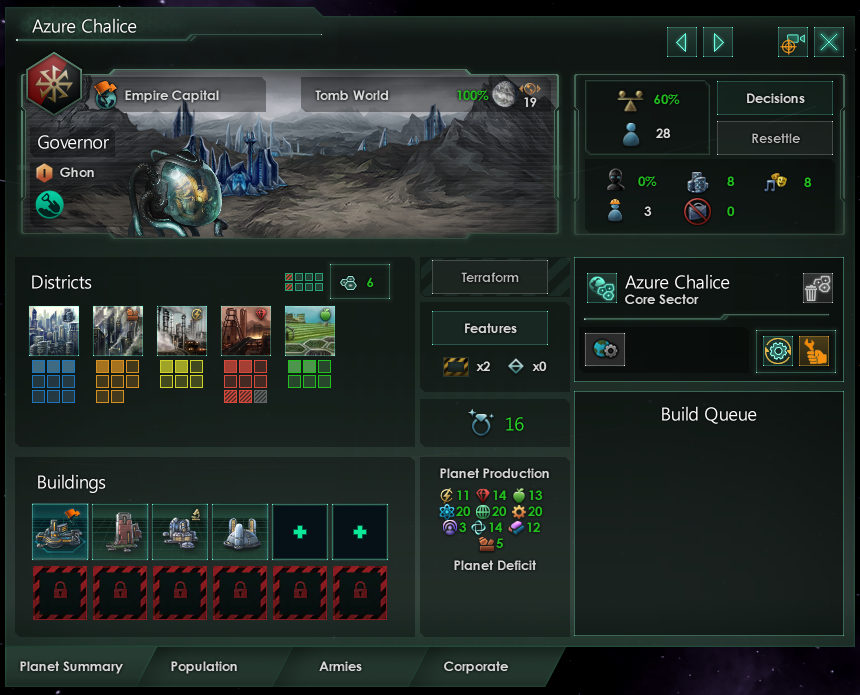 Azure Chalice is… er, was... a lovely place.
 Work, work, work.
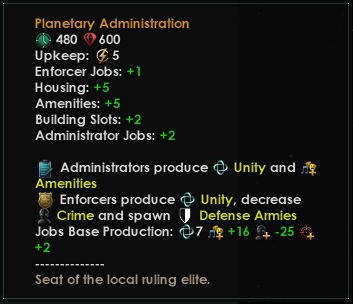 Build up that infrastructure.
 Insider Trading. Institutionalized corruption exploited by the upper classes, or just greasing the wheels of trade?