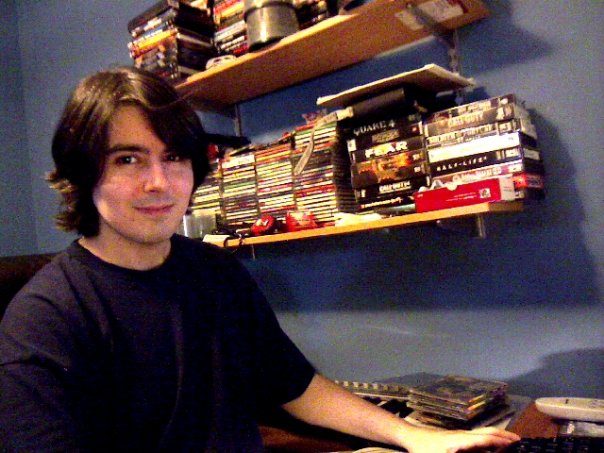
Chon Kemp
[h3]
Tell us a bit about yourself and your role at Crowbar Collective.[/h3]
My name's Chon, I'm 28 years old and I'm from London. I’m the Lead Level Designer at Crowbar Collective. I mostly make sure all the Level Designer’s (LD’s) cages are stocked with enough food and water to keep them alive and mapping!
Jokes aside, my role at Black Mesa is really split into two prongs here: the Level Designer aspect and the Lead aspect. My attention has been split roughly 50/50 between the two areas across my time in the role.
The first prong of my role is the Level Design side of things. All the LDs have contributed to our game in two overarching capacities. Firstly, each LD has their own set of maps that they realized the majority of the work on, making those maps their “babies” in a sense. My “babies” so-to-speak are Surface Tension maps G, H and I, Xen B1 (the Descent-inspired tree), the final map of Gonarch’s Lair, map A1 (Gargathon) and all 3 B maps in Interloper. Secondly, every LD has worked on every map in some meaningful way or another; be it design reworks, environment art and polish, scripting, bug fixes, feedback, etc. There wasn’t a map in all of Xen that I haven’t had some influence in or done some work on, and this is true for every LD on the project. I also played a very heavy hand in all the rebalancing and overhauls we did for the 1.0 release of Earthbound. Because of all these things together, us LDs are basically the “everymen” of the team.

The second prong of my role is the Lead side of things. In this capacity, my role is about defining specific tasks and milestones for the LDs/maps, and also making sure that every LD has what they need to get their current set of tasks done. Game development is a highly collaborative process, and Level Design is probably the most collaborative field within it. This is because we bring together everything made by all the other talented and amazing departments, while simultaneously designing the maps’ core gameplay and layouts. Thus, a lot of the time I wind up coordinating with the other department Leads (art, sound, animation, etc) or individuals within those departments, to make sure things get done properly based around what’s currently needed; simultaneously making sure that anything we do add serves our gameplay and design purposes.
Feedback and direction plays a huge role in this. Literally anyone can give feedback, but giving good, relevant, actionable feedback in a concise and easy to understand way is a significant obstacle, particularly across an online team. A major part of my role is ensuring that I give LDs good, clear feedback on their work that continues to advance the game and get it closer to being finished. I also wind up giving other departments lots of feedback too, as we work together so much. As part of that same process, it’s also my job to decide what feedback we choose to take from the community. You guys are absolutely chock full of brilliant suggestions and are constantly finding creative (or depressingly simple!) ways to completely break our game, and I serve as the LD’s way of sifting through it.

But that’s not to imply that LDs have no say in the matter! One of my great prides as the Lead LD on Black Mesa is that I think we’ve struck a perfect balance between direction/management and autonomy/freedom. Our LDs are free to alter the maps in any way that they see fit outside of the Lead’s feedback/directives as well, and we are always open to new and interesting ideas from anyone. But at the same time, I feel that I am able to provide a solid sense of direction and purpose to LDs, which helps keep the ball rolling. I’m really proud of it!

[h3]
How did you get involved with Black Mesa (If you joined later on)?[/h3]
I started out among the modding community for Black Mesa all the way back in 2012, when Black Mesa itself was a mod. I ended up making 2 mods for it called Surface Tension Uncut and On a Rail Uncut, which aimed to restore map sections that the Black Mesa Team had cut out of their interpretations of those respective chapters.
At the time, I was an absolute mega-fan of Black Mesa. I must have played it all the way through AT LEAST 10 times or more, and evangelized it to ALL my friends! This stemmed from me being a huge fan of Half-Life in general and also of the Source modding community in general. My only previous experience in Level Design had been making crappy Counter-Strike maps to play with my friends, as well as some maps for another Source mod called The Hidden. Being such a huge fan of Black Mesa and having played it so much with the original for comparison, I had come to appreciate the brilliance of its Level Design and was fascinated by how they had re-interpreted this very basic old world!
I remember the idea of Surface Tension Uncut came to me one day when playing through Surface Tension in Half-Life. I got to a section that wasn’t in Black Mesa’s interpretation. It was an extremely blank and open section with no detail or real thought put into it, and it had a bounce pad going to the upper floor of this giant concrete structure. And I suddenly thought “hey, this bit would look really cool in Black Mesa as a destroyed car park”. As I continued to play through, I realized that none of these Surface Tension maps had made the cut and that their humans vs aliens scripted combat was something that Black Mesa had sorely been missing. I just couldn’t get the idea of that destroyed car park out of my head, so I just...fired up Hammer and started trying to make it.

I managed to put together the car park and some of its surrounding areas. I’ve always been very reserved (shocking for a game developer, I’m sure!), but at that moment I felt proud enough of myself to want to share what I’d done with others. So I just whacked together a thread on the Black Mesa Forums showcasing a couple of crappy Hammer screenshots of it, saying that it was part of my idea to bring back cut parts. The response was amazing and supportive! The people who replied had loads of interesting things to say, and I started to engage with the conversation, and I found myself getting totally sucked into it!
The rest is history! The community was vastly supportive and offered me so much fantastic feedback and conversation throughout development. I will always be appreciative of everything they did for me. That’s something which has continued to this day, as you guys have continued to support our entire team through thick and thin.
When I finished On a Rail Uncut towards the middle of 2013, I was approached by the Black Mesa team and asked to hop on board to help develop some maps for an upcoming multiplayer component. How could I ever have turned that down?! For a fanboy such as myself, there was no greater honor, and I remember feeling at the time as if they must have overlooked hundreds of far more talented Level Designers in favor of me, something which humbled me and made me strive to do the best I possibly could. After I joined the team, I was told that Black Mesa was actually now going to be sold as a retail product and that the team had some big plans in store. It was all just...so surreal and incredible. I don’t know where I got my immense luck from, but I’m thankful for it all!

I became the Lead Level Designer towards the end of 2018, in the thick of our insanely challenging Xen development. I helped see Xen through to the end, through what was a very tough time for the team. It remains (and likely always will) the single proudest achievement of my entire life. It’s not perfect, but it’s ours. And it’s wonderful.
[h3]
Did you go to school for your respective parts of the project?[/h3]
I learned how to do Level Design by simply opening Hammer one day at the age of 15 and trying to make a map of my house for Counter-Strike: Source (which I was borderline addicted to at the time). As I hit obstacles that I couldn’t figure out myself, I consulted internet tutorials for my specific problems, often in the form of random YouTube videos or forum threads on Source modding forums. I thoroughly enjoyed the process of making the map, so I just kept trying to make better and better maps, and that was how I got into Level Design for real eventually, modding for Black Mesa.
Game design (like most forms of art) has so many different ways that you can approach it from a learning perspective. It really does come down entirely to who you are as a person and how best you learn. For me, “learning by doing” was the most effective approach, and is one I would wholeheartedly recommend to anyone who is capable of learning in this manner. I loved being able to take things at my own pace, not having to listen to long-winded explanations of basic things that I was able to puzzle out just by mucking around in the editor. I made my own mistakes and took my own lessons from them, forcing myself to stay honest along the way. Sometimes they might have been the wrong lessons, but that’s how life works sometimes!
There were some downsides to this approach, however. In the past, I mostly mapped by “feel” and by the seat of my pants, and I think it showed in a lot of my early work. Across my time in development, I learned to think a lot more like a proper designer: puzzling and planning things out better and with the bigger gameplay picture in mind. Being able to hone in better on the player direction and encounter design, knowing what works and doesn’t work. I think if I’d gone to a school to learn about the process of Level Design, I might have been able to get a head start on learning some of these basic principles a lot sooner. There’s an absolute ton of merit to learning Game Design in a school too, but that wasn’t the way that worked best for me, and I’m glad I took the route I did!
[h3]
What software did you use for your work?[/h3]
I almost exclusively use Hammer, which is typical for the Source engine, as it’s the only Level Design tool. As such, it is also pretty much the final vanguard of the old-school Level Design tools. It’s a vastly different workflow and toolset to what any modern game uses, such as those on the Unreal Engine or Unity. Hammer is heavily designer-driven compared to more modern workflows, which I would say are often more artist-driven now.

In an attempt to bridge the gap between the Absolutely Ancient Software™ and modern tools, most of the LDs (myself included) dabbled in a bit of 3DS Max and Wallworm. Wallworm is an amazing tool developed by our resident superstar Shawn Olson that allows 3DS Max to read and write to Hammer’s VMF format, among a million other amazing things. This allows us to use 3DS Max for Level Design and Environment Art, giving us the benefits of many different kinds of modern workflow despite our ancient engine.
Truth be told, I didn’t use Wallworm anything like as much as I should have. I mostly used it to import and subdivide displacements (the natural-looking geometry from which outdoor environments are built-in Source). It would take 18+ hours to run the subdivision process for an entire map in Hammer, but ~30 seconds in 3DS Max! The subdivision process was something we often had to re-run any time we made some kind of meaningful layout change, so this saved us vast amounts of time across the whole of development. I’m not exaggerating when I say we would not have finished Xen without this tool. Our artists made far, far greater use of it than the LDs did, too!

As a Lead, I also made pretty extensive use of Google Docs and Paint 3D to provide feedback and art/design direction to the Level Designers and other departments too. My drawing skills are absolutely horrendous, but luckily, I’ve always been able to make do with very ugly scribbles over screenshots, coupled with a lot of text. As this Q+A has probably already shown, I’m no stranger to writing a lot!
[h3]
What do you enjoy the most about Black Mesa?[/h3]
Please allow me to gush for a minute here. I think Black Mesa is the most fascinating and interesting remake of any video game ever, period. I felt this before I had even joined the team myself!
There aren’t many remakes that have the balls to drastically change things from the original and put their own spin on it. That’s because, typically, that’s not really what remakes are meant to do, and not why fans would play them. And there’s nothing wrong with that at all, either! But, Black Mesa is so unique because it is a fan reinterpretation of an absolutely beloved classic; one of the greatest shooters of all time, one which changed the genre forever. It would have been so much easier to play it safe(r) and just stick with a graphical remastering. Instead, it became its own beast, with its own identity and strengths and weaknesses, but still the distinct flavor of the original.
Sometimes we go quite close to the original. Sometimes we go completely wild and do something totally different (case in point: Xen). Sometimes it works, and perhaps sometimes it doesn’t. Everyone’s going to have a different opinion on that particular aspect! And that’s what’s so fun about it. I think anyone who plays our game has a list of things they preferred in our game over the original, and a list of things they preferred from the original. That facilitates some really interesting discussion. We don’t really aim to replace the original or “one-up” it. I view us as a companion piece to the original. They elevate each other. And that’s really awesome, in my view.

And the best part is, regardless of what you liked or didn’t like, there’s really no denying that this game is the truly ultimate fan labor of love. The team worked for free on this for more than 8 years before the prospect of money even became a discussion. It was never even on the cards until Valve approached us. Then, when the product actually did go retail, we poured our hearts and souls into making Xen this epic, huge experience; attempting to build an awesome, original piece of new Half-Life content. A real swan song to the Half-Life universe. At the time, we were not aware that Valve was going to make Half-Life: Alyx. We were trying to use Xen to honor that universe in our own special way.
On top of that, we even went back and revisited numerous parts of Earthbound, making continuous tweaks and bugfixes, ending up with a version of the game which is vastly improved over the mod version in so many ways that I think fans weren’t really expecting or even asking for. In an alternate world, we probably could have just made our own version of Xen relatively close to the original, released the mod version as-is coupled with Xen as the retail product on Steam, and still have been fine overall. But we didn’t do that. We chose the harder path. We worked on the game for 7 years after we had gone Early Access. And it was because we loved our game and we loved the Half-Life universe and wanted to do something special with this amazing opportunity we were given.
All games have had blood, sweat and tears poured into them by a developer team who loves what they’re doing. That isn’t something unique to Black Mesa, really. But I do think that Black Mesa is a particularly special and beautiful example of that!
[h3]
How did you resist getting burnt out over such a long development process for Xen?[/h3]
When a project has gone on this long and been this challenging, burnout is really just an inevitability. We have all been through it, a lot. That is doubly true for those of us on the team who work full-time jobs in addition to Black Mesa, such as myself. Throughout the majority of Xen development, my daily routine on the team was to work 9 - 5 at my full-time job, and then come home and work on Black Mesa until ~1am, then repeat across the week, often with one day on the weekend thrown in too. I worked like this for literally years. It was even tougher during the crunch periods (leading up to releases), where I’d normally work the whole weekend too. It was really tough!
I think there’s one key factor that kept everyone on the team going despite these kinds of schedules. We have always loved what we are doing and believed in our game and believed in us as a team. I think anyone on the team will tell you the same thing. We are all driven by passion. That’s why Black Mesa even existed in the first place. Passion, and determination. It’s helped pull us out of some of those dark tunnels when the going has gotten tough. Which it has done on many occasions!
When even that passion wasn’t enough, my solution was usually to just take some time off until I felt I had the creative juices flowing well enough again to come back to it. This typically would happen when someone on the team shared something cool or asked for input, or a new task emerged that needed some help, which was never that far around the corner. Working on some of those new things would help ease me back into the flow again, and would help me overcome whatever I might have been stuck on.
The other massive thing which has always helped was the incredible support and response from the community. There have always been naysayers and mean/negative voices out there (and I have read them more than most on the team!), but they are mostly drowned out by those who have loved what we’ve done, and believed in us and our game. We can’t thank them enough.
[h3]
How often do you watch youtube videos/Twitch streams of Black Mesa?[/h3]
All the time! Sometimes it hurts. Sometimes it’s a beautiful experience. But it’s always necessary and important for us to learn as designers!
Often a player will get hopelessly stuck on a section of the game, and then I’ll watch them go down the wrong path, press use repeatedly on everything in sight except the thing they can actually use, completely miss the answer that’s right in front of them, and just entirely not understand something that we poured loads and loads of effort into carefully designing and refining. Without meaning to, sometimes I’ll even feel annoyed about it as I watch! But I always end up reminding myself: we made this game for the players. Half-Life style design is unique in that almost every single element of the gameplay is exclusively communicated through the environment. If a player struggles with something, that’s almost always on us. Room to improve!
On the flip side, there are also many times where I’m watching streams or videos of our game and a moment or section of the map just lands perfectly. The stars will line up, and a scene will unfold exactly as we designed it, to the letter. Or the player will give off a wonderful reaction of excitement or enjoyment, or just stop to marvel at the visuals, or will comment on something we spent ages working on; even really small obscure details. It’s seeing those moments play out for others and provide them with enjoyment/a good experience that makes me feel proud to be a game designer, and proud to have worked on this project. Ultimately, we just want others to have a fun and memorable experience!

It’s that mixed bag that makes this art! It is really valuable to have the ability to see which things worked and didn’t work for players, across such a wide spectrum of people. And this is only a relatively recent tool that has become available to us, I would say even within the last 10 years. So it’s a tool that we appreciate and use across the whole team. On the team, we are often sharing playthroughs and streams of our game, and discussing them among ourselves. Why someone got stuck here, what didn’t work here and why, and what we can do about it in a future update. This was particularly valuable for us during the early betas throughout Xen’s development. It helped make us better and helped us make a better game.
[h3]
If you had unlimited time, money, and help, what game would you make?[/h3]
You know those escape rooms where you have to solve puzzles to get out of a room you’re trapped in, before the timer expires? I’d make one of those, but with the entire Black Mesa Research Facility. I’d pay thousands of skilled actors to portray the entire resonance cascade, and we’d build an entire Black Mesa experience in real life. The facility is just so bloody cool and Gordon’s journey across it is honestly my favorite of any video game ever. I’d love to just walk the length of it. We probably couldn’t do Xen, though, unfortunately...
Funny story that’s sort of tangentially related to this. Back when I first started working on Black Mesa, I needed to set up a business bank account so I could keep the money separate from my other income sources. I, therefore, had to do an interview with a business representative at the bank. She was really nice to me, but she seemed to know very little about computers in general and even less about video games. I really struggled to explain to her what Level Design was, as I couldn’t even get her to understand what 3D assets were! She interpreted my explanation (which I’m sure probably wasn’t very good!) to mean that I actually built locations from video games out into the real world. I showed her a picture of dm_gasworks, and she asked me how long it took to build that in real life! I’m sure it was no fault of hers, but that misinterpretation always stuck with me as being really funny! And thus, that was what inspired my stupid idea above.

[h3]
What would you be doing if you weren’t part of the Crowbar Collective team?[/h3]
Crying myself to sleep every night over how hollow and meaningless my life really is.
Actually, I guess it would be the same!