Towns, Nations, and United Nations: Multiple Governments in Eco
Hey all, for this week I want to go into some big ideas we have for Eco 9 with levels of government.
We’re exploring ideas about how to bring multiple levels of government to Eco, and how their growing and combining would work within the game. Along with that comes a new approach to property. Check it out and let us know your feedback, this is an initial concept so lots more to be designed still.
Eco will be changed to have the following new features:
New objects will be created for different levels of government: a ‘Town Hall’ for towns, a ‘National Constitution’ for nations (can replace the existing Constitution) and a ‘Global Charter’ for global governance. These objects will be known as Government Sources, each with a different tier of government associated with it. Additionally, a new ‘Home Claim’ marker will be used for each individual, which marks their residency, and is essentially a level 0 government containing just the player.
When placed and meeting building requirements, a Government Source will create a radius of influence around it, competing with all the other governments at the same tier.
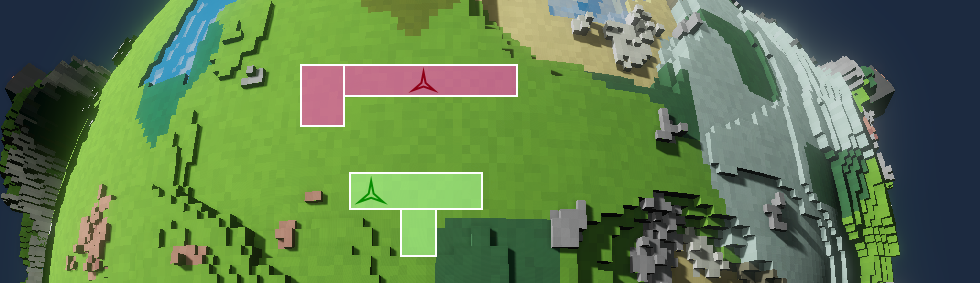
Example: a couple individual plots in the world. The triangles mark where they have placed their home markers, and all their property must be contiguous with that marker.
The red player then builds a Town Hall at the starred location. This extends a circle of influence (yellow circle), which envelops part of the green player’s territory. The size of this circle depends on the housing value of the Town Hall. It encircles both the home markers of Red and Green, so they can both become citizens of Yellow Town.
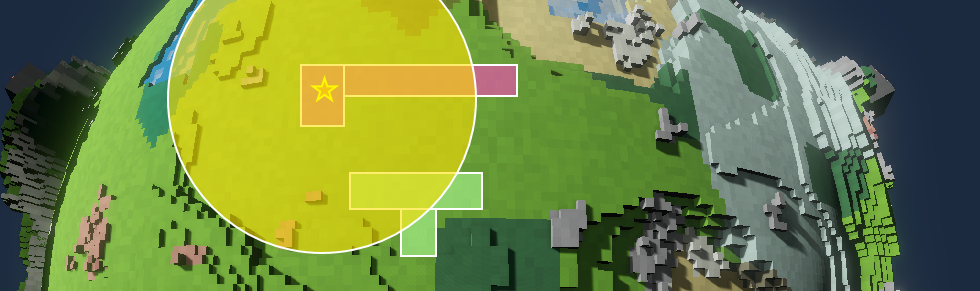
The green player now has the option to become part of the shared town; the option appears on their home marker. If they choose to become part of the town, they will become members of the automatically generated ‘Yellow Town Residents’ demographic, which can be configured to give specific benefits. Many other benefits to being in the same towns will be added over time (knowledge sharing, boosts to skill growth, etc).
If they choose NOT to become residents, they will stay as an individual. The red player can force them to become a member of Yellow Town by paying a large cost (say, 500 wood), having a much more powerful town hall (housing value is a multiple of the housing value of green), having a larger town population (say 2 or 3 people), and waiting for a delay (a day or two).
In this case, we’ll say green decided to join the town voluntarily.

Now that the town is formed and has a population of 2, additional land can be claimed, and Red and Green have claimed more property. Each resident will have additional claims granted to them on their home marker, benefits from Yellow Town. As residents, they can claim property anywhere within the influence of the town, even non-contiguous blocks.
The number of land claims they get depends on the population and power of the town. As the value of the property in the town increasing (measured by housing value of all property) and as the population increases, more claim markers are released. This provides an incentive to players to increase the power and population of their town, with specific ‘immigration tools’ being introduced to help players find new residents.
Government is unlocked with the creation of a town, and the new government objects can now be placed (Bill of Rights, Election Office, etc), which will determine the town government, allowing laws that affect any player within the yellow radius (whether or not they are ‘residents’ of this town). The laws created will override some (but not all) of the individual rights of the town population (property rights will be meta-protected, so players can’t troll others and steal their property this way).
Later, a neighboring town is created, Blue Town:
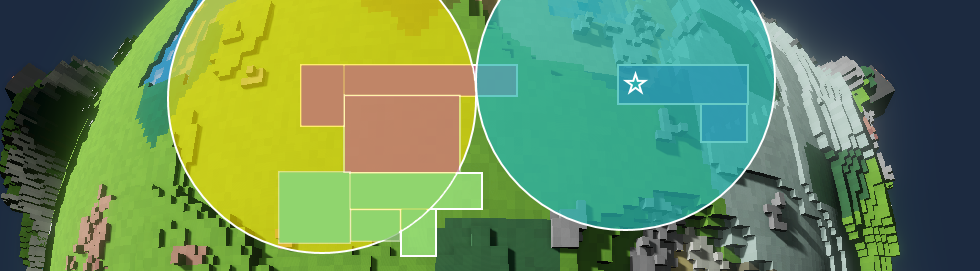
They begin to push on each other’s borders, affecting what area can be claimed by an individual (although already claimed land won’t be lost by this pressure). They can either continue fighting for influence, increasing the value and populations of their town to exert border pressure on each other, or join together into a nation.
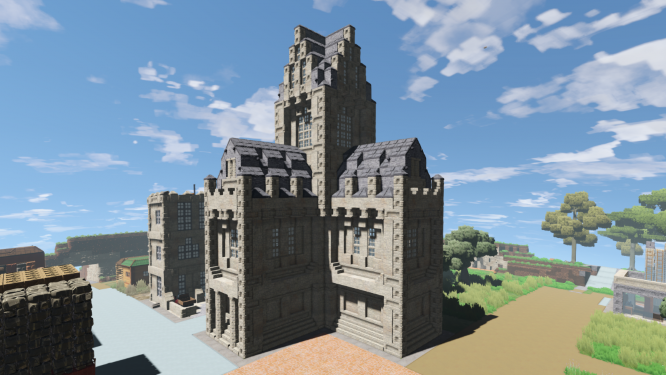
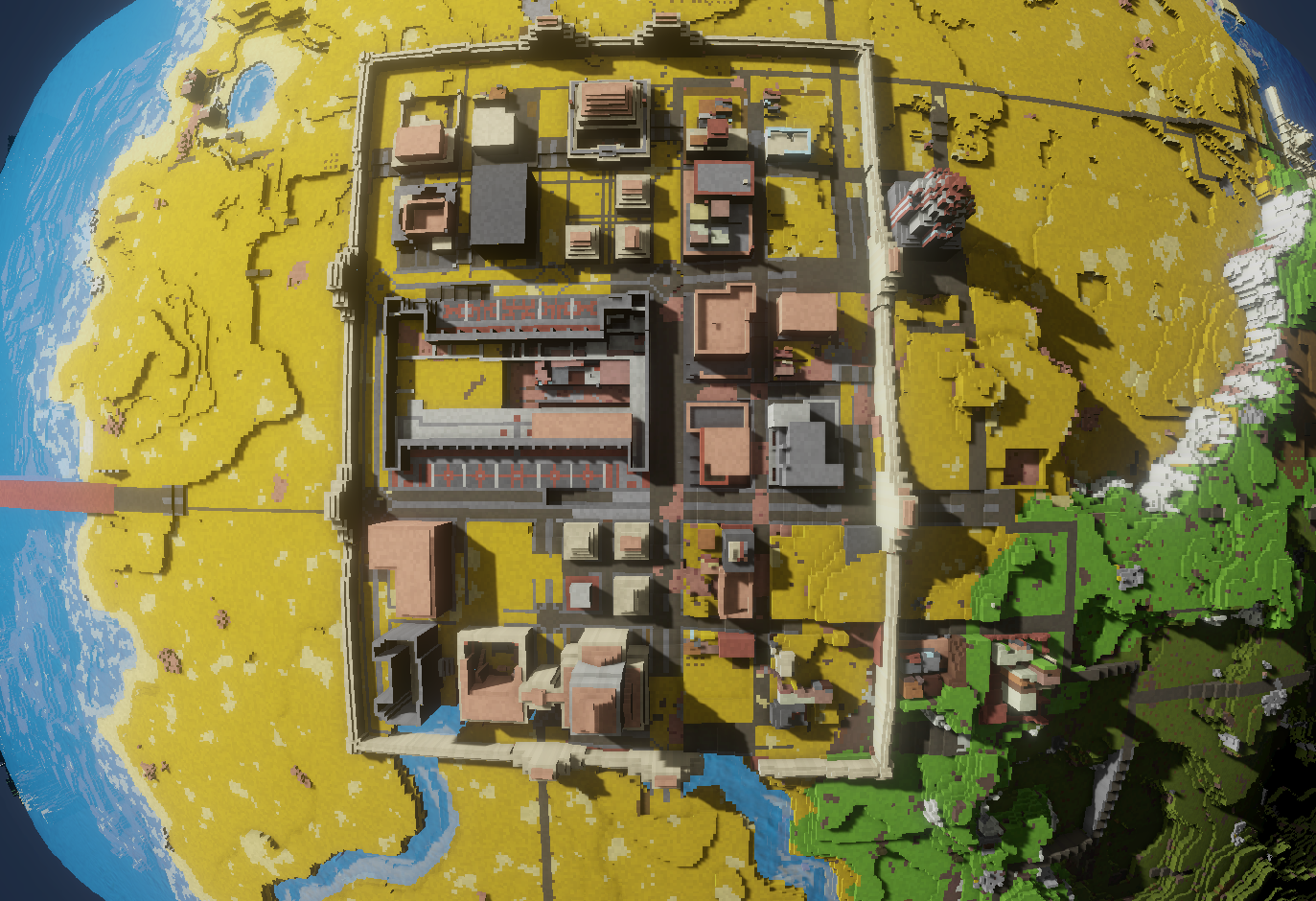
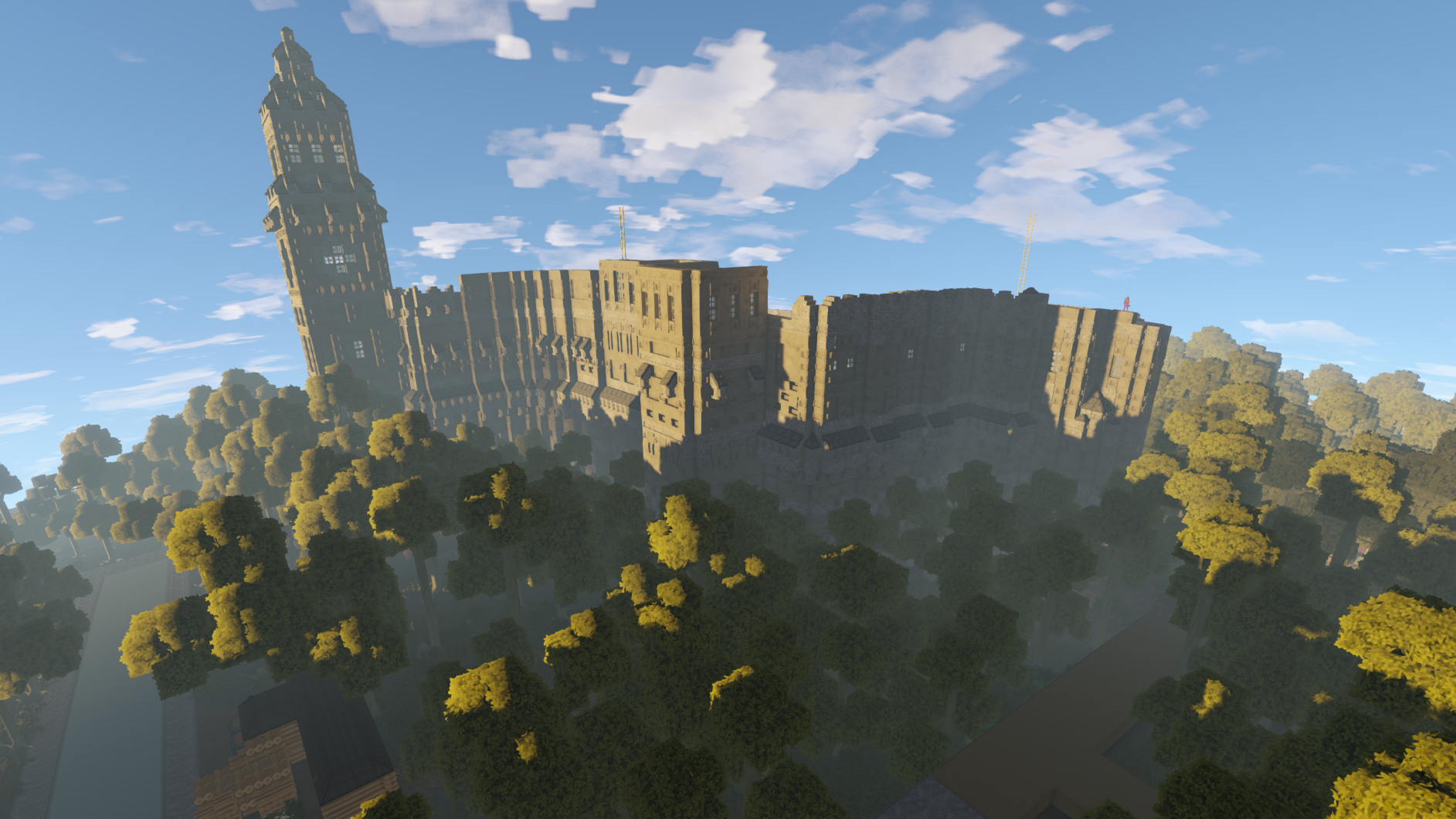
Yellow Town builds a National Constitution in a fabulous palace at the east of their property (which is still considered Yellow Town territory because Red Player is a resident of Yellow Town):
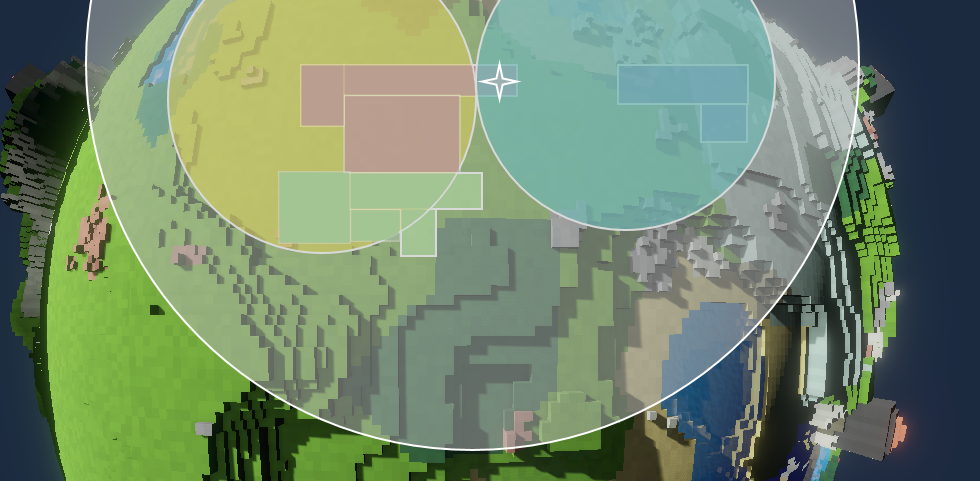
This creates a very large circle of influence, which envelops all of Blue Town. Just like with individuals, the government of Blue Town can decide to join the nation, or resist. If they resist, they can still be absorbed if the nation pays even larger penalties and has even larger influence/population as described above. For our example, blue town decides to become part of Gray Nation. Much rejoicing and celebration takes place. Festivals with fabulous elk tacos are thrown to welcome the two groups. Now all the area in the extra-large gray nation radius can be claimed, and residents of the nation will again gain extra claim papers.
Now laws of Gray Nation can impose restrictions on both towns. Gray Nation can even revoke laws and titles assigned by the town governments, as the nation’s government supersedes the town governments. It can also offer more powers not available to towns, like new kinds of laws (property revocation could be one, more kinds of tax, etc). Going up in tiers in government allows groups to have more powerful controls, and new types of government get unlocked at each level.
This process can repeat at an even higher level with Global Governments. These would envelop multiple nations, and have a large enough possible radius to cover the whole world, imposing laws and taxes worldwide.
The benefits to joining into towns and governments are:
Governments will have their power grow with their populations, so having more residents will allow for more progress and upgrades. For example, a town will need a population of say, 10 people in order to found a nation (configurable). To incentive growing populations, towns can create ‘immigration centers’, which will provide resources and possibly land claims or land deeds to new joining players, communicated in the server browser, and available for selection on the spawn page (a new feature will be added to let players choose if they want to spawn in an available immigration center or in an unclaimed land somewhere). Note that governments won’t necessarily require greater populations to gain more powers, they can also be gained by more buildings and house value.
This feature would be a big addition to the game, and turn what was previously automatic (everyone is in the same society) into something that is built. I believe this will go a long ways towards shifting the game to a more collaborative one, where players are building trust and community through expanded growth, with interesting political maneuverings required at each stage of expansion. New debates surrounding immigration that mirror the real world will be added to the game, the tradeoffs between the additional resources required to support new residents and the benefits they provide. The conflict it introduces will add more complex situations to navigate, with complex solutions required that go beyond yielding a winner and loser. All within the high-stakes of a vulnerable ecosystem facing an existential threat from a meteor will create a very unique experience.
We’re exploring ideas about how to bring multiple levels of government to Eco, and how their growing and combining would work within the game. Along with that comes a new approach to property. Check it out and let us know your feedback, this is an initial concept so lots more to be designed still.
Eco will be changed to have the following new features:
- Multiple governments will be allowed in tiers: individuals, towns, nations, global.
- Governments start bottom-up, with growing towns merging into nations, and nations merging into a global government.
- Property is controlled by the governments (no longer affected by reading skillscrolls).
- Multiple governments will compete for citizens, offering incentives when new players spawn into their region, or when other players move to them.
- Players are ‘wanted’ in the world. Having more citizens in your town / nation / global community should be a big benefit. When a player enters the world other players should respond ‘thank goodness you’re here’. Mutual benefits to sharing the same town / nation / globe should abound, such that players will work to overcome their differences to better achieve their goals better and collaborate more effectively.
- The game arc will feature growing and merging governments. It will begin as a collection of individuals, with big events as they form towns together, then merge towns into nations, then merge nations into a global government. The same way that it’s currently an interesting event in the game when players move to a common currency, merging governments and building hierarchies of governments should be even more interesting.
- Conflict and resolution of ideas should be the ‘PvP’ of the game. In this way, it should be much better for both parties to resolve their differences and merge together, but if they can’t there will still be a prolonged/difficult/costly process to force another individual or group to your whim, such that both parties would much prefer a resolution. In this sense, it’s not the typical winner/loser pvp of video games; instead win/win and lose/lose situations are possible
Influence Example
New objects will be created for different levels of government: a ‘Town Hall’ for towns, a ‘National Constitution’ for nations (can replace the existing Constitution) and a ‘Global Charter’ for global governance. These objects will be known as Government Sources, each with a different tier of government associated with it. Additionally, a new ‘Home Claim’ marker will be used for each individual, which marks their residency, and is essentially a level 0 government containing just the player.
When placed and meeting building requirements, a Government Source will create a radius of influence around it, competing with all the other governments at the same tier.
Example: a couple individual plots in the world. The triangles mark where they have placed their home markers, and all their property must be contiguous with that marker.
The red player then builds a Town Hall at the starred location. This extends a circle of influence (yellow circle), which envelops part of the green player’s territory. The size of this circle depends on the housing value of the Town Hall. It encircles both the home markers of Red and Green, so they can both become citizens of Yellow Town.
The green player now has the option to become part of the shared town; the option appears on their home marker. If they choose to become part of the town, they will become members of the automatically generated ‘Yellow Town Residents’ demographic, which can be configured to give specific benefits. Many other benefits to being in the same towns will be added over time (knowledge sharing, boosts to skill growth, etc).
If they choose NOT to become residents, they will stay as an individual. The red player can force them to become a member of Yellow Town by paying a large cost (say, 500 wood), having a much more powerful town hall (housing value is a multiple of the housing value of green), having a larger town population (say 2 or 3 people), and waiting for a delay (a day or two).
In this case, we’ll say green decided to join the town voluntarily.
Now that the town is formed and has a population of 2, additional land can be claimed, and Red and Green have claimed more property. Each resident will have additional claims granted to them on their home marker, benefits from Yellow Town. As residents, they can claim property anywhere within the influence of the town, even non-contiguous blocks.
The number of land claims they get depends on the population and power of the town. As the value of the property in the town increasing (measured by housing value of all property) and as the population increases, more claim markers are released. This provides an incentive to players to increase the power and population of their town, with specific ‘immigration tools’ being introduced to help players find new residents.
Government is unlocked with the creation of a town, and the new government objects can now be placed (Bill of Rights, Election Office, etc), which will determine the town government, allowing laws that affect any player within the yellow radius (whether or not they are ‘residents’ of this town). The laws created will override some (but not all) of the individual rights of the town population (property rights will be meta-protected, so players can’t troll others and steal their property this way).
Later, a neighboring town is created, Blue Town:
They begin to push on each other’s borders, affecting what area can be claimed by an individual (although already claimed land won’t be lost by this pressure). They can either continue fighting for influence, increasing the value and populations of their town to exert border pressure on each other, or join together into a nation.
Yellow Town builds a National Constitution in a fabulous palace at the east of their property (which is still considered Yellow Town territory because Red Player is a resident of Yellow Town):
This creates a very large circle of influence, which envelops all of Blue Town. Just like with individuals, the government of Blue Town can decide to join the nation, or resist. If they resist, they can still be absorbed if the nation pays even larger penalties and has even larger influence/population as described above. For our example, blue town decides to become part of Gray Nation. Much rejoicing and celebration takes place. Festivals with fabulous elk tacos are thrown to welcome the two groups. Now all the area in the extra-large gray nation radius can be claimed, and residents of the nation will again gain extra claim papers.
Now laws of Gray Nation can impose restrictions on both towns. Gray Nation can even revoke laws and titles assigned by the town governments, as the nation’s government supersedes the town governments. It can also offer more powers not available to towns, like new kinds of laws (property revocation could be one, more kinds of tax, etc). Going up in tiers in government allows groups to have more powerful controls, and new types of government get unlocked at each level.
This process can repeat at an even higher level with Global Governments. These would envelop multiple nations, and have a large enough possible radius to cover the whole world, imposing laws and taxes worldwide.
Benefits
The benefits to joining into towns and governments are:
- More claimable property per player for larger governments.
- More governmental powers are unlocked for upgraded governments.
- Wider influence of laws, more ability to control actions of the population.
- Shared benefits to residents – boosts to skill points for town buildings like libraries.
- Increased levels of trust between fellow citizens, promoting more shared work projects, which will be another area of development.
Governments will have their power grow with their populations, so having more residents will allow for more progress and upgrades. For example, a town will need a population of say, 10 people in order to found a nation (configurable). To incentive growing populations, towns can create ‘immigration centers’, which will provide resources and possibly land claims or land deeds to new joining players, communicated in the server browser, and available for selection on the spawn page (a new feature will be added to let players choose if they want to spawn in an available immigration center or in an unclaimed land somewhere). Note that governments won’t necessarily require greater populations to gain more powers, they can also be gained by more buildings and house value.
Summary
This feature would be a big addition to the game, and turn what was previously automatic (everyone is in the same society) into something that is built. I believe this will go a long ways towards shifting the game to a more collaborative one, where players are building trust and community through expanded growth, with interesting political maneuverings required at each stage of expansion. New debates surrounding immigration that mirror the real world will be added to the game, the tradeoffs between the additional resources required to support new residents and the benefits they provide. The conflict it introduces will add more complex situations to navigate, with complex solutions required that go beyond yielding a winner and loser. All within the high-stakes of a vulnerable ecosystem facing an existential threat from a meteor will create a very unique experience.