1. Occupy White Walls
  2. News

Occupy White Walls News

Paint me like one of your French avatars contests

Check out the Outdoor Contest winners and entries

Hello, we have a slight twist for this next contest, we are running TWO contests at the same time and for longer!

Challenge 1: Mosaics
Challenge 2: Screenshots, Avatars, and Monoliths

[h2]What[/h2]
Challenge 1: We all like mosaics right? But some like them more than others, and this contest is for those mosaic lovers.
Create a mosaic that represents your favorite artist or location in your home city.

Challenge 2: OWW is an MMO which means that there are many players across the artiverse doing many different things, whether it is building, making mosaics, dancing, partying with friends, jumping, or even shopping at the vendors in the Plaza, there is bound to be something to catch your eye.
Create an in-game screenshot/poster that shows avatars/players with monoliths (Type "Monolith" in your inventory search) in interesting scenarios across the artiverse..

[h2]When[/h2]
Entries open Now - Jan 24th
Winners will be chosen between Jan 25th - 8th Feb, winners will be announced by Feb 12th

[h2]Rewards[/h2]
5 winners for each challenge (10 in total) will receive;
    Either 5 upload codes or our soundtrack DLC (Art codes can be gifted to anyone even if they don't play the game)
    2 million cubes
    Mosaic contest only reward: Your gallery featured in the new teleport menu (terms apply, the gallery must be accessible)
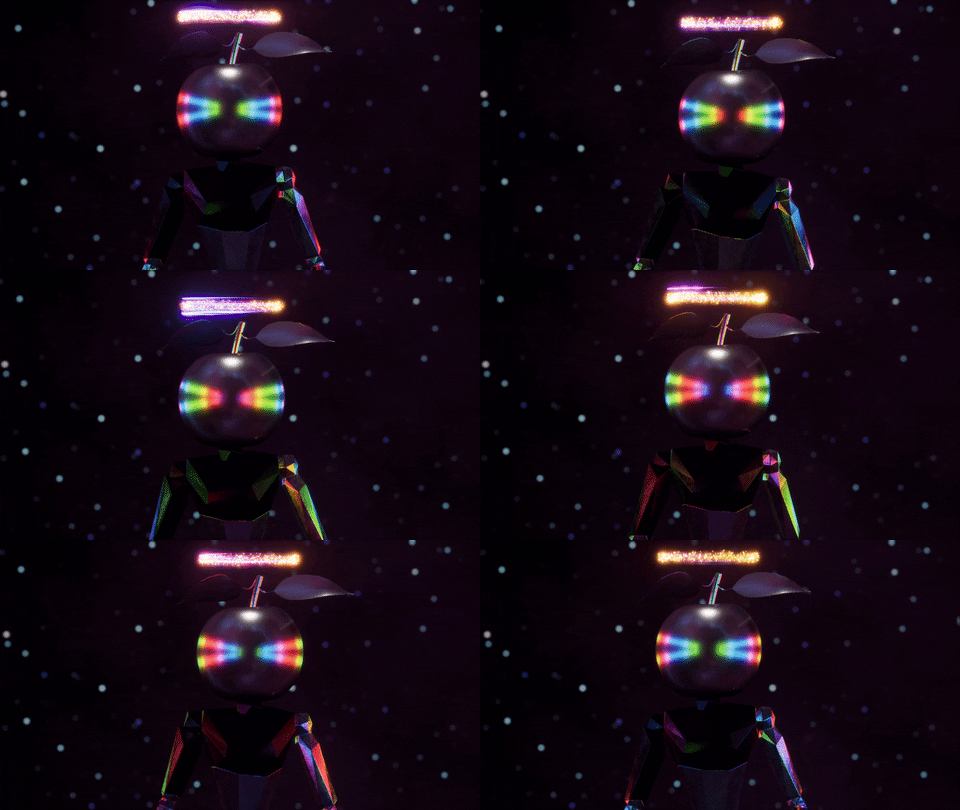
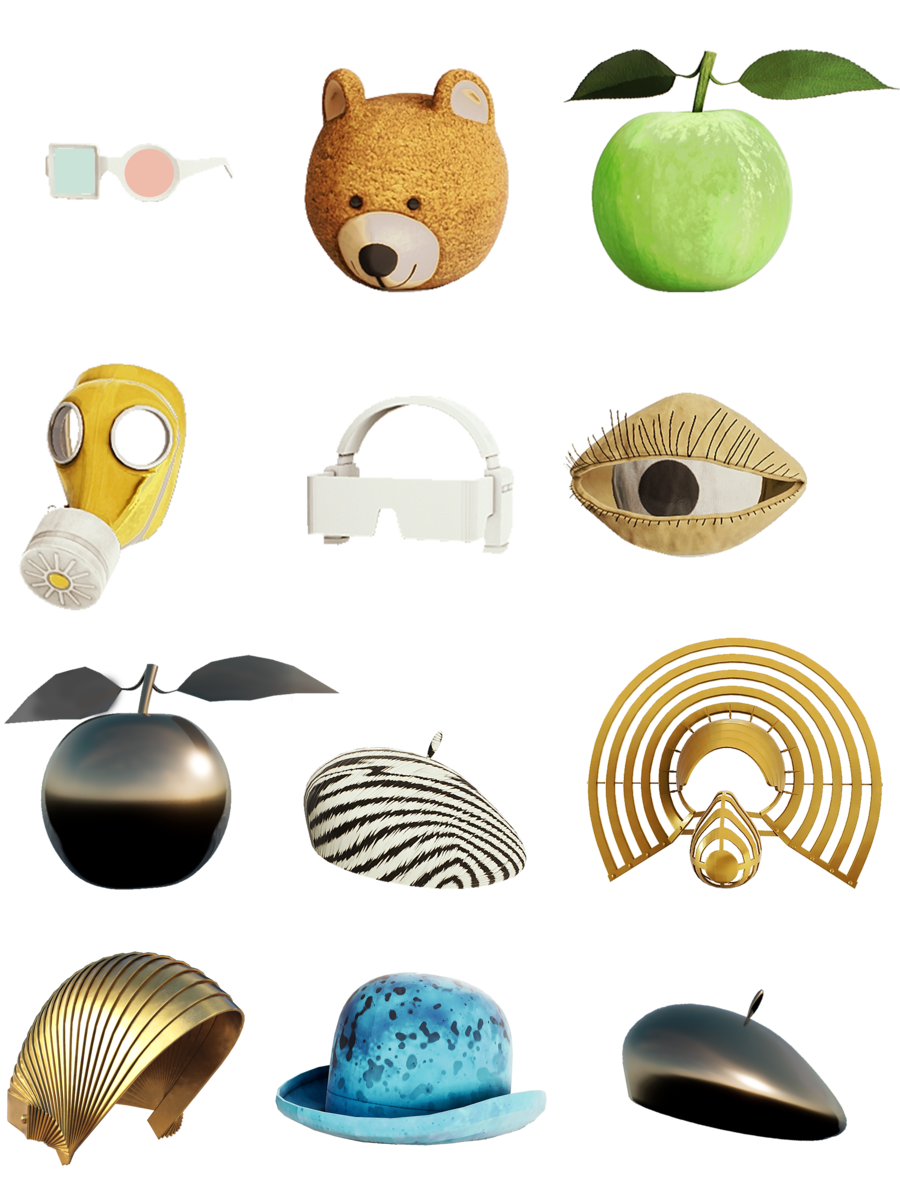
    A choice of one of 12 special masks, with a special halo (can you collect them all?)


[h2]Rules[/h2]
  • All entries must be submitted by midnight EST on Jan 10th
  • Entries must be made entirely in-game (some minor edits outside the game are permissible for the poster entries)
  • You may enter one time in each contest.
  • Art uploads must follow our upload guidelines


[h2]How to enter[/h2]

Submit all entries via the following forms
Challenge 1: Mosaics, enter by clicking here
Challenge 2: Screenshots, enter by clicking here

Minor Asset Update

87 additional new assets for 26 current sets are available in-game now.

  • 40 columns
  • 16 walls
  • 4 windows
  • 9 doors
  • 15 ceilings
  • A plinth
  • and a balustrade


Asset sets
  • Renovation
  • Paneled
  • Eindejaar
  • First Steps
  • Lemon delight
  • English Green
  • Art deco
  • Hortensia
  • Rose Garden
  • Marengo
  • 2055
  • Steampunk
  • Canon and Fugue
  • White
  • Checkmate
  • Crystal
  • Foliage
  • Deepstate
  • The Factory
  • Kraftwerk
  • Painted Brick
  • Kakudan
  • Azur
  • Ratland
  • Rancho
  • Macintosh White

From military to monks, to virtual art galleries


Imagine you’re standing in front of a captive audience at a Taiwanese stationery store. You’re an artist, and you’re there to show off your work - but this isn’t your typical show and tell. You’re Benedict Yu, a multi-disciplinary artist and researcher who explores Eastern philosophy, psychology, and human behavior through the lens of contemporary arts, technology, and artificial intelligence. Now imagine you’re there to introduce Occupy White Walls to a room full of people who might never have played a videogame. Exciting, isn’t it?


I got the chance to chat with Yu about how he wound up exhibiting an OWW gallery featuring his work to physical audiences and the role he sees the game playing in an art world still dominated by capitalist structures.


Yu’s only 24, but he’s already lived a more interesting life than most. Despite growing up in Taiwan, as a dual citizen of Singapore, he served two years of military service in the Singaporean army. While there, he kept an art diary, with pieces that reflected and expressed his homesickness - and then the pain of returning to a home that no longer felt the same, with his experiences overseas laying bear “political problems and social illusions” that were now clear for him to see.

"As Yu puts it on his website, “leaving home is tough, but accepting the reality of those changes is harder.”


Confronting those changes was, in part, what ultimately lead him to Tibet. After securing an art residency at the Lasalle College of the Arts and exhibiting his work in London, Taiwan, and Singapore, Yu’s college sponsored a trip that saw him live and work with Tibetan monks. The result of that trip is a sprawling mandala entitled “Conversations between Heaven and Earth,” reflecting Yu’s belief that our souls can communicate and exchange the energy between us to the heavens and the earth. To the monks, that manifested through song - and through Yu, into art.


But let’s go back to that stationery store in Taiwan and how Yu first started dabbling with Occupy White Walls. His interest was sparked by the global pandemic and the resulting closures of local art galleries. To Yu, the virus was as much a threat as it was an opportunity to explore new artistic horizons - except he didn’t quite have the kit. That’s when the boss of Ipaper, that stationery store, stepped in and lent Yu a PC powerful enough to boot the game. You can see how Yu set about building his gallery for yourself here. For those who can’t make it to Taiwan, it’s well worth visiting in-game, too. Just search for Benedict Yu.

It’s a sprawling place, split into four wings that explore consciousness, intelligence, gender identity, and religion. Yu’s exhibited his in-game gallery at four separate events, each time seeking to explain how Occupy White Walls acts as a platform to explore those ideas. Many, though, are impressed by the platform itself:

“The audiences are quite amazed by the quality of the rendering, and the entire game idea,” Yu told me.

Unsurprisingly, younger people tend to be “more drawn to this imaginary world” - although they do have some reservations. “There are still a lot of restrictions,” Yu points out, “like how the artworks are all in rectangular forms.”


It’s a fair point. No matter how OWW is expanded and improved on; physical galleries will always allow for possibilities you won’t find online. Possibility cuts both ways, though.

Yu envisages a future where “art festivals, museums, and other major presentations” incorporate physical and virtual elements. He sees online exhibits playing a role in international outreach and diplomacy, where participants can embrace “the impossible functions of games and roles playing.”

I see what he’s getting at. Digital worlds are ideal places to foster communities that transcend nations, and OWW is poised to connect people in an artistic sphere that isn’t dominated by the snobbery of a wealthy elite. Despite his success, Yu’s well aware that creating under market conditions is far from an easy or untainted path. “The problems with the art ecosystem lie in the accessibility of these arts and its fundamental capitalist structures,” he said and was keen to elaborate.

“Capitalist structures have, in a way, shaped my rigid structure of approaching art. I am trained and taught to paint on canvas, make sellable artworks, monetize them, and market myself. I do have many exhibitions and a rather successful journey. However, there is more to just selling your artworks all the time: it’s about curiosity, exploration, and constantly challenging the ‘frame’ that I have trapped myself in. This frame is the capitalist world and what society expects to see from me. "

"OWW, in a way, gives me that freedom to explore the possibilities that cannot be achieved in the real physical world.”


There’s a leveling effect, too, in removing what Yu sees as “a certain hierarchy to the art ‘industry.’” While tempered by the way you do first need a decent PC to play, Yu still sees OWW as an accessible alternative to the traditional art world.

“OWW diminishes those boundaries and gives creatives the freedom to share their creations equally. "

"For a creative's journey, you have to go from making art to the galleries, then one day to the museum. However, we can see more non-profit initiatives have formed because they know this system of structures is not inclusive enough. There are places like art residencies that give artists opportunities to research and explore the areas they are interested in or collectives that help artists and art-lovers connect. I believe OWW is in this position as well.”


The fundamental structure of our society may well be bigger than one game (no matter how innovative) can take on, but that’s why Yu talks about OWW in the context of other initiatives.

OWW sits at a unique intersection between, as Yu rattles off, “artists, curators, audiences, participants and gamers.

It’s both a new sphere for artists trying to make a living and a way of introducing people to art and artistic roles they’d never have otherwise encountered.


It’s also a platform that’s allowed a former Singaporean soldier’s art to reach me, sat in my bedroom over in the UK. As I like to think Yu would appreciate, there’s an echo of the interconnectivity he came to value while living with those monks. I saw his art (and you’re reading this article) thanks to a game, a global pandemic, and the generosity of a Taiwanese stationery store manager. Take that, capitalism.

Going global in lockdown - Check out BMAG in game

[h2]It’s Birmingham Museum & Art Gallery (BMAG), but not quite as you know it![/h2]

[previewyoutube][/previewyoutube]

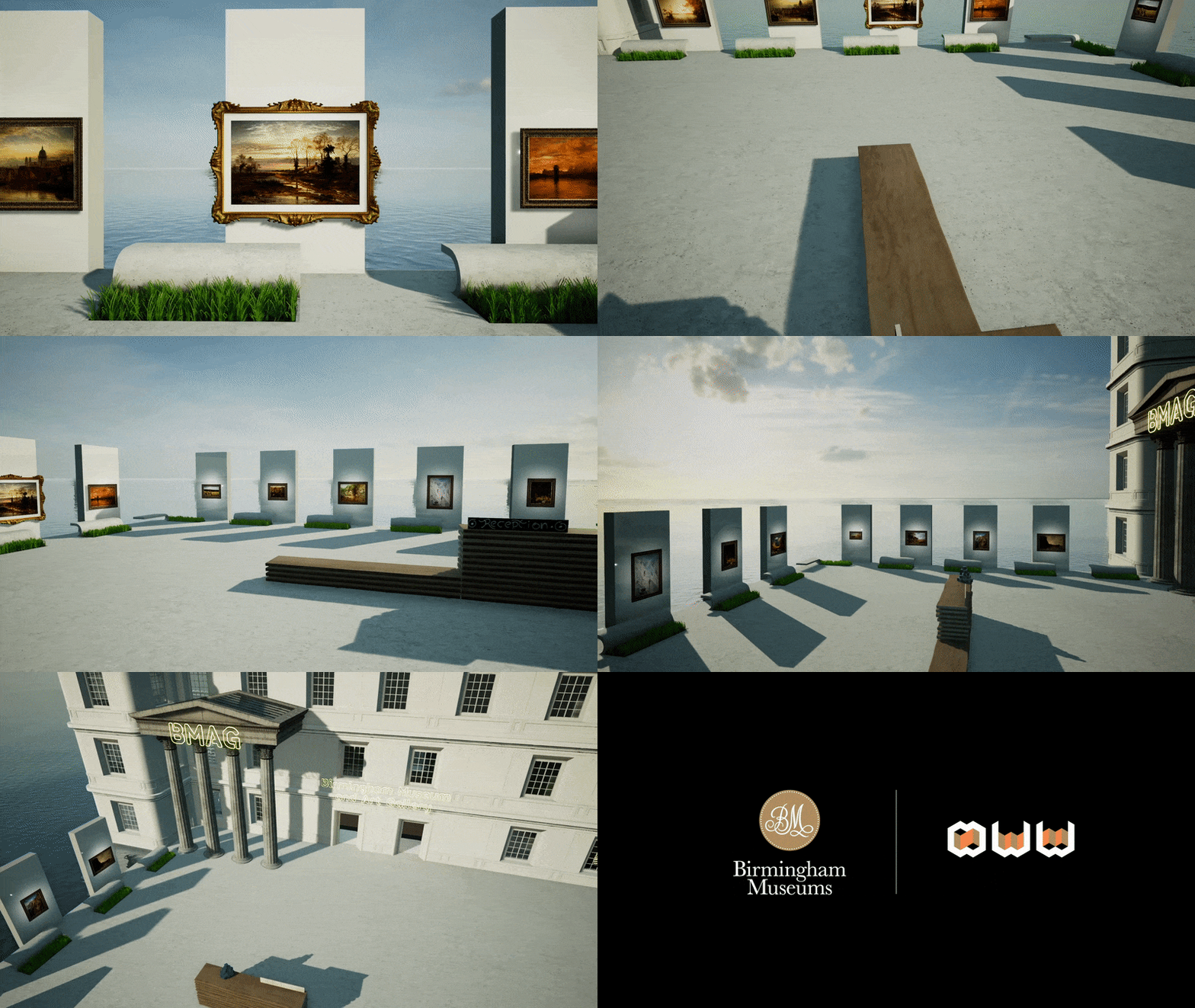
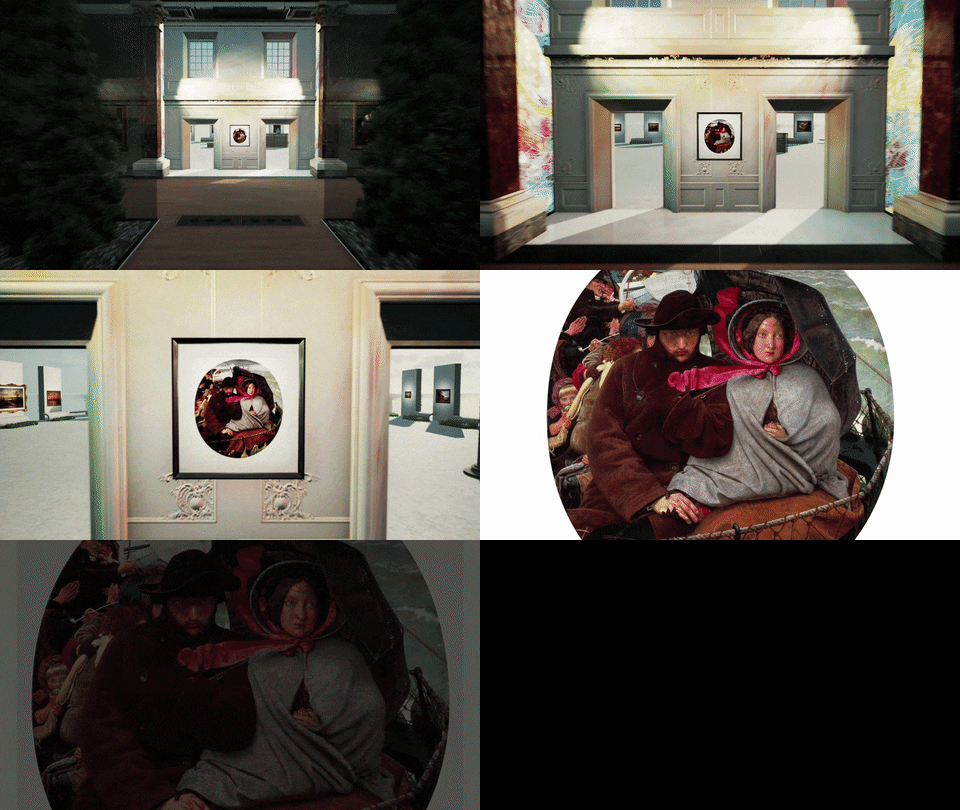
You can now curate your own exhibitions in a virtual BMAG from the comfort of your own home, as Birmingham Museums Trust has embarked on a collaboration with the new online game Occupy White Walls (OWW), making it the first official museum to partner with the AI-driven art platform that allows users to explore a growing fantasy world of art.

Two hundred artworks from Birmingham’s collection of Public Domain images, including some of the city’s most famous Pre-Raphaelite works such as The Last of England by Ford Madox Brown and Proserpine by Dante Gabriel Rossetti, are now available to players in the digital world and can be explored at www.oww.io. As the partnership continues, it is planned to upload the full collection of Birmingham’s public domain images, which are accessible via Birmingham Museums’ online database.

In a year where we are all spending more time at home and museums have closed again due to the latest lockdown restrictions in England, the collaboration means players can discover art from galleries around the world and curate, design, and build their own without stepping foot outside. Created by London-based start-up StikiPixels, OWW currently has over 75,000 users and is looking to expand the online art collection that players can interact with through museum collaborations.


In the game, players collaborate to curate their exhibitions. As their vision is not bound by conventional museum curation guidelines or the physics of a brick and mortar building, players can create environments that combine Renaissance masterpieces with modern art gems or artworks from Birmingham, UK can sit alongside artworks from the USA in displays that would never usually be seen gracing the same wall in the physical world.

While Birmingham Museums is the first collection to officially work in collaboration with the game, public domain artworks from galleries, such as the National Gallery in London and New York’s Metropolitan Museum, also sit within the game’s digital collection ready to be discovered.

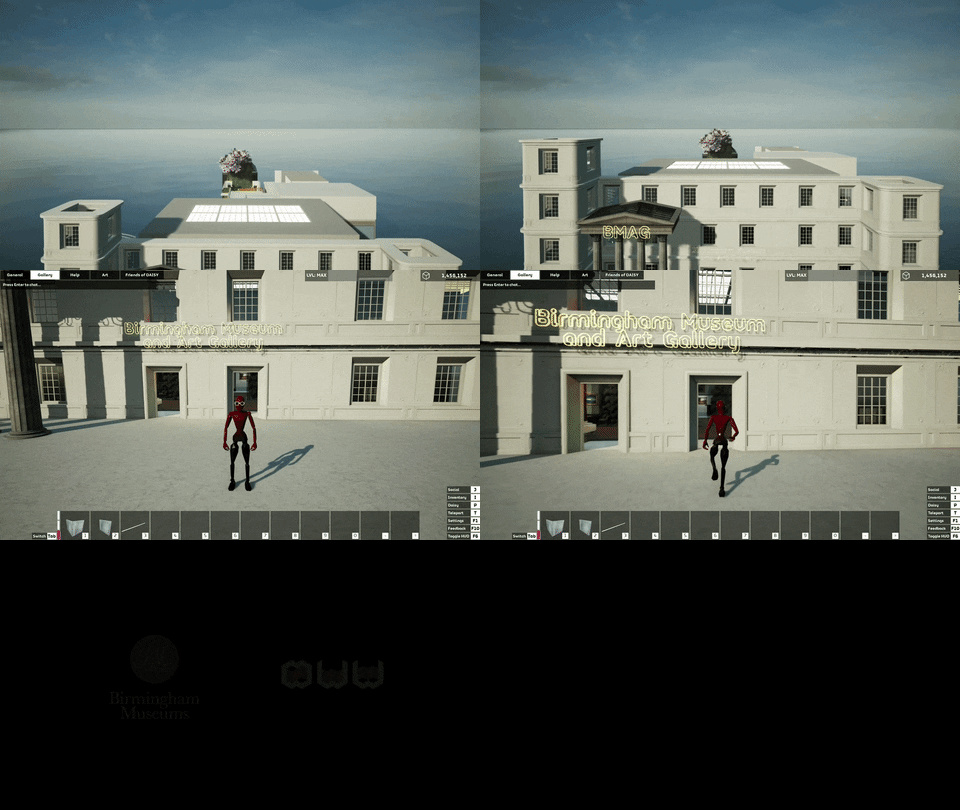
As you delve into the cyber world, players can visit an official digital version of Birmingham Museum & Art Gallery (BMAG), inspired by the actual museum but is a playful and creative space. Players can acquire digital copies of any BMAG artworks they find inspiring and build their gallery around those (and others).

For Birmingham Museums, partnering with OWW is another way for people to explore the collection if they cannot physically access it in person. It also opens up data and analytics about how the public engages with the collection on a level never seen before in ‘brick and mortar’ collections.


Linda Spurdle, Head of Digital at Birmingham Museums, said: “Working with such an exciting, forward-thinking company like StikiPixels, which brings art to life in such an innovative way, has been a really eye-opening collaboration. To see gamers from across the world discover and interact with our artworks is exactly the kind of engagement we hoped for when we made our out-of-copyright images available online. We look forward to seeing what the players create.

The pandemic has reinforced the importance of our digital work and ensuring our audiences can still access the collection, even when we are closed. Partnering with Occupy White Walls is just one of the ways we are looking to grow engagement levels with the city’s digital database of artworks and encourage people to explore it and use it creatively.”

OWW is driven by a unique art discovery AI (called DAISY) that learns players’ taste and, over time, helps them discover more art that will resonate with them.

The average player in OWW ‘owns’ a virtual art collection of around 800 artworks. At the same time, the AI promotes emerging artists (like BMAG local artist Rosa Francesca who has had over 4,500 copies of her work displayed in over 1,600 player galleries). artists can also upload their works to the platform.


Yarden Yaroshevski, founder and CEO at StikiPixels added: “It was an absolute pleasure working with BMAG on this collaboration. Sadly museums are often slow to adapt as the world changes around them. This was not the case here, as the team in BMAG is enthusiastically and creatively embracing the new opportunities offered by digital technology.

“Through this collaboration BMAG has the potential to increase its global footprint by – literally - orders of magnitude, reaching people around the world who have never heard of the collection (or maybe even of Birmingham). Using the AI that's at the heart of OWW, they can discover and be inspired by BMAG’s cultural treasures. We look forward to further collaborations with BMAG, other collections, and contemporary artists."

Find out more about BMAG here and take a 360 virtual tour.

Pulsating lovers, space fairies, and psychedelic fever dreams

[previewyoutube][/previewyoutube]
Nothing spurs creativity like a little competition. To see the truth in that, all you need to do is stroll around the seven winning entries from October’s gallery contest. Every victor was rewarded with seven upload codes, but the rest of us get to enjoy something even better: the fruits of their labour.

I hope you like your fruit spicy. Every gallery here is an ode to an individual artist, from the kaleidoscopic medley of Larskristo to the restrained deities of Mohrbacher. These are, genuinely, some of the best virtual spaces I’ve been treated to - so I’m extra glad I got to chat with their designers about how they came to be.

[h2]LinkCube[/h2]
[previewyoutube][/previewyoutube]

LinkCube exudes elegance. By honing in on the work of Rodrigo Aguilar (or Zapatoverde, as he’s known online)
Linkmyboy has shown what’s possible when you mould a space to suit a particular aesthetic - as long as you have a few tricks up your sleeve.
Cute meets macabre in Aguilar’s monochrome etchings, which surround a chamber lit largely from above. Perfectly placed windows cut the room with shadows, merging each piece with its surroundings while never overwhelming them. It’s all topped off with a short bio and quote from Zapatoverde, cleverly snuck beneath your feet and behind a pane of glass. Not an inch of space feels wasted.

Linkmyboy told me it was all possible thanks to the Gray and Red Sky skybox, which came out at the start of the competition and “really caused the spark of inspiration” that lead to the gallery’s construction. Aspiring shadow artists: take notes.

[h2]R'lyeh[/h2]
[previewyoutube][/previewyoutube]

Nothing screams ‘fever dream’ like the work of Larskristo - or at least, nothing did until Artisan built a temple to him. His gallery provides a psychedelic descent into a crustacean-adorned ocean, with all sorts of demonic creatures to meet along the way. Each lives in a biome of its own: ladybirds and flying eyeballs glide across a multicoloured meadow, Cthulhu strides out from a tentacle-rich sea, and death himself floats aside neon pentagrams. There’s even a semi-secret passage to a hidden woodland deer god.
“I love how each artwork tells a story, and I tried to follow these stories with my gallery”, says Artisan.
Even more impressively, for me, is how the gallery itself tells a sort of story. The chaos becomes more orderly as you descend until you emerge into that ocean and find it complemented by the calm orange glow of ambiguously satanic beasts.

Look into that ocean, though, and you’ll see a trilobite resting in an ocean of its own that spirals out into space, with bubbles blending into planets. Reaching the bottom brings you back to the heavens. Neat.

[h2]Jgs3[/h2]
[previewyoutube][/previewyoutube]

Do you ever look up at the sky and think, ‘what are all those rotating disks, and why does that one keep flipping back and forth?’ You would if you spent time in Jgs3, where the backdrop frames Robert Delaunay’s art so perfectly you’d be forgiven for thinking it was made for it.

Joelgshot’s gallery may be small, but it feels disproportionately grand. You’re first confronted with a huge canvas, aswirl with vibrant colours and intersected circles - and then you’re confronted with a plunge. You need to jump down into a central glass chamber to reach the bottom floor, where more serendipitously circular art awaits. It’s a clever marriage, in more ways than one.
“The dynamism of a plunge felt really appealing when combined with the motion in the art and sky”, Joel told me, especially once he decided to do away with stairs: “they kept ruining that feeling of floating that I wanted, so I took them out”.
Sounds like a big step up.

[h2]Silentvoice[/h2]
[previewyoutube][/previewyoutube]

Silentvoice is one of those galleries that makes you rethink what Occupy White Walls is capable of. It’s a forest memorial, where black butterflies frozen mid-flight echo the floral prints of Anna Atkins, a 19th Century botanist credited with creating the first book illustrated with photographic images. Red light from an unseen source draws you towards the centerpiece, where a girl pays tribute to a monument she may or may not be a part of.

It’s a strange thing to capture life on a photogram. I’m thinking of Atkins’ contact prints, where she’d press algae and ferns directly onto paper. There’s something wonderfully circular about their digital representation here, inside a moment that itself seems locked in time.
It’s a rare gallery that manages to be both visually and metaphorically striking.

[h2]Where the Green Fairy lives [/h2]
[previewyoutube][/previewyoutube]

At long last, someone has finally come along and put fairies where they belong: space. Artorius devoted his gallery to Alphonse Mucha, pinning the fantastical Csche painters’ work up against a nebula. You start off on a garden path, weaving between flower-adorned women affixed to wooden pillars. It’s much less grim than it sounds. From there, you ascend a narrow staircase into a treehouse fit for a (minimalist) queen, all the while bathed in green crystalline light.

Artorious told me he wanted to create a gallery that captured “the same feeling of wonder and mystery” that Mucha reveled in, and I’d say he succeeded. Artorious was also kind enough to answer me the biggest enigma of all: what would Mucha say if he knew his work would one day be shown off in a digital space treehouse sitting in the stars?
“He’d probably think I’d had too much absinthe, before walking up to the top level and getting one for himself.”

[h2]Triarchy of the lost lovers[/h2]
[previewyoutube][/previewyoutube]

Many galleries are full of life, but you won’t find many that pulsate. Segalla has created an exception.
It hosts just three paintings, each centering a god-like automaton. Three other-worldly figures, each in command of their surroundings, each dwarfed inside a towering black and red cathedral. Silver light flows around that cathedral’s contours, as if in worship either of them or from them. I’m not sure who prays to who.

Segalla says he picked out Peter Mohrbacher as an “intelligent digital artist” whose work he admires. He told me he “wanted the focus not only on the works but also on the architecture,” all “to reach the point of ecstasy.” I might not go that far, but it’s a pretty impressive effect.

[h2]The Drawing Room[/h2]
[previewyoutube][/previewyoutube]

Let’s wrap up with a period piece. Glitteremitter’s Drawing Room offers a refreshing change of pace from the more outlandish galleries on show here, instead artfully recreating a snapshot from a Victorian mansion.
Its walls are bedecked with the work of Viktor Vasnetsov, a Russian neo-romantic with a fondness for depicting the aftermath of battles and disturbingly feminine harpies.
The place wasn’t built for Vasnetsov from the ground up, mind. Glitteremitter told me she first “‘auditioned’ several artists, including Bonnat and Tadema,” before finding that “Vasenetsov's impressively sized pieces, with their scenes from epic Viking sagas and Old World tales, just fit so well!”

The ace up Glittermitter’s sleeve, however, actually sits behind a wall. Poke into the right corner, and you’ll find a little plaque revealing the location of an audio accompaniment, cleverly stitched into a Spotify QR code built from a mosaic. Credit goes to Whitearanha, whose gallery-inspired Glitter back when she first started playing OWW.

You can jump into any of the winning entries by searching for them in-game or just by clicking on them from the featured menu. Merry wandering, and to those about to enter the November competition: we salute you. Good luck!