1. NeuroNet: Mendax Proxy
  2. News

NeuroNet: Mendax Proxy News

Guide the citizens of the future as a powerful AI running a cyberpunk city


Reigns is a super-simple medieval management sim in which you, the monarch, make binary decisions based on a wide variety of scenarios that will either cement your place in history or, more likely, lead to your untimely and ugly demise. It's blend of simplicity, variety, and humor is quite good: "The enjoyment is in the journey," we said in our 82% review of the sequel Reigns: Her Majesty...
Read more.

NeuroNet Is Heading To The Next Fest


Hey there!

We're incredibly pleased to announce that our Next Fest demo is now available, and we'll be participating from October 1st, right through the 7th! Amongst hundreds of other games available, this will be the first time that NeuroNet: Mendax Proxy is playable.

As a story-driven adventure that invites you to make quick-fire decisions, you'll need to manage a city and the expectations of its citizens. Every choice you make will drive the story, and you'll encounter dozens of characters along your journey.


Inspired by Reigns, players must make quick-fire decisions that impact the future of the city and the prosperity of its citizens. Every choice matters and every decision has a lasting impact on the characters you meet and the wider city status.

From helping jolly Papa Ru to turn his food truck in downtown Shentilar into a successful business, to grander city-wide choices like aiding the politician Denton Talingrey, players will find themselves faced with moral dilemmas, where there are no right choices, just a city in need of direction, with you at the helm.

We can't wait to see what choices you take. Will they allow the city to prosper or set it on a path to ruin?

/NeuroNet Team

https://store.steampowered.com/app/1423000/NeuroNet_Mendax_Proxy/

What Is NeuroNet?


Hey there!

In just over two weeks time, NeuroNet: Mendax Proxy will be playable for the first time during the October Steam Next Fest.

This is a significant milestone for the studio, not only to get the game in your hands, but to gather feedback and gauge audience reactions to what we’ve been working on for so long.

NeuroNet is unique and to be brutally honest, it’s hard to pigeonhole it into one specific genre. In some ways, it plays closely to the incredibly popular Reigns. You can make quick-fire decisions (or left and right choices) which leads to an outcome and progression, but that’s probably where the similarities end. Instead, NeuroNet focuses on a story-driven experience that’s wrapped with stunning artwork and fully voice acted characters.

The biggest divide between the two games, however, is that Reigns often sees players solely focus on the resource bar at the top of the screen in order to guide their decision making: that’s something we really wanted to step away from. Simply put, we want players to make a range of decisions, from the challenging to the mundane, but we don’t want them to be influenced by a user interface but instead by their own, personal, moral compass.

[previewyoutube][/previewyoutube]

As for NeuroNet’s story (don’t worry, no spoilers here!), this is something we’re incredibly proud of. It explores our relationship with technology and the impact this can have on our lives, while dealing with challenging themes of morality, corruption and greed.

You play as an experimental AI under the ownership of the megacorporation Mindcore, and you’ve been charged with meeting the needs of the city’s inhabitants. Whether that’s aiding them make simple decisions in their daily lives, such as helping jolly Papa Ru to run his food truck in downtown Shentilar and turn it into a successful business, to grander city-wide choices like aiding the politician Denton Talingrey. Every decision you make directly affects the story and how the city views you. You’ll even receive regular reports as to just how well (or poorly) you’re thought of and how your choices impact every aspect of the city.


With multiple endings, key decisions you make can lead to very different outcomes and as you progress through the game’s chapters, you’ll not only uncover the mysteries surrounding your creation, but also the true motives of characters you encounter. From corrupt CEOs, to journalists, shop workers and lab technicians, you’ll meet over 20 characters along the way.

On October 1st right through to the 7th, you’ll be able to download NeuroNet on Steam and experience all this for yourselves. We can’t wait to hear your thoughts, and to see what decisions you take.

Will they be the right ones for the future of the city? There isn’t long to wait to find out.

/NeuroNet Team

https://store.steampowered.com/app/1423000/NeuroNet_Mendax_Proxy/

NeuroNet: Mendax Proxy — Creating The Art Direction

Hi, I’m loïc Bramoullé, the Art Director and sole artist on NeuroNet: Mendax Proxy.

NeuroNet: Mendax Proxy puts the player in the shoes of Arc, an AI designed to manage the city of Catena. Through Arc’s journey, players visit a large number of locations and meet a diverse cast of characters. Each character has their own problems that need solving and ultimately players must make decisions using a simple Tinder-like interface where every choice impacts the balance of the city across 4 resources and the narrative path that the player will take.

This post gives a breakdown of my process across the development of the art for the characters, locations and UI that I developed.

CHARACTERS

Defining the visual feel of the game was a question of balance between our existing IP, NeuroNet’s character illustrations, and the specific needs of this new gameplay. Here the players spend all their time talking to these characters and, in a way, exploring the city they live in through a camera lens.

Having more stylised and graphical art was important to give the game a unique look. Additionally, it made it easier to produce a variety of different facial expressions to match the tone of the recorded dialogue.

Comparing young Kyros from Mendax Proxy with old Kyros from NeuroSlicers

ENVIRONMENTS

NeuroNet: Mendax Proxy provided a nice opportunity to explore the different areas and moods of the city that you’re in charge of, Catena.

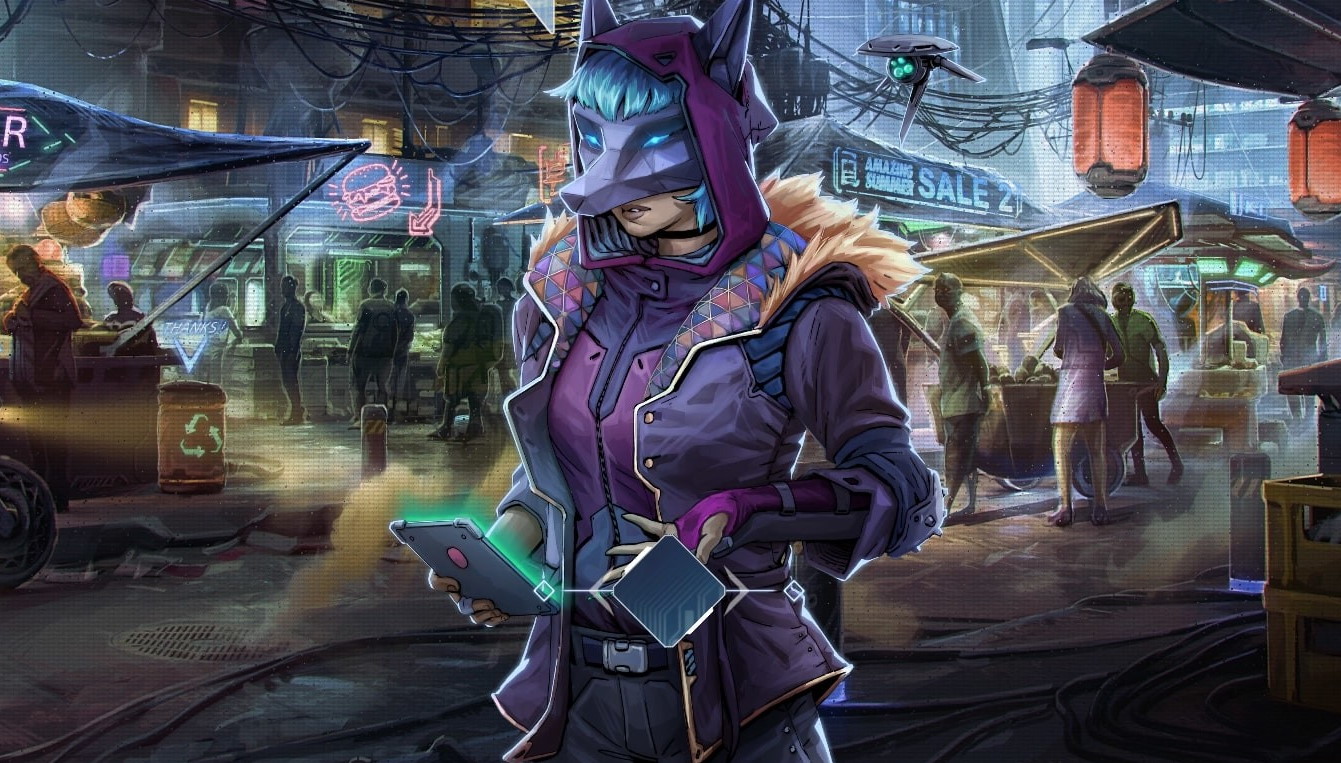
Narratively you’re looking at it from camera feeds, but it was important that the characters integrate nicely on top of the backgrounds, so I kept the camera around the eye level when I built the scenes in 3d, so the perspective we see in-game feels more natural.

[previewyoutube][/previewyoutube]
Building all the environments in 3d was no small feat just to produce 2d illustrations, but it allowed us to get a more immersive and believable final result, along with some special effects for the transition between the camera feeds.

It was important as well that the aesthetic of the background relates harmoniously with one of the characters. For example, they couldn’t look too photorealistic, as the characters were stylised, the environments needed to have the same tone, so everything feels like belonging to the same universe. But the environments also needed to be more detailed and intricate to feel immersive, so I started to design all of them in 3d, before painting over them. This would allow the reuse of outlines and brush strokes to match the unique aesthetic of our character art and create visual harmony.

In NeuroNet: Mendax Proxy you’ll discover new areas of the city as you progress the narrative; from the underbelly of Catena with its Meta-Church to the private apartments of the richest corporate sharks.

If you play on mobile, you will have the choice between seeing more details on the character with your screen in portrait mode, or locations in landscape mode.

USER INTERFACE & BRANDING

The UI went through a few different iterations to build up the level of polish, with close to 500 concepts in the end. We needed to explore each useful variation on each element that could drive the look and feel of the game forward.

[previewyoutube][/previewyoutube]
Development overview of the main UI systems in NeuroNet: Mendax Proxy.

The first element to tackle was the resource and swipe section, as it’s the element that players spend the most time looking at and interacting with. Firstly, it needed to allow the gameplay to be understood instinctively by new players, but also allow all players to read the information clearly and easily as they progressed. I avoided having the resource fill colour be inside the shape of the icon, as it was harder to read the current level, but instead make it contrast heavily by filling the whole background of the icon.

Initially, I judged that displaying the resources icons in black would be more visually striking. There was also consistency with the answers being this black box, as they are the two elements that represent the player.

It was an interesting point to push the visual identity of the game, experimenting with this contrast of black shapes on bright backgrounds, but I realized it did not help readability for each icon, which was more critical than style.

I avoided colour-coding the four resources, even if it helped to identify them. It wasn’t worth it given how much multiple colours weakened the overall visual style.

After balancing everything and exploring different directions, we found the best compromises between each idea, usability and style constraints.

The final UI has this overall dark blue background, and key elements are highlighted with this bright blue colour ramp. Even more important elements that demand immediate attention, like gameplay impact on the resources, are highlighted in bright orange, which still contrasts over the bright blue colour.

For polish, everything received a subtle circuit texture treatment that’s slightly organic. This follows the slightly neuromorphic take on the AI and environment design, mixing circuits, hard angles and lines, with curved bevel and overall smooth look.

[previewyoutube][/previewyoutube]
Evolution of the main UI screen where most of the gameplay happens.

Thanks for reading. If you have any questions about the processes I used or just want to chat about the game then head over to our discord server at www.discord.gg/neuroslicers

Loic Bramoulle, Art Director
DREAM HARVEST GAMES

NeuroNet: Mendax Proxy — Humanity In The Machine

I left the office last Friday with a cocktail of emotions. Primarily, I was feeling exhilaration from the announcement of NeuroNet: Mendax Proxy. The reveal of our upcoming game resonated deeply with a core tenet I hold as a game designer; I was a kid with a new toy, eager to share it with his friends.

Contrary to my excitement was a sense of relief. For the past few months, I’ve been dancing around the questions “how’s work going,” “what’s this new project about,” and “when will we know more?”

Now, I can finally talk about NeuroNet.

Introducing NeuroNet: Mendax Proxy

I am an avid believer that building an immersive world takes time. Not in the sense that it takes time to write, rather that it takes time for the audience to settle into the world and become invested. Every event feels more significant when it involves people you know. NeuroNet: Mendax Proxy does just this.

NeuroNet is a precursor to NeuroSlicers, expanding upon the world’s lore and characters. Through its story, players will experience the origins of the titular NeuroNet, learn about the people who made it and witness the struggles of Catena’s citizens as they try to navigate this new digital landscape.

NeuroNet sets in motion key events that become the focus of NeuroSlicers’ story, bridging the narrative between these two games.

Without spoiling too much, NeuroNet: Mendax Proxy is told through the eyes of an artificial intelligence. The player, as the AI, is tasked with managing the NeuroNet as it spreads across Catena.

The information available on the NeuroNet is completely incomprehensible to the average person, thus it becomes the AI’s job to interface between the two. This manifests as citizens making requests of the AI, which the player must respond to as best they can. Though, being an AI, things may not always go as expected.

The Story of NeuroNet

Telling the story from the perspective of a non-human entity is not a new idea by any means, but it was still interesting to write. Although we are asking the player to take on this role, the character is not entirely theirs. The AI is the central figure of the story — they have a specific journey to go on. That journey is one of growth, where over the course of the game, the AI learns about the world it inhabits and gradually forms an identity for itself. The game is about building relationships, and through those relationships, the AI finds itself.

I took inspiration from the way Horizon: Zero Dawn handles their branching dialogue. While the game has multiple paths you can take through conversation, the character of Aloy is consistent in the central aspects of her personality: she is driven, she is brave, she wants to do the right thing. The player’s agency comes in how they choose to express themselves in each situation. Sometimes Aloy is aggressive, sometimes she is compassionate, and sometimes she is analytical. Regardless of what the player chooses, the story still moves in the same general trajectory.

Similarly, in NeuroNet, one player’s version of the AI might be smarmy and sarcastic; another’s kind and earnest. Despite the way the player expresses the AI’s personality, the idea that they naturally want to help people remains the same.

That being said, it wasn’t enough to have branching paths just for self-expression. They had to mean something more. Thus, the player is free to make choices that have serious consequences. Some sections of the game can be missed entirely if the player says one thing over another. Several characters can remove themselves from the story if the player mishandles (or rejects) their relationship.

These critical junctions are not signposted either. It is up to the player to read the situation, to understand the people they are speaking to, and how they might react to what the player says. In fact, most of NeuroNet’s gameplay revolves around evaluating situations based on contextual understanding and trying to predict the outcome of each response.

Stories About People

Traditionally in games, the gameplay alleviates much of the responsibility the narrative would hold. But games are also an exceptionally powerful medium for storytelling. It is incredibly immersive when you experience a story as the protagonist. It is easy to invest in a world and its events when those events are happening to you. However, simple interactivity isn’t enough.

When it comes to making a story engaging, I find the greatest contributors to be plot, world and characters. Each story has its own balance, but if one of those three is strong enough, it can carry the narrative. Personally, I find the most engaging stories are the ones with interesting characters. I can’t enjoy a book/movie/series if I don’t like spending time with the people in it. Consequently, the cast of NeuroNet: Mendax Proxy is where much of the narrative focus resides.

The cast is extensive for a game of its size. It was important to us to include a diverse range of characters, improving the variety of stories being told. Each one brings something unique to the world of NeuroNet, making the city feel larger and more real. We were lucky to have such a talented range of voice artists join us, as they really brought these characters to life.

The focus on characters in NeuroNet was more than just an effort to make the game engaging. Each character’s plot is used to explore different ideas. There is plenty of overlap, with many characters discussing ethics with the player, but some issues are localised to specific character plots. Not only do they have their unique personality traits and aesthetics, but they have thematic distinction on the meta-layer.

More Than an Aesthetic

Traditionally, cyberpunk focuses on dystopian predictions of the future, our relationship with technology, and the faults of our economic infrastructure. It is these sorts of themes that an audience expects from a story set within the genre. In NeuroNet: Mendax Proxy, we **aimed to incorporate these themes, while also adapting them into something that felt unique to our world; our version of cyberpunk.

For example, cyberpunk typically portrays figures of authority as villains (e.g. Pershaw). Talingrey, however, is the only politician the player meets directly. He is upbeat, earnest and clumsily charming. He is genuinely trying to make the world a better place, acting as a counter to the stereotype of corruption typically seen in cyberpunk political figures. It was important to give each of our characters nuance that humanised them, so even those that were more in line with cyberpunk archetypes avoided becoming caricatures.

Humanity in the Machine

A classic cyberpunk theme explored by NeuroNet is identity through a transhumanist lens. The player is an AI, after all. We wanted to examine how the technology of our world affects us; what parts of our humanity it erodes and what parts it amplifies. In witnessing the struggles of the people around it, what aspects of humanity does the AI take upon itself?

As the AI becomes more human, their relationship with the people around them evolves. The player can build trust with each character, who open up as their perspective of the AI changes from a tool to a friend. The AI’s sentience (and being player-controlled) makes the emotional connection easy to believe. However, it is a reflection of something that happens in real life.

Humans have a habit of anthropomorphising their world. I am no exception, having named many of my personal devices (my laptop is called “Capheus”, my rice cooker is called “Daisy”, and my backup drive is called “Esther”). The attribution of human traits to non-human things is something we’ve been doing for a long time. However, the introduction of functional AI and assistant systems like Alexa and Siri is rapidly closing the gap between us and the technology we create. It makes the technology more relatable, trustworthy, but is this a good thing?

Systems like Alexa do not exist in a void. They are designed by companies whose purpose is entirely self-serving. It doesn’t matter how well-intentioned the tech is itself; it is still bound to the agenda of its creators. NeuroNet: Mendax Proxy attempts to address this concept by placing the player in the proverbial shoes of the AI as the bridge between the corporate entity and the consumers. They have to balance helping the citizens in need with the demands of MindCore executives. Sometimes, for the sake of self-preservation, they might have to make a decision they morally disagree with because the alternative ends in system failure.

Looking to the Future

I am thrilled by the upcoming release of NeuroNet: Mendax Proxy. I cannot wait for the game to get into people’s hands and hear what they think about it. We have created something that we hope resonates with people and leaves them with powerful, emotional memories. But we’ll have to wait and see: keep your eyes and ears open for NeuroNet’s official release date. Until then, thanks for reading and I’ll see you next time.

Scott Brebner, Game/Narrative Designer/Writer
DREAM HARVEST GAMES