1. War Robots: Frontiers
  2. News

War Robots: Frontiers News

Development Spotlight: Builds & Customization


War Robots: Frontiers gives you a lot of freedom when it comes to Robot building. On the far reaches of the Wild Ten, Pilots can equip their squads as they see fit. Little attention is paid to corporate marketing and blueprints. Two identical chassis from the same shipment can end up powering two completely different Robots when they make it to the battlefield.

Learn more about builds & customization in War Robots: Frontiers with this Developer Spotlight written by Shredder-Blitz (Community Manager).
[h2]BUILDING BLOCKS[/h2]
To build a combat walker you will need a torso, a chassis (legs), and two shoulders. With eight Robot models currently available in the game, this leaves you with 70 possible combinations—and that doesn’t even include weapons and modules, which can alter your combat role all by themselves!


The Torso is usually the main component around which you assemble your build. Its core defines the unique ability of the Robot. The dashing Bulgasari, for example, features a missile barrage with an area of effect—no module can give you this ability. So, if you like bombarding your enemies while staying out of their line of sight, the Bulgasari torso is a good foundation to start with.

The Chassis will define the weight your Robot can carry, and the power supply it has to manage its weapons and modules. Take Fury's legs, for example. The carrying capacity of this model is unmatched, and allows you to choose the heaviest parts with the best armor. However, it all comes at the cost of a lower power supply and lower speed. With this Chassis, more powerful modules like Infinite Ammo will not be a viable option.

The Shoulders serve as mounting points for your weapons. Most of the models will only support light weapons, but there are some that give you access to the big guns. For weapon-specific builds, shoulders can be even more important than the chassis or torso. The complex system of amplifiers will rely heavily on your choice of shoulders.
[h2]STRUCTURAL INTEGRITY[/h2]
When forging a perfect war Robot, you will need to consider Armor and Durability. Squeezing as much firepower out of your build as possible can be a good strategy, but remember that in a fight, there will be counterfire.

Durability is the health pool of your Robot. When it reaches zero, the Robot is destroyed. While every Robot part has its own characteristics, the Durability is the sum of all its parts added up, and it’s the Robot as a whole that takes damage, no matter which part took the hit.

Armor, on the other hand, can be destroyed bit by bit. Armor is the upper layer that mitigates damage to Durability, and it takes damage separately depending on which part gets shot. When the armor on one of the Robot parts is breached, all the following hits dealt to that spot will deal 100% damage.


Even a couple of well-placed hits on an unarmored part can take your Robot down. Imagine building for close range and, for example, deciding to go with Ares’ Chassis for increased mobility—those legs can quickly become your Achilles heel. An experienced opponent will remember that their armor is subpar and try to exploit this.
[h2]GAME CHANGERS[/h2]
While your choice of Robot parts determines the way you traverse the battlefield and survive, it's your weapons that bring you closer to victory. You will often find yourself tailoring a Robot build to a weapon set more often than not.

There are three main types of damage in the game: kinetic (e.g. machine guns), energy (e.g. electricity), and explosive (e.g. rockets and missiles). 
  • Kinetic weapons deal increased damage to armor but get blocked by any type of energy shield. 
  • Energy guns ignore certain shields but don’t have any other perks.
  • Explosives cause area damage, allowing you to chip away at the armor on two Robot parts at the same time. Weapons also differ in their ballistics and effective range. You can assemble a diverse hangar and be ready to counter any deployment from the enemy team, or fill your lineup with clones if you really liked that one particular loadout.


Modules are an essential part of every build. They negate weaknesses and amplify strengths. Burst-type rocket launchers, for example, are a great choice for mid-range. You can fire a volley and take cover to reload—-but what if your opponent manages to get close? In this case, Infinite Ammo could be a life-saver, allowing your weapons to keep firing for a short time without spending ammunition. 

Installing an Armor Regeneration module on top of heavy armor will create a strong synergy, making survivability the defining feature of your build.

While Robot Pilots are still early in their development, they already play a significant role in cementing your choice of tactics. Some of them favor close quarters, some give life to sniper builds, and some encourage you to move around the map more.
[h2]PHYSICAL LIMITS[/h2]
We balance the power of Robot builds so that there is always a trade-off. You can go with superior armor at the expense of additional weapon slots, or choose to be a walking battery with little protection. You will always have your strengths and weaknesses. We achieve this by limiting the Robot’s Energy and Weight.


Weight is a characteristic present in all weapons and Robot parts—more armor and more firepower mean more weight.

Energy is drained by guns and modules. Heavier weapons and game-changing modules will usually have a higher toll on your energy supply.

These two pillars of balance in War Robots: Frontiers allow us to leave class building in your hands. We invite you to try every combination that sounds like it could possibly work. In the meantime, we will continue working on more building blocks for your Robot squad.

In the next Development Spotlight, we will talk about Progression. Most of the game’s meta is still in the works, but we’ll share our general vision and explain the core concepts. Tune in next week to see what we have in store!
Robot Overview: Bulgasari


Meet your new favourite Robot: Bulgasari! Able to dash into the fray and use their special ability to rain down missiles on the enemy, this Team Beast is perfect for your squad’s next mission.

This video will give you the scoop on Bulgasari, from tactics to trivia, and much more you’ll need to know before you Pilot this fast and furious Robot in War Robots: Frontiers.
 
[previewyoutube][/previewyoutube]

Subscribe to our YouTube channel and stay tuned for more War Robots: Frontiers videos!

War Robots: Frontiers Patch Notes - 01/12/2022


These are the patch notes for the build available on December 1. Update your game to the latest version and play War Robots: Frontiers today!
  • The damage of the following abilities has been decreased:
    • "Rainfall" (Bulgasari)
    • "Deadlight" (Alpha)
    • "Homing Pack" (Alpha)
  • Homing of the weapon "Scourge" has been disabled. The damage decay curve has been adjusted.
  • The damage, reload speed and ammo capacity of some weapons has been adjusted.
  • The instant heal volume provided by the "Scrapper: Armor" talent of "Kang Strong" Pilot has decreased from 20% to 10% per kill.
  • The armor, health, and speed of some Robots’ parts have been adjusted.
  • The Shop option "Skip Box" will now consume 200,000 Alloys instead of 1,000 Credits.
  • The Robot abilities are now locked in "Tutorial Mission" until the player approaches the Beacon arena.
  • "Low Fuel" indication is now displayed when trying to use "Dash" or "Floating Jetpack" with insufficient fuel.
  • Minor localization fixes have been implemented.

Maintenance – 01/12/2022


War Robots: Frontiers servers are scheduled to enter maintenance at the following time:
  • Maintenance Time: 01/12/2022 at 08:00 UTC
  • Estimated Downtime: 1.5 hours

The game servers will be inaccessible during this time. Keep an eye on our official social channels and Discord for further updates, and to find out when War Robots: Frontiers servers are live again.

Thank you for your patience!

Development Spotlight: Combat


In War Robots: Frontiers you take the helm of a 15-meter-tall combat walker to fight for fame and fortune. Ahead of you is a vast battlefield and a team of six enemy Pilots. Challenge them together with your team, brawl over beacons, rack up damage using the best weaponry the future has to offer, and win with tactics or brute force!

Learn more about the combat mechanics of War Robots: Frontiers with this Developer Spotlight written by Shredder-Blitz (Community Manager) and Baz (Lead Level Designer).
[h2]THE LAY OF THE LAND[/h2]
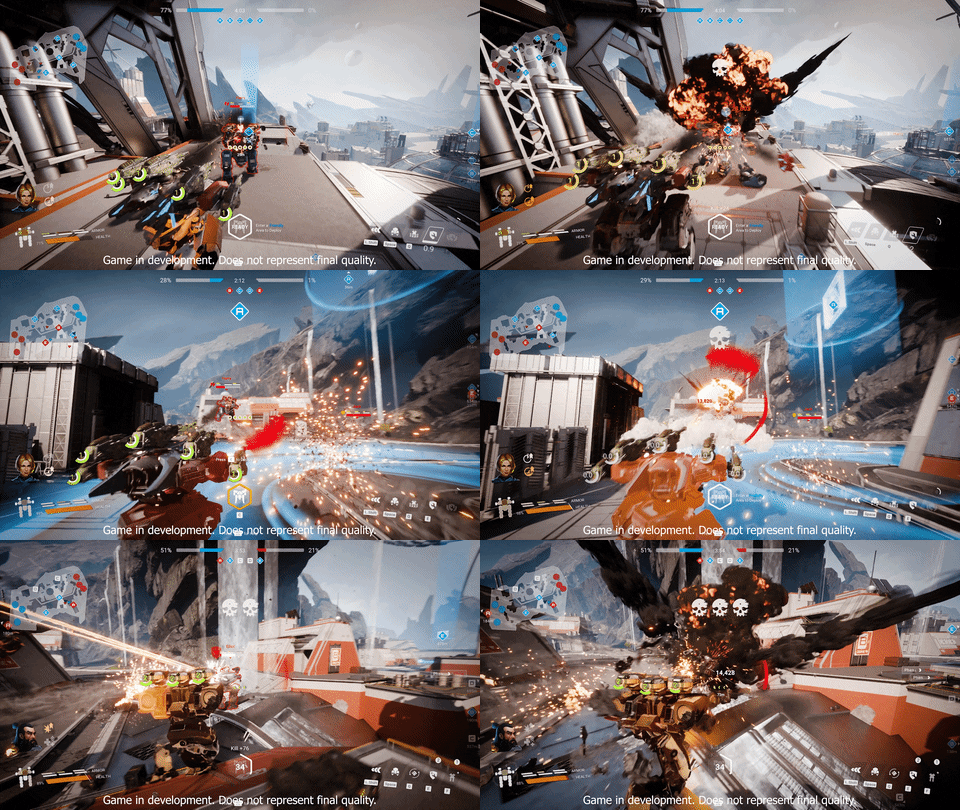
The bedrock game mode of War Robots: Frontiers is Beacon Rush. Two teams set out from opposite sides of the map and fight for strategic points. Every captured beacon becomes a beachhead where you can deploy your next Robot to press the attack. As either team hold their controlled territory, they accumulate victory points. With enough points, one team will instantly win the match.

Our goal was to make the destruction of each Robot a major event in the course of battle, so there will be no respawns (at least not in Beacon Rush). Once you’ve annihilated your target, it won’t be coming back. However, each player fields a squad of five Robots and one special Alpha unit. This makes more room for team strategy and turns each match into a ceaseless festival of Robot destruction. There will always be something to shoot at!


[h2]SUPER-SIZED DOESN'T MEAN SUPER-SLOW[/h2]
War Robots: Frontiers rewards fast reactions and encourages you to always be on the move. A well-placed hit to a weak spot can instantly send an enemy Robot to the scrapyard (especially if someone has already done some work on their armor). However, even though you’re aiming at a four-storey tall giant on two legs, hitting it can prove to be a challenge. Each Robot is equipped with jet thrusters that allow dashing and jumping, and most of them run at a formidable speed.


Faster gameplay means a higher skill cap—this is exactly what we aimed for when balancing the game. You will find that most weapons require very precise aiming to be effective. At the same time, we have left room for more strategic playstyles. Robot abilities are a powerful tool, especially those installed on the Alphas. When used at the right time, you have the chance to turn the tide of battle singlehandedly. Of course, it’s better to be both a good marksman and a smart planner.
[h2]CHOOSE YOUR COMBAT STYLE[/h2]
On the Frontier, there are no pre-arranged Robot builds. Your walkers arrive in parts—torso, legs, shoulders, weapons, and modules. There are plenty of possible combinations, and replacing even a single component can change the way a Robot works in battle.

If you go with items of the same brand, your final setup will feel intuitive and familiar. Bulwark, for example, lives up to its fortified name and features additional armor on the torso, legs, and shoulders. At the same time, it doesn’t have to be a walking shield for its squad. Opt for more fuel-efficient legs, maybe change one of its shoulders, slap a Stealth module on top, and your bot may just as well become a sneaky beacon runner that doesn’t shy away from a duel against a heavier opponent. 

There are multiple roles you could try to fill, such as brawler (close-range fighter), sniper, support, or scout. However, you don’t have to adhere to one particular role—-by combining different parts, modules, and close/mid/long-range weapons, you can discover some interesting hybrids. Whichever playstyle you prefer, Frontiers will have you covered. We want to encourage you to experiment with your builds as freely as possible. 
[h2]WREAK HAVOC[/h2]
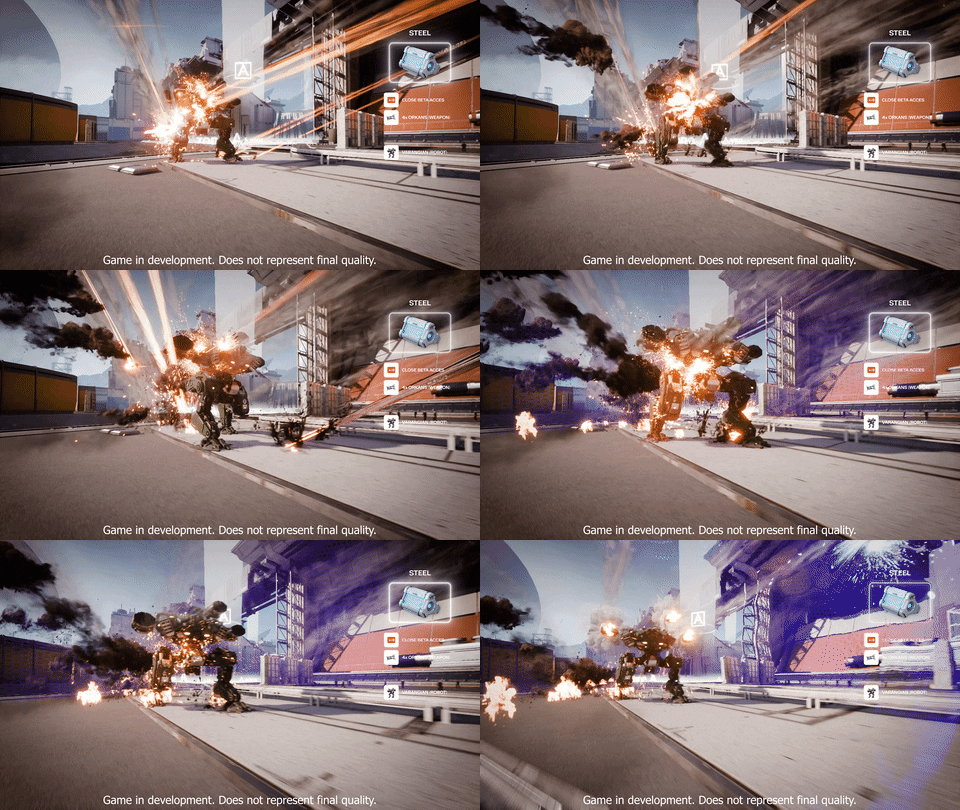
We want to convey the feel of piloting an unstoppable metal behemoth, and destructible objects on the map serve exactly that purpose. When missiles start flying, you will see that certain buildings around the map take damage. As they crumble down, new tactical decisions become available and the dynamics of the fight change.


Early in development, we agreed on three types of destructibles on the map:
  • Cosmetic: This destructible type reminds you what a huge and dangerous machine is now under your control. Most surfaces you shoot or tackle give you some kind of visual response. Shattering glass, crumbling stones or exploding vehicles—you name it.
  • Cover: This destructible type was different at first, with half-height obstacles serving as cover because Robots COULD crouch. Those are now gone, replaced with full-height objects that can take a shot or two for you if you manage your positioning correctly.
  • Path Blockers: The final and probably the most interesting destructible type provides you with shortcuts during the match. Players who know the map well can use big destructible structures to their advantage, either opening a faster way to the other side of the map or using the structures for cover instead.

The Cover type was the most difficult to implement, and it changed its purpose as development progressed. Early on, cover could only be crushed by Alphas, making ordinary Robots much less mobile by comparison. At some point, we gave the Dash and the Jetpack abilities to every walker in the game, which brought us to the point where cover simply didn’t deliver fun—-they felt like annoying obstacles. The technical art team reworked them and now you can rush right through, destroying the objects with the weight of your Robot.

Later, we also introduced cover which looks like part of a larger structure. For example, here’s one of the landmarks of the Crash Site map—a giant glass dome:

It can hide an ambush if most of its structure is left intact. Consider such terrain features as you plan your next move, or just wreck everything that’s not too durable for the sheer fun of it!

In the next Development Spotlight, we’ll do an in-depth rundown of Robot customization. There’s a lot to cover, so be sure to tune in next week!