Science enjoyers,
[h3]When working on a Sci-Fi universe, how to properly root the fiction part into actual science?[/h3]
Read more about what Aliza, Lead Programmer, has to say about it:USC: Counterforce is set in a tense sci-fi universe depicting a controversial future for mankind, where despite our technological advances that enable interstellar travel – a dream that may never come true in reality –, not all is bright: resources on Earth are running low, and a new kind of arms race between the multi-concerns controlling what is left is now what defines politics, and consequently, civilian life. United Space Command, though not completely above corruption, is the one thing that really unites mankind in its dream of conquering the stars, and striving for a better future for all.
 Wormhole representation, www.unsplash.comWhen you are working with a concept like this, some major questions naturally arise.
 For example:
if interstellar travel is possible, why does it matter if Earth is dying?
And you have to dig deeper and set up the causes properly to create a plausible world.
And, though USC: CF is science-fiction, I always felt that the fiction part must be properly rooted in the science part. Will technology enable feasible interstellar travel to be ever possible in reality? Even if yes, well, not for a long time.
That’s the fiction part, to “invent” a technology that transcends this border. But, on the other hand, there are things in the universe that are known and well-described in science: the speed of light, or the nature of inertia and gravity – and you really shouldn’t tinker with those if you hope to create something even remotely believable in sci-fi terms.
[h3]
"if interstellar travel is possible, why does it matter if Earth is dying?"[/h3]
So, returning to the question of
why Earth is so miserable if the whole universe has been “opened up” for us, there are answers:
First of all, if you think about how any technology has been introduced into our lives in the past, you see that the first steps are always hard and expensive. And when we’re talking about
a technology that, in this instance, can bend spacetime (i.e. to a far greater and more controlled extent than how it is already bent due to mass), we shouldn’t visualize a machine that fits in a box and is produced on an assembly line for everyday use.
It’s a volatile, hard-to-produce, and hard-to-maintain technology, with extreme material requirements, and a power draw so high that if it was operated on the ground, entire countries’ power grids would have to be shut down temporarily to power it.
But it is not operated on the ground. It needs to be placed on “pioneering ships” that can use it to go somewhere else (you wouldn’t want to mess with spacetime in your backyard, would you?) – so these ships need power sources so advanced, they probably cost even more than an SST-Warp drive by themselves.
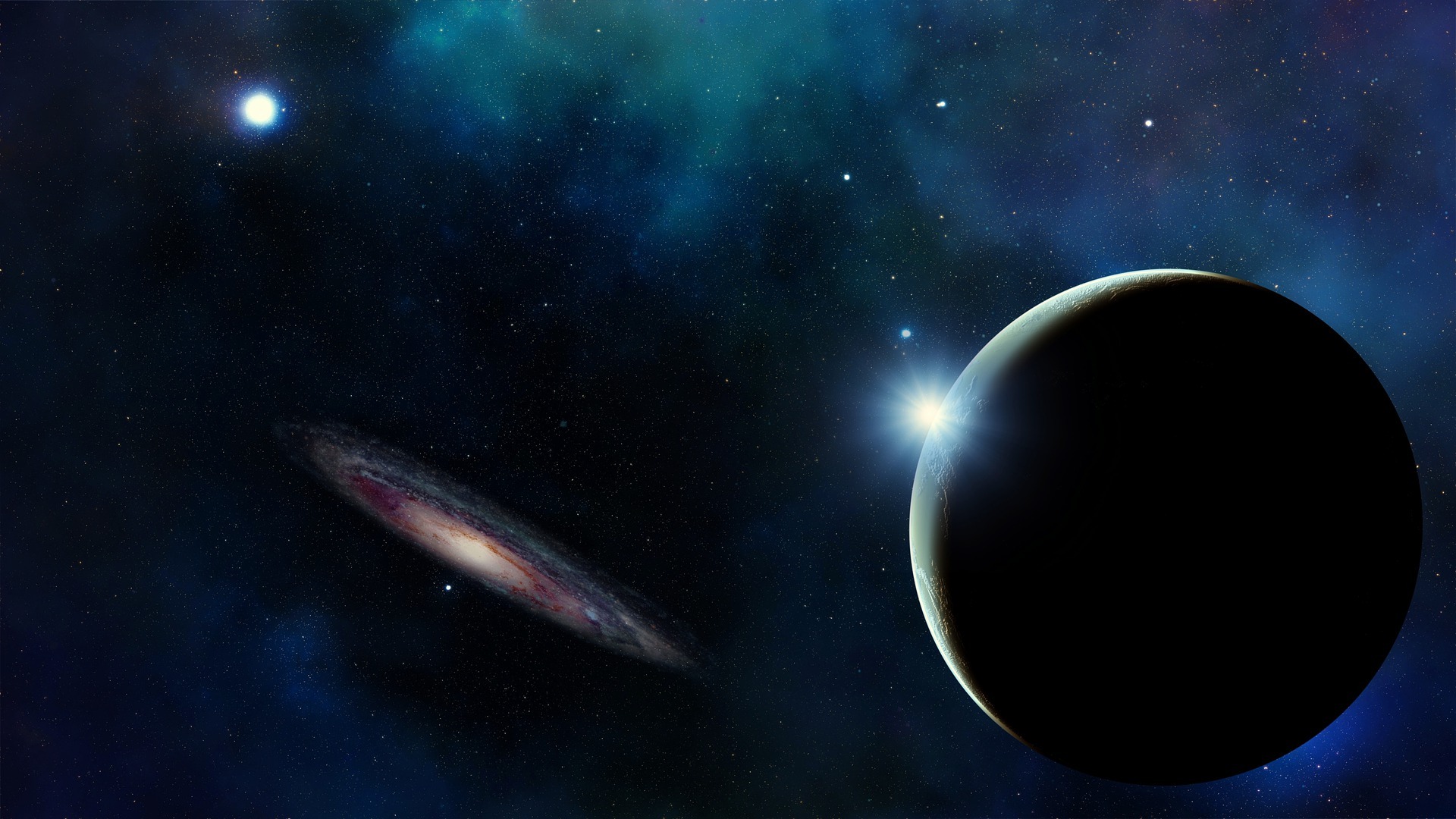 Exoplanet and galaxy representation, www.pixabay.com
[h3]
"Where to send your ships?"[/h3]
Obviously, these ships should look for planets with extremely rich mineral compositions or other materials that are deemed invaluable, in return for the operating cost. But information is hard to come by.
There’s no “magic method” that can map the galaxy for exoplanets in an instant. The speed of light is the final barrier for conventional technology; we can’t just “know” what is out there. So, the pioneering ships have to see for themselves, based on data already available to pick out the best probable star systems. And whatever they find, they also can’t just send a text message back. (That would take somewhere between 10-1000 years!) They have to come back, risk spacetime-warping again, burning up fuel and/or taxing their power source and warp-drive to their limits.
Okay, but then it’s all okay, right? Not exactly. Who or what does the mining? And if, for example, this warping technology still has to somewhat abide by general natural laws – which it does –, wouldn’t a cargo of trillions of tons of materials make warping more complicated?
And my favorite problem: [h3]
"Okay, you warp to another star system. But where exactly in that system?" [/h3]
Say you can’t really do it too close to planetary bodies due to their mass, or the mass of the stars somehow determines where you can “pop out”: the planets themselves could be still years, decades away when you have to travel there with conventional thrusters! So technology should also exist for “micro-warping”, or for a far better conventional traversal of space (without imposing G’s so high on the ship it breaks in half).
There are a lot of possibilities to handle these problems when we are treading more and more into the realm of the fiction part.
My take in USC: CF is that the pioneering ships when they find a star system worth exploiting, build a Relay Gate; a space station orbiting the local star. These gates are built in three separate stages:
- first, they build a habitat and engineering station from materials that were in cargo;
- secondly, they disassemble the pioneering ship and use its power source and warp drive for building the gate itself;
- and last, when the gate is operable, and smaller ships without their own warp drives can travel there, they finish the station with all other necessary elements (more habitats, storages, laboratories, refineries, etc.)
But Relay Gates are not capable of maintaining a “tunnel” to Earth indefinitely; these gates can only warp for a fraction of a second like they were able to when being housed on the ships, and only during that split-second can other ships – prepared in advance to be relayed – can travel, and also, this is the tiny timeframe when any information can also be sent forth and back between the two star systems. After that, the gate has to be maintained, the power source recharged, and any communication is shut down for days or weeks. But hey – still better than a hundred years!
It is impossible to estimate the cost of such a venture. So, interstellar travel is possible. We figured it out. We have the technology to build sufficient power sources, to build warp drives, to build ships that can house these and survive the warping process. And in the long run, this is the future of humanity – but it really, really does cost.
And when you’ve finally found a star system with a planet abundant in a resource so much needed, so valuable, you’re not going to give it up because a few “space worms” ate some scientists. Instead, you’re going to war.Join our Discord to chat with the developers of USC Counterforce: https://discord.gg/vsxD6n8P8J
The USC Counterforce team


