1. Pathbreakers: Roaming Blades
  2. News

Pathbreakers: Roaming Blades News

Devlog #7 - Status Effects

[p]In a past devlog, we went through the combat system of Pathbreakers: Roaming Blades, including how strategic you can be by exploiting the environment and positioning to your advantage. However, we did not dive deep into one of the foundational pillars when it comes to this genre: the status effects.
[/p][p]For Pathbreakers, we decided to have a smaller amount of buffs and debuffs and keep them more streamlined. This does not, however, mean that they will be bland to play with. Quite the contrary: with the way skills can be altered by ability modifiers, we end up with more complex permutations of debuffs and buffs in a sense.[/p][p][/p][p]Generally speaking, when it comes to the debuffs, you can expect to pick up the system quickly and easily in the early game, and discover more complexities as your characters gain levels and start getting access to more passives and modifiers. As the game progresses, you’ll pick up new tricks and setups that will increase the mileage you gain out of debuffs.[/p][p]
[/p]
The base debuffs of Pathbreakers
[p]Before expanding on the debuffs explanation, we are going to list all the basic ones that you will have at your disposal:[/p]
  • [p]Poison: a venomous application that reduces a unit's max Action Points (AP) for a few rounds, limiting the number of actions and movements they can take during their turn.[/p]
  • [p]Bleed: an open wound that deals a fixed amount of damage to a unit at the end of their turn for a few turns. The unit will also leave a blood puddle on the ground that conducts electricity, just like a water puddle.[/p]
  • [p]Root: immobilize a unit for a short while. It is more effective on melee characters.[/p]
  • [p]Charm: a mind-domination effect that causes the affected unit to take actions that benefit the spellcaster who charmed it. It has a short duration.[/p]
  • [p]Stun: a dazed unit cannot do anything at all and will skip its turn. It only lasts 1 round.[/p]
  • [p]Taunt: a taunted unit will only target the unit that aggro’d it. If the taunted unit isn’t in range to attack the taunter right away, it will start moving in the shortest path possible toward them.[/p]
  • [p]Smite: a special debuff exclusive to Paladins. The smite itself doesn't do anything to the target, but when the caster attacks the target, it triggers bonus holy damage on the unit for each hit.
    [/p]
[p][/p]
How status effects work
[p]In Pathbreakers, status effects are unique on the target. That means a unit can be rooted and poisoned simultaneously, but it cannot have two different root effects at once. In general, debuffs will overwrite each other or refresh their respective durations (except for Smite: a target could have many Smites applied at once, one for each Paladin casting it). [/p][p][/p][p]Debuffs have a pretty high success rate by default. There’s a catch, though: the more you cast them on a target, the easier it is for them to resist the status effect later. Most units start with 0% resistance to debuffs, but as you apply a Stun, for example, the target will build a tolerance to it, so that the next application will be harder to land. Each debuff has its own "speed of resistance building", usually tied to how powerful the effect is.[/p][p][/p][p]The “gradual resistance” concept is intended to not only make debuffs a useful part of your arsenal from the onset, but also to try to limit them from becoming overpowered, by avoiding situations where enemies (or your own mercenaries) could be locked into a debuff chain and be completely nullified.[/p][p]
We want to make debuffs an appealing and prominent choice for your builds, and that is why they have a limit. They are powerful if used correctly, and with proper planning, you can finish a fight without even letting the enemy properly set up.
[/p][p][/p]
More combinations with the extra effects
[p]All debuffs can carry "extra effects", usually tied to passives or ability modifiers. So, for example, the base Root will immobilize the target, but the caster could have chosen an ability modifier to also add a "Defense -4" debuff for the duration of the effect. There are a lot of different modifications, tied to defense, damage resistance, accuracy, and a lot more, that can be applied to status effects.[/p][p]This is why in our introduction, we prefaced by saying that the complexity will increase as your characters gain more levels and skills, even for known debuffs.[/p][p][/p][p]Finally, there are also special debuffs that can have multiple tiers of application and combine different effects. Those are usually only used by special enemies and bosses, so you'll have to be on the lookout for them. Thankfully, tooltips are extra informative, and you'll always know exactly what a debuff does.
[/p][p][/p]
The buffs
[p]When it comes to the buffs present in Pathbreakers, we again tried to keep it simple and streamlined, with a smaller amount of base effects, but with the same extra effect system that can be applied to them.[/p][p][/p][p]Here's the list of all the base buffs:[/p]
  • [p]Physical Damage Up: any physical damage the unit deals will be increased by the buff's % increase.[/p]
  • [p]Elemental Damage up: any elemental damage the unit deals will be increased by the buff's % increase.[/p]
  • [p]Accuracy Up: the unit's accuracy rating is increased by a flat amount.[/p]
  • [p]Physical DR Up: the unit gets physical damage resistance.[/p]
  • [p]Elemental DR Up: the unit gets elemental damage resistance.[/p]
  • [p]Crit chance Up: the unit gets an increased chance of scoring a critical hit with their attacks.[/p]
  • [p]Simulacrum: the unit gets phantom images around it, which will each have a chance to absorb an attack aimed at the caster.[/p]
  • [p]Invisible: the unit becomes invisible for a short while. Enemy units won't know where the unit is unless they are standing right next to them, and they can't be targeted by single-target abilities for the entirety of its duration. While a unit is invisible, it has bonus accuracy on its next attack as well.[/p]
  • [p]Fortified: the unit takes reduced damage from all sources for a short while.[/p]
  • [p]Rage: a special buff exclusive to Berserkers. The unit will gain bonus damage and temporary HP, but suffer a malus to their defense in exchange.[/p]
  • [p]Dash: all normal movements cost only 1 AP for the duration of the buff.[/p]
  • [p]Regen: the unit will heal a % amount at the end of their turn.
    [/p]
[p]Buffs, much like debuffs, can only be applied once per unit. Identical buffs will overwrite or refresh in general.[/p][p]Like for the debuffs, they can have multiple different effects attached to them, such as increased accuracy, damage, and flanking bonuses.[/p][p][/p][p]There are a few special buffs tied to boss units or special enemies as well, but we'll keep those a surprise for now.[/p][p][/p][p][/p]
Singing and Auras: AOE Status Effects
[p]On top of buffs and debuffs, Pathbreakers also has songs and auras. These function as large AoE bonuses for allies (for singing) or penalties to enemies (for auras) that follow the unit generating them. Any ally or enemy within the area, depending on the type, is influenced by it. They work a bit differently from standard status changes, but you can view them as mobile zones that provide ongoing supportive or hindering effects for a limited time.
[/p][p]We are still tuning the status effects in the game, but in general, our philosophy is to make sure buffs and debuffs are interesting to use, so they are often paired with other effects, such as some amount of damage for debuffs, so they don't feel too much "all or nothing". The system that builds up “resistance to debuffs” as they are cast on a target will also need to be finely tuned, to make sure debuffs don’t feel too overwhelming, yet interesting to use.[/p][p][/p][p]
And that’s a wrap for the Status Effects devlog! We hope that you are as excited as us to see all of these mechanics come together in Pathbreakers.
If you want to keep updated with our latest news, consider following our socials and joining our Discord Server to start interacting with the rest of the community members and, as always, thank you for your support![/p]
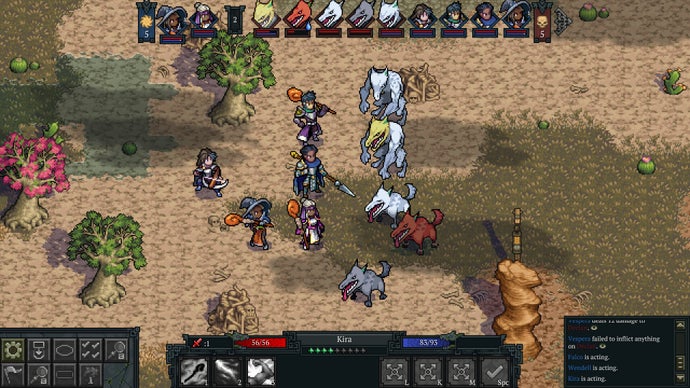
Hooded Horse's latest strategy RPG looks like some Final Fantasy mercs invaded the world of Battle Brothers


I've been savouring the modest upsurge in turn-based strategy games about savage and malodorous bands of mercenaries, not least because it accompanies wordlarking as fine as this. Here to join the screaming pile of gushing throats and grazed elbows is Pathbreakers: Roaming Blades, the latest from Fell Seal: Arbiter's Mark developers 6 Eyes Studio.


Hooded Horse have just announced that they're publishing it, which is lovely because it means I can write about a horse game this week that hasn't been banned from Steam for infringing upon Valve's ever-elastic content policies. There are no scenes of iniquity so far in Roaming Blades, just good, wholesome disembowelment and the chance to blow up lingering balls of lightning. Here's the trailer.

Read more

Pathbreakers Joins the Hooded Horse Family!

[p]Hey everyone![/p][p]
We are thrilled to announce that we will be partnering with Hooded Horse for the development of Pathbreakers: Roaming Blades!

While working on Pathbreakers, we have been in talks with many publishers, but we quickly realized that Hooded Horse was the best fit for us.

Hooded Horse has a deep understanding and expertise in the RPG/strategy field, boasting an impressive catalogue, a sterling reputation, a wide reach, quality localization teams, and a lot more resources.

With their help, we'll be able to bring Pathbreakers to completion faster, in more languages, and with an even greater degree of quality than what we imagined initially!

[previewyoutube][/previewyoutube]
We certainly hope you're as excited as we are about this! Stay tuned, as this partnership should bring some exciting news along for the future of our game. 

6 Eyes Studio Team[/p]

[h3]Join the Community and Follow Along[/h3][hr][/hr]You can find us on Discord, Twitter, Facebook, and Reddit for discussions, updates, and feedback about Pathbreakers: Roaming Blades.

https://store.steampowered.com/app/1777480/Pathbreakers_Roaming_Blades/

Devlog #6 - Building your party

[p]Building your party is one of the fundamental and defining aspects of Pathbreakers: Roaming Blades, and this makes it a lengthy topic to discuss. There are many things to consider when assembling your group of mercenaries, but in this devlog, we will dive into the process you will face when picking the members and how they will serve you in battle, and the roles they play outside of combat.[/p][p][/p][p]By default, you can field up to 8 units in battle and maintain a total roster of 14, though certain Company perks can expand these numbers.
[/p]
Picking the right roles and items
[p]We want to preface that many of the things we are going to discuss are ultimately based on personal preference and playstyle. We’ll be focusing on setups that would appeal to most players, but we are eager to see which combinations and “meta” you will be able to find and exploit![/p][p]A well-rounded party usually starts with strong frontliners. Sellswords and Knights are the classic choices for tanking, relying on heavy armor and high HP. However, there are alternatives: Monks and Rogues can both act as more agile, evasive tanks if built for it.[/p][p][/p][p]Having some healing resources is usually a safe bet, which is where the Vestal shines the most. The advanced class Paladin also has some options there.[/p][p]Still, players who prefer to rely on consumables can stock up on health potions or employ an Alchemist to enhance their effectiveness. Hardcore players might even skip a dedicated healer entirely, focusing instead on raw damage and efficiency. Just remember to plan for a well-equipped infirmary in your caravan to treat wounded mercenaries after battle!
[/p][p]Most battles can't be won without taking out the opposition, so while tanks and healers will keep your crew alive, someone's going to have to focus on taking down the enemies.[/p][p]On that front, most classes have their ways of dealing damage. The Sellsword tends to focus on a single target in melee range. The rogue is a bit more balanced, with single target, multi target, and debuffs, and even ranged options, but they won't be as sturdy.[/p][p]A mage brings solid ranged and AoE options, but they are quite frail and need careful positioning and protection to bring out their full potential.[/p][p]Rangers excel at long-range attacks, and Bards are jacks of all trades, with a lot of team buffing options.[/p][p][/p][p]A mix of tanks, a healer, a few ranged units, and a solid front line is probably a setup that will appeal to most players, but in the end, it's up to the player and their style.
[/p][p][/p]
Building around utilities 
[p]Making your party is not only about damage, tankiness, or healing. While in combat, you must also rely on the various members’ utilities and quirks that can help you defeat your opponent by gaining the upper hand, thanks to their unique traits.[/p][p][/p][p]Some units have very high mobility and even the option to become invisible, so trying to blow up specific enemy units from the start is a viable strategy too.[/p][p]The above considerations are typical when it comes to a balanced team, but there are many other factors to consider.[/p][p][/p][p]For example, the elemental environmental effects are a point of consideration. A player can mostly ignore them and be fine, but at the same time, they can be pretty powerful, so many might be tempted to set up a team that can utilize as many as possible.[/p][p]There are two main setups that utilize elemental interactions. Water + electricity is the first. This setup utilizes water puddles, which slow down most units, and electricity, which propagates damage through connected water tiles. The effects can be fairly potent, but there's always the risk that your own people will be in the water and exposed to the shock.
[/p][p]The other main setup is electricity + fire. This combination is about creating volatile motes on the battlefield with electrical attacks and then exploding them with fire. Electrical motes don't have any effect by themselves, but if you detonate them with a fire attack, they create a high damage explosion and a burning effect. The DPS can be impressive, but again, you have to make sure your own people don't get roasted!
[/p][p]Choosing classes with easy access to elemental effects that you'd like to take advantage of is certainly a worthwhile consideration when deciding on your crew.
[/p][p]That being said, no single strategy will "always work". Some enemies will be resistant to fire, water, or electricity. Some will be very evasive, and others have high physical damage mitigation. Having a few different options is safer than having a one-trick team.
[/p][p][/p]
Variety is the key
[p]There are many other combos a player might consider when forming their team. An example is “attacks of opportunity”. All units have "attacks of opportunity" (by default, they have 1 per turn), which are triggered by moving outside the range of an attacker's melee weapon. This helps your frontline punish opponents who try to get past them to reach your squishy backline.[/p][p]But there is more to it than that. Some mercenaries you can hire, mostly the Knight and the Monk, have access to displacement abilities, either pushing or pulling other units. Forcefully moving a unit can trigger attacks of opportunity from teammates. As such, Knights and Monks can easily act as multipliers when positioned to maximize their displacement capabilities.[/p][p]There are risks to such strategies, of course, as they tend to leave some units overextended or exposed, but it's a high-damage setup.[/p][p][/p][p]Many other combinations exist, some more subtle than others, many of which we probably haven't even thought of. A clever and resourceful player will find many ideas for building their team. Even with multiple units of the same class, how the player allocates their skill points can result in wildly different capabilities, so options abound for interesting compositions.
[/p][p]One other consideration is keeping extra units on your bench as backup for when other characters get hurt, or for particular encounters if a player favors a very specific strategy that might not always be the best. Some of the benched units can be assigned to crafting, manning cannons and ballistae on your caravan, and the like, and they become more effective at it at higher levels, so keeping a benched roster that's in good shape is a good idea.[/p][p]And don’t forget about dungeon exploration! Different types of mercenaries have different dungeoneering specialties, so ensuring the player has extra exploration tools to compensate for their dungeon crew's weaknesses is a good idea.[/p][p][/p][p][/p][p]Finally (and for some, possibly the most important aspect), you wouldn't be building your party if you didn't have options to customize it. The player can set the name, biography, and visuals of all their units, customizing them to their liking.[/p][p][/p][p][/p][p]And that is all for today’s devlog! This was a meaty one for sure, but we really wanted to share with you all the potential and depth that we designed for the party building system that you will experience in Pathbreakers: Roaming Blades.[/p][p][/p][p]If you don’t want to miss out on the next devlog and keep up to date with our latest news, start following us on our socials and be the first to know![/p]

Devlog #5 - The Story

[p]Every journey into the Stormtossed Isle begins with a choice. Who will lead your band of mercenaries, guiding them through danger, intrigue, and discovery? In Pathbreakers: Roaming Blades, this decision takes the form of your avatar: a figure who stands apart from the battlefield, shaping the fate of the group from the sidelines.[/p][p]The avatar is not just any mercenary unit you can find during your adventure. They’re born leaders and are responsible for the well-being of your party. It’s your duty, as the one controlling the avatar’s actions, to oversee not only the combat strategies and equipment of your companions, but also to chart their course through the Isle to keep them fed and paid.[/p][p][/p]
The Avatars
[p]Each avatar comes with its own unique story. Some are bound by curses, others by duty, vengeance, or ambition. Their traits and decisions leave their mark on your campaign, influencing the path you walk and the conclusion you reach.[/p][p]At launch, at least six avatars will be available. Let’s take a look at all of their unique traits and characteristics:[/p]
  • [p]The Adventurer, hounded by a specter of death through a mysterious curse.[/p]
  • [p]The Knight-Errant, eager to dedicate himself to a new lord and a new cause.[/p]
  • [p]The Trader, focused on making a new life for himself on the Isle, dreaming of becoming a top merchant.[/p]
  • [p]The Sorceress, bent on revenge for her slain brother, going against a formidable magical group situated in the Stormtossed Isle.[/p]
  • [p]The Healer, searching for a mysterious panacea said to be found only on the Stormtossed Isle. We still don’t know why she’s looking for it…[/p]
  • [p]The Freebooter, a blank slate for the player to customize.
    [/p]
[p][/p][p]Their stories begin with illustrated introductions that show how they came to the Isle, and end with unique conclusions that tie their journey together. A shared ending option will also be available, ensuring every player finds a way to close their tale.[/p][p]Avatars are more than just a starting point. They are the heart of your campaign, turning every run into a distinct and personal story.[/p][p][/p][p][/p][p]Thank you, everyone, for reading our fifth devlog! We can't wait to show you more of Pathbreakers: Roaming Blades. That's why we recommend you follow our socials to be the first to know when new devlogs, game clips, and more will be published![/p]