1. War Thunder
  2. News

War Thunder News

Fair Play: December 2023


Nobody likes cheaters. We’re continuing to actively fight them — and we want to thank those who are actively helping us on this matter. The number of violations identified and banned recently has significantly increased — and with it of course the integrity of all battles!

[h2]Banned accounts[/h2]
Over the last month, we’ve blocked 6,818 accounts that were found to be in violation of the rules. Specifically 3.2.3 of the EULA namely in the automation of gameplay (using bots) and cheat software.

For full transparency, we’re publishing the full list of these blocked players. This list will be available for two weeks after the publication of this article.

[h2]What we recommend[/h2]
We recommend that you set a strong password for your account and enable two-step authentication in your profile. This will protect your account from fraudsters. And remember, don’t use forbidden client modifications and never share your account information with anyone!

Update 2.33.0.39


  • Overly bright effects in overcast weather have been fixed.
  • A bug that caused an aircraft’s landing gear on Karelia while on an airfield to clip into the ground making it not possible to take off has been fixed. (Report)
  • Challenger 2 — engine smoke (ESS) coming out of the wrong exhausts when using the armor package has been fixed.
  • JAS39A, JAS39C — a bug where it was possible to use the AIM-9 missile even if the AIM-9 modification was not unlocked has been fixed. (Report)
  • The XeSS performance improvement setting for discrete Intel cards is now available under Options > Graphics.

[h3]Sound[/h3]
  • Swedish KSP 58 machine guns now have their own unique firing sound. They previously used sounds from the M1919 Browning.
The current provided changelog reflects the major changes within the game as part of this Update. Some updates, additions and fixes may not be listed in the provided notes. War Thunder is constantly improving and specific fixes may be implemented without the client being updated.

Winter Extreme: Boxer Vilkas


Coming to the game as part of the Winter Extreme event, the Vilkas is the Lithuanian variant of the Boxer armored fighting vehicle jointly developed by four Western European countries, with Germany the lead.

[h2]Boxer Vilkas: An Event Vehicle Light Tank for Germany at Rank VII[/h2]

Features:
  • Excellent mobility!
  • Deadly 30 mm autocannon.
  • Light protection.
  • Crewless turret.
  • Lethal Spike missiles.


[h2]Meet the Boxer Vilkas![/h2]

The Boxer Vilkas will soon be joining Rank VII of the German ground forces tree as one of its most advanced IFVs which you are able to obtain by taking part in this year’s winter event, Winter Extreme. Eager to find out more about this nimble new wheeled AFV? Then join us as we explore the details below!

[h3]Did you know? The name “Vilkas” is Lithuanian which translates to “Wolf”! [/h3]


If you’re a user of German tanks, you’ll be no stranger to highly nimble and well armed IFVs — the Vilkas however takes this experience to the next level. Fitted with a crewless turret that houses the Bushmaster II 30 mm autocannon — an already familiar weapon from the game — the Vilkas can present itself as a serious threat to both other lightly armored vehicles but also to MBTs thanks to its powerful sub caliber ammunition. Furthermore, the Vilkas also comes equipped with a Spike ATGM launcher, enabling you to quickly engage ground targets with the missile’s fire and forget capabilities!

[h3]Interesting: The Boxer features a modular design of its mission compartment. As a result, its configuration can take on many different forms ranging from classical IFV to recovery and training variants.[/h3]


Being a wheeled vehicle, engineers placed a particularly high emphasis on the Vilkas’ mobility. Equipped with a 720 HP engine, the Vilkas can reach a top speed of 103 km/h on paved roads while its high power-to-weight ratio not only ensures high acceleration but also provides this vehicle with good off-road capabilities. However, these are stretched to their limits when faced with extreme terrain conditions such as deep snow or mud: something to keep in mind when making tactical moves on the battlefield!

Despite featuring composite protection, the Vilkas armor layout remains only effective against high caliber machine gun and autocannon fire at longer engagement distances. Therefore, facing off high-caliber cannons and ATGMs head on isn’t the most suitable tactic to employ the Vilkas for.


The Boxer Vilkas comes to War Thunder as a strong reinforcement to the German top rank light vehicle lineup and is a prize in this year’s winter event, Winter Extreme. Happy hunting!

The details surrounding Spall Liners in War Thunder


In War Thunder, we try to add as much details as possible to various types of combat vehicles. Spall liner is a new armored vehicle protection feature that we introduced in the Air Superiority update, which we know is widely discussed on all platforms. We’d like to explain in detail how this mechanic works, and what its capabilities and limitations are.

In the near future, we’ll be making an additional post addressing your concerns with spall liners for MBTs in general.

First up, let’s take a look at what spall liner is in reality. Spall liner is part of the structural protection of an armored combat vehicle, designed to reduce the damaging effect in the main compartment once a tank is penetrated. To do this, liners are attached inside of the main compartment. Material such as fabrics made from aramid fiber are most often used, but other materials are also used occasionally too. These liners help to stop part of the fragmentation flow, reducing the cone of fragment dispersion and therefore reducing the damaging effect caused by armor penetration.

In the game, the effect of a spall liner is implemented as follows: inside the main fighting compartment, directly after the main portion of a tank’s armor, a module is present that imitates spall liner material. These modules have the same size and shape depending on the vehicle and how it is laid out in a vehicle in real life. Taking into account the thickness and resistance coefficient, the current spall liner has a protective equivalent of 2 mm of rolled armor alongside the normal armor amount.


This module also has a structural strength parameter, which is noticeably less strength than the energy caused by a HEAT or APFSDS projectile fired from a tank. Therefore, once penetrated and hit by a powerful projectile, the spall liner is then destroyed.

Secondary fragments from penetration of armor by a HEAT or APFSDS projectile have armor penetration in the range equivalent to 3 to 30 mm of rolled homogeneous armor. This wide spread in variation is due to the simulation of fragments of different sizes and energies formed when armor is penetrated. In the game, a fragmentation stream consists of several groups of fragments with different angles of expansion, having different armor penetration and damage. The more powerful the fragments, the narrower the cone of their dispersion and the smaller their number is. It may seem that there’s an inconsistency here, where the 2 mm of spall liner should not have any effect on the fragmentation flow at all. But if we take into account the fact that when breaking through armor, each fragment also takes into account the angle of contact with the armor, then everything is consistent.


Fragments following a small angle of deviation from a projectile’s trajectory enter the spall liner with a small angle of impact, and the equivalent protection is not enough to stop them. These fragments travel further into the fighting compartment and can damage tank modules and crew. Fragments flying with a large deviation hit the lining at a large angle, so that even a 2 mm equivalent is enough to stop them. Of course, the greater the penetration of a fragment, the fewer such fragments can be stopped by the spall liner, and the amount of fragment spread will be minimally reduced and vice versa. The weaker the fragment, the greater the effect the spall liner has.

The parameters that we set up are made in such a way to slightly reduce the armor effect of powerful APFSDS projectiles and more noticeably affect the damaging effect of HEAT ammo, which coincides with information about real tests of this protection.


We’d like to also clarify that other than adding spall liners, we did not change the damage model settings. The parameters of the fragmentation field (number, range and penetration of fragments) has remained the same as before the update. However, we’ve noticed your feedback about the reduction of fragments after penetration. After checking, we found an error that was discovered in the game code that appeared during the process of refactoring game logic, leading to a decrease in the number of secondary fragments for some weapons. This issue has been found and fixed, and at the moment, the algorithms for fragments after penetration are working as intended.

We’d like to thank you for your feedback surrounding the spall liner and issues with fragment penetration.
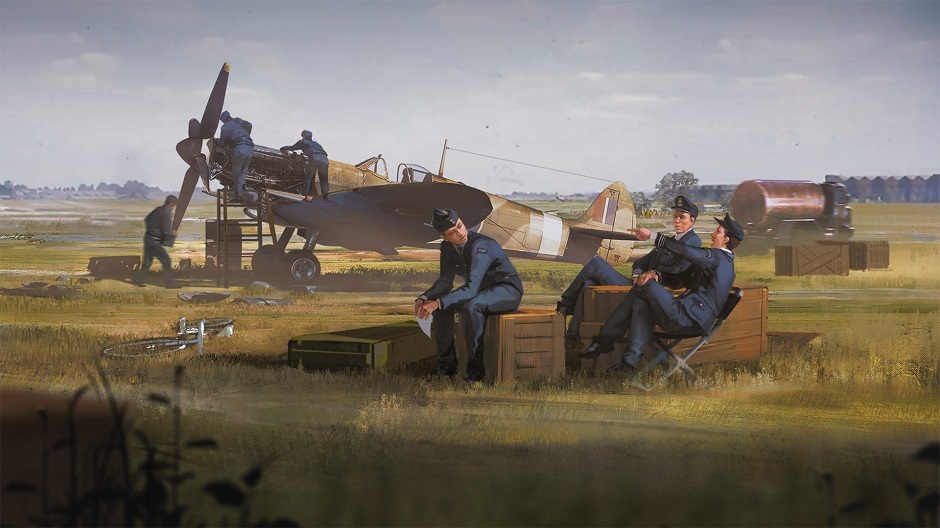
Collecting Your Ideas for the 2024 Roadmap


As previously announced, today we’re inviting you to help us create an interesting list of features and improvements for War Thunder that you’d like to see.

Below you’ll find a link to a survey where you can submit your ideas for the 2024 Roadmap. The survey will be available until December 25th 07:00 GMT.

After we’ve collected your ideas, we’ll take some time to look at them in detail thoroughly. As soon as we draw up specific plans for the 2024 Roadmap, we’ll announce them in a news article.

Click here for the survey