1. War Thunder
  2. News

War Thunder News

Pages of History (October)


[h3]In this month's Pages of History, you'll find yourself at the centre of events that happened at numerous battlefronts. From Hungary and the Netherlands, to Israel and the Solomon Islands — participate in battles using the vehicles that were used in these historic events and receive prizes![/h3]

[h3]
From October 1st until October 31st you’ll be offered 8 tasks consecutively. Completing each will reward you with a trophy, completing all of them earns you a unique player icon.
[/h3]

[h2]Reward for completing all 8 tasks[/h2]

[h3]John Basilone[/h3]
John Basilone was a US Marine Corps Sergeant tasked with defending the Henderson Field airfield on Guadalcanal. On October 24th 1942, his unit came under attack by the Japanese forces, and two machine gun sections under Basilone’s command held them off for two days, not stopping even after only three defenders were left. As ammo began running low, Basilone fought through hostile ground to get supplies to his machine gunners. For his heroism during the battle he was awarded the Medal of Honor, US military’s highest award.

You can immediately purchase this profile icon for Golden Eagles until November 3rd, 11:30 GMT without completing tasks. Click Nickname → Achievements → Pages of History (October).


[h2]Trophy reward for each task[/h2]
Completion of each individual task will bring you a trophy with one of the following rewards:
  • 20-50% RP booster for 3-10 battles;
  • 20-50% SL booster for 3-10 battles;
  • 3-5 universal backup vehicles;
  • 1 day of premium account;
  • A random camouflage for ground vehicles (out of the selection of camouflages currently obtainable in game for completing tasks, or purchasing with Golden Eagles).

[h2]Other terms[/h2]
  • Tasks are available from 11:00 GMT until 11:30 GMT on the final day of each task.
  • Tasks can be completed in random battles, except for “Assault” mode.


[h2]October 1st — October 4th[/h2]
[h3]Battle of the Scheldt[/h3]
The Battle of the Scheldt began on October 2nd, 1944 in Dutch Zeeland and northern Belgium. A month earlier the Allies took Antwerp, the next major port to the east of Normandy, but the ships heading towards it had to pass through the Scheldt estuary which was in range of German artillery. After a month of fierce battles the Canadian army managed to push the Wehrmacht to the east, opening the supply route through Antwerp.

[h2]October 5th — October 8th[/h2]
[h3]Valley of Tears[/h3]
On October 6th, 1973 the Yom Kippur War began, with a coalition of Arab states invading Israel. The advance of much more numerous Syrian forces was held off for three days by the 7th Armored Brigade of the IDF: it lost almost all its vehicles, but managed to push the enemy back. The battlefield was later called the Valley of Tears.

[h2]October 9th — October 12th[/h2]
[h3]Orsha offensives[/h3]
October 12th, 1943 marked the beginning of the Soviet offensive in the Orsha region in Belarus. This area spent two years under German control, allowing the Wehrmacht to build strong defensive fortifications. As a result, the USSR forces suffered heavy losses while gaining little new ground.

[h2]October 13th — October 16th[/h2]
[h3]Battle of the Chinese Farm[/h3]
From October 15th through 18th of 1973 the biggest tank battle of the Yom Kippur War was held on the eastern bank of the Suez Canal. The Israelis called the Egyptian agricultural station with lots of Japanese equipment the “Chinese Farm”: it was near it where hundreds of tanks from both sides met in an intense close quarter combat. Both Israel and Egypt suffered heavy losses in the battle, but Israel emerged victorious and gained control of the bank of the canal.

[h2]October 16th — October 19th[/h2]
[h3]Tikhvin Defensive Operation[/h3]
On October 16th, 1941 the Soviet Army began its defensive operation under Tikhvin. It was one of USSR’s first strategic successes after the start of the German invasion: the full encirclement of Leningrad was prevented, the Wehrmacht wasn’t allowed to take the southern bank of Lake Ladoga, and German and Finnish forces remained separated.

[h2]October 20th — October 23rd[/h2]
[h3]Second Battle of El Alamein[/h3]
On 23rd of October, 1942 the decisive battle of North African Theatre began. The forces of the British Commonwealth were victorious against the Axis armies, making them retreat — first from Egypt, then from Libya, and finally into Tunisia where they were forced into a corner. For this victory General Bernard Montgomery was awarded the title of a viscount.

[h2]October 23rd — October 27th[/h2]
[h3]Battle of Henderson Field[/h3]
On October 23-26, 1942 the Japanese army stormed the American fortifications near Henderson Field airstrip on Guadalcanal, while being supported from sea and air. The opposing forces were nearly equal in numbers, but the losses of the Japanese were 30 to 50 times higher than those of the Americans. The Japanese were forced to withdraw, stopped any large-scale offensive operations on the island, and left it next February.

[h2]October 27th — October 31st[/h2]
[h3]Budapest operation[/h3]
On October 29th, 1944 Soviet and Romanian armies began their advance on the capital of Hungary. They spent the entire November trying to reach the city and then almost all winter in fierce urban warfare: Hitler ordered the German forces to defend Budapest at all costs. Victory was achieved only on February 13th, 1945.
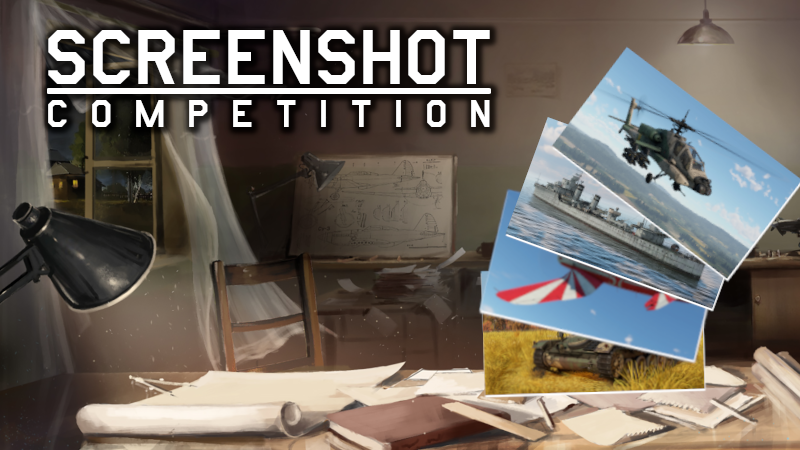
Screenshot Competition - Machines in Motion!


Welcome to the 86th War Thunder Steam Screenshot Competition!


Your screenshots from last week looked fantastic! In many situations, small guns can still pack a punch! The three most popular and three selected by us will get 300 GE. See the winners down below!

[h2]Let’s begin the 86th edition of our competition![/h2]

Create a stunning screenshot and submit it on the War Thunder Steam Community Hub with the tag #WTscreen86. You have time until 29.09.2023 to submit your screenshot.

After that date, 6 winners will be selected (3 of which will be the highest rated by the community and 3 selected by our judges), each of which receive a reward of 300GE.


[h3]Terms:[/h3]
    Your screenshot must include a vehicle in motion.
    You must add the #WTscreen86 tag (title cannot have any other text in it).
  • Screenshots need to be compliant with the War Thunder rules.
  • You need to be the author of the screenshot.
  • Screenshot needs to be new. You cannot use those which have previously been published or used in other competitions.
  • We will only accept raw screenshots from the game. You cannot use any editing software nor any other visual enhancements (like Nvidia Ansel filters).
  • You can use filters and settings built into War Thunder.
  • You can use the replay functionality built into War Thunder.
  • Rewards will be delivered to the author's account within 14 working days.


[h2]And now, time for the winners of the competition’s 85th edition - Small Caliber![/h2]

[h3]Winners selected via community votes:[/h3]
https://steamcommunity.com/sharedfiles/filedetails/?id=3036489266
https://steamcommunity.com/sharedfiles/filedetails/?id=3033249674
https://steamcommunity.com/sharedfiles/filedetails/?id=3036644737

[h3]Winners selected by our judges:[/h3]
https://steamcommunity.com/sharedfiles/filedetails/?id=3037291596
https://steamcommunity.com/sharedfiles/filedetails/?id=3037041947
https://steamcommunity.com/sharedfiles/filedetails/?id=3036607633

Each winner will get 300GE! Congratulations and see you next week!

Update 2.29.0.38


  • A bug that caused flag names and icons to not update when changing camouflage has been fixed.
  • A bug where during a test drive or flight, ammo fired from vehicles was swapped, for example a tank’s machine gun could fire smoke grenades and aircraft missiles fired flares, has been fixed.
The current provided changelog reflects the major changes within the game as part of this Update. Some updates, additions and fixes may not be listed in the provided notes. War Thunder is constantly improving and specific fixes may be implemented without the client being updated.

Tokushu Heiki: Ki-48-II Otsu & Ki-148 Missile


The Ki-48-II is a late modification of the prolific Japanese Ki-48 light bomber, more commonly known under the allied reporting name of "Lily". During the tail end of the war, this aircraft was specifically used as a testbed for an experimental guided missile. Soon you’ll be able to obtain this aircraft along with its unique weaponry by taking part in the upcoming Tokushu Heiki crafting event!

[h2]Ki-48-II, light bomber, Japan, rank II. Premium vehicle.[/h2]

Features:
  • Experimental guided missile.
  • Premium bonuses.


The Ki-48 was developed in the late 1930s under the "fast bomber" principle, which sought to develop a bomber which utilized speed as a defense; if contemporary aircraft struggled to catch it, it wouldn’t need to be weighed down with extra armor or heavy defensive guns. Despite eventually falling out of favor later in the war when allied fighters began to catch up, the Ki-48 continued to see wide use in a variety of roles, one of which being a testbed for a secret weapon. It was selected to test the Ki-148 radio controlled air-to-ground missile, which underwent a variety of trials with the Ki-48 and ended up being produced somewhat widely. However, it failed to enter service before the end of the war.


This late war Ki-48-II model along with its special missile is coming to War Thunder as one of the many exciting prizes in the upcoming Tokushu Heiki crafting event starting on September 26th! Specially modified to carry the deadly Ki-148 — an experimental Japanese WWII air-to-ground missile — the Ki-48-II will join the early ranks of the Japanese aircraft tree as a new premium vehicle. Let’s take a closer look!


The Ki-48-II represents an excellently versatile Japanese bomber, built with speed in mind. Being able to reach a top speed of over 500 km/h at medium altitudes and maintaining excellent agility while doing so, the Ki-48-II can simply outrun its opponents in some cases. If an enemy does manage to catch up however, it also manages to retain a deceptive amount of maneuverability. Enough to let it fly defensively against fighters to bleed their speed, getting them nice and slow for the defensive guns to pick them off. What’s truly unique about the Ki-48 though is its Ki-148 air-to-ground missile. Using manual controls to guide it to its target, you’ll be able to engage an enemy from a range of up to 12 km while still ensuring deadly accuracy. Thanks to its impressive HEAT warhead, the Ki-148 can easily punch through armor, and is therefore equally suited for engagements against both ground and naval targets.


The unique Ki-48-II and the accompanying Ki-148 missile will arrive soon to the early ranks of the Japanese aircraft tree as part of the Tokushu Heiki crafting event. Eager to add it to your collection? Then keep an eye out for the news on September 25th to see how you can take part! See you in the skies!

Tokushu Heiki: LOSAT


Ever heard of an ATGM that doesn’t use a shaped charge? Well meet the American LOSAT tank destroyer — equipped with guided missiles that feature a kinetic penetrator!

[h2]LOSAT, ATGM Carrier, USA, Rank VII. Event Vehicle.[/h2]

Features:
  • Unique kinetic ATGMs.
  • No vertical traverse.
  • Great mobility.
  • Ineffective at close range.


The main tank prize of the Tokushu Heiki crafting event will be the American experimental LOSAT anti-tank system. Featuring a launcher for 12 ATGMs with kinetic armor-piercing cores on a highly mobile chassis — you've definitely never seen something like this before!


At the heart of the LOSAT project are its unique guided missiles. Instead of the standard shaped-charge warhead regularly found on such weapons, the LOSAT missiles utilize a reinforced core, which is accelerated to hypersonic speeds. The principle of this ammunition is functionally quite similar to tank-fired APFSDS rounds, only the missiles fired by the LOSAT have a significantly greater mass.

In flight, these missiles are conveniently guided by a laser beam, but their launch has certain peculiarities. Firstly, the entire ammunition load of 12 missiles are all ready to go in the launcher, but the launcher itself can only traverse horizontally. Once fired, for the first few seconds the missile tends to dip in its trajectory until its engines provide the required propulsion for steady flight. In combat, this means that it's nearly impossible for the operator to accurately hit close range targets, or even guide the missile if there are obstacles in front of the vehicle. Additionally, due to the kinetic warhead, the missile achieves its optimum armor penetration after its engines fully kick in, so even if the missile does connect at close range it won’t have much power behind it.


The platform of the system itself will be familiar to tankers who have experience with the CCVL. It's a mobile platform with a top speed of up to 70 km/h and a quick turn rate for swift adjustments to positioning. The compromise of this mobility however is, no surprise — the armor, which is only bullet-resistant and made of light alloys, so it doesn't offer any tangible protection.


The unique LOSAT tank destroyer will only be available during the Tokushu Heiki crafting event, which starts on September 26th. This vehicle is certainly a special one, we hope you enjoy adding it to your collection! Make sure to check out all the details of the event and how to take part this Monday on the 25th with the news article — See you then!