1. War Thunder
  2. News

War Thunder News

Hungarian Aircraft: The MÁVAG Héja I & II

[p][/p][p][/p][p]A pair of Hungarian Hawks will be making their way to the start of the Italian air tree in the next major update![/p][p][/p]
[p]Héja I and II: Hungarian Fighters for Italy at Rank I[/p]
[p]At a glance:[/p]
  • [p]Two heavy machine guns[/p]
  • [p]Reliable speed[/p]
  • [p]Armored headrest[/p]
  • [p]No suspended weaponry[/p]
  • [p]All-metal construction[/p]
[p] [/p][h3]Vehicle History[/h3][p]The MÁVAG Héja (Hawk) was a development of the Italian Re.2000 and came in two variants. The Héja I was a lightly modified variant, equipped with an 8 mm armored headrest and slightly weaker but more logistically convenient WM K-14A engine. The installation of this new engine necessitated a slight lengthening of the fuselage to accommodate the shift in the center of gravity.[/p][p][/p][p]Based on the operational performance of the Héja I, the Héja II was developed shortly after with some pivotal changes. It was constructed completely in Hungary from the ground up, while still maintaining the basic framework of the Re.2000. This improved variant featured a more powerful WM K-14B engine, and a pair of 12.7 mm Gebauer 1940.M GKM machine guns with a much faster fire rate. The wing fuel tanks were also slightly reduced in size, and a new propeller was installed. In total, 70 Héja I and 204 Héja II fighters were built.[/p][p][/p][p][/p][h3]Introducing the Héja I & II![/h3][p]As promised previously, we’ve been hard at work modeling and developing some domestic Hungarian aircraft to plug the gap at the start of the Hungarian line in the Italian tree. The first aircraft we have to show you are the Héja I and II, developed by Hungary on the framework of the Italian Reggiane Re.2000. Let’s get into them![/p][p][/p][p]The Héja I (Hawk), was a modified version of the Re.2000 exported to Hungary. These aircraft had their engines swapped for the WM K-14A as it was convenient to maintain, though it was slightly less powerful than the original engines. This lighter engine, however, caused a shift in the aircraft’s center of gravity, which resulted in engineers lengthening the fuselage by around 40 cm to accommodate. An 8 mm steel plate was installed behind the pilot as well, increasing survivability but also weight. The Héja I will ultimately be quite familiar and comfortable to fly, maintaining a lot of the core elements of the Re.2000.[/p][p][/p][p][/p][p][/p][p]The Héja II is a much deeper development; while the Héja I was a simple modification, the Héja II was built from the ground up in Hungary. While maintaining the same core design as the Re.2000, it featured several improvements. It received a more powerful WM K-14B engine, redistributed fuel tanks, and swapped out the Italian weaponry with a pair of 12.7 mm Gebauer 1940.M GKM machine guns. These guns still fire the same Italian ammunition, but have a much faster fire rate, increasing their lethality significantly.[/p][p][/p][p]These Hawks represent a key part of Hungary’s aviation history, adding some nice variety to the lower ranks. They’re agile, fast, and effectively armed, making them convenient for new players and veterans alike. They’re also fairly survivable, being full metal designs with pilot armor, allowing you to get away with some glancing hits. The engines do struggle in a climb however, so extra care should be taken to gain altitude before entering into any dogfights, as once that altitude is lost in the heat of battle it will be very difficult to reclaim.[/p][p][/p][p][/p][p][/p][p][/p][p][/p][p]This is just the start, we have even more interesting Hungarian aircraft to show you very soon! Stay tuned and keep checking in, and we’ll be back soon for more. Have a good one![/p][p][/p][p][/p][p][/p][p]Please note that the characteristics of these vehicles may be changed before being added to the game.[/p]

Pages of History (March): The Legless Ace

[p] [/p][p]In Pages of History this month, you will find yourself at the center of events that took place in various theaters of war. From Rzhev and Vienna, Rhine and Euphrates: participate in battles while using vehicles linked to these historic battles and get some prizes![/p][p] [/p]
[p]From March 1st until March 31st, you will be able to participate in 8 tasks consecutively. Completing each task will grant you a trophy with a reward, completing all of the tasks will earn you a unique profile icon![/p]
[p]
[/p][h3]Douglas Bader[/h3][p][/p][p]Douglas Bader was a Royal Air Force ace. In 1931, he lost both legs in an accident and was discharged, but with the outbreak of the Second World War, he returned to service. Bader participated in the Battle of Britain, flying over occupied Europe. On August 9th 1941, he was shot down over France, and while bailing out lost one of his prosthetic legs. The Germans received Bader well and even allowed British aircraft to airdrop a prosthetic leg for him. In total, Bader was credited with at least 20 air victories.[/p][p][/p][p]You can purchase this profile icon for Golden Eagles until April  3rd (11:30 GMT) without completing tasks. To find it, go to your Nickname → Achievements → Pages of History.[/p][p][/p][h2]Trophy reward for each task[/h2][p]Completing each individual task will give you a trophy with one of the following rewards:[/p]
  • [p]20-50% RP booster for 3-10 battles;[/p]
  • [p]20-50% SL booster for 3-10 battles;[/p]
  • [p]3-5 universal backups;[/p]
  • [p]Premium account for 1 day;[/p]
  • [p]A random ground vehicle camouflage (out of those that can currently be unlocked or purchased with Golden Eagles).[/p]
[h2]Other terms[/h2]
  • [p]Tasks are available from 11:00 GMT until 11:30 GMT on the final day of each task.[/p]
  • [p]Tasks can be completed in random battles except for “Assault” mode.[/p]
[p][/p][p]You can read a detailed description of which task is for which day and your overall progress by going to your Nickname → Achievements → Pages of History.[/p][p] [/p][p]March 1st — March 4th[/p][p]Rzhev-Vyazma Operation[/p][p]On March 1st 1943, the Wehrmacht’s Army Group Center began an organized retreat from Rzhev. They employed scorched-earth tactics, so that when the Red Army occupied the abandoned German positions, they were met with only mines and ruins.[/p][p] [/p][p]March 5th — March 8th[/p][p]First Flight of the Supermarine Spitfire[/p][p]On March 5th 1936, the Supermarine Spitfire made its maiden flight at Eastleigh Airfield near Southampton. Test pilot Joseph Summers is said to have said “Don’t change a thing” upon landing, as he loved the aircraft so much.[/p][p] [/p][p]March 9th — March 12th[/p][p]Pskov Operation[/p][p]In March 1944, the Soviet Army unsuccessfully attempted to encircle and capture Pskov. German forces were well-fortified along the Panther Line, taking advantage of natural barriers such as swamps, rivers, and lakes. The Red Army’s advance was hampered by muddy roads and a shortage of engineering resources. A second offensive took place in July, and Pskov was liberated.[/p][p] [/p][p]March 13th — March 16th[/p][p]Saar-Palatinate Offensive[/p][p]On March 15th 1945, the Allies launched an operation in southwestern Germany to clear enemy forces from the Saar-Palatinate and establish bridgeheads near the Rhine. The Wehrmacht’s defenses were successfully crushed, the operation achieved its objectives, and the Allies occupied all major cities in the region.[/p][p] [/p][p]March 16th — March 19th[/p][p]Vienna Operation[/p][p]On March 16th 1945, Soviet troops broke through the defenses at Lake Balaton, reached the Danube, and outflanked Vienna from the south and east. On April 5th, the assault on the Austrian capital began, ending after a week of fierce urban fighting.[/p][p] [/p][p]March 20th — March 23rd[/p][p]Second Battle of Sirte[/p][p]The Second Battle of Sirte took place on March 22nd 1942 between the British escort of a convoy bound for Malta and the Italian fleet, led by the battleship Littorio. The British held out well in the face of superior enemy forces, but the delay allowed Axis aircraft to overtake the convoy and inflict massive damage. Over 80% of its supplies were lost.[/p][p] [/p][p]March 23rd — March 26th[/p][p]Battle of Najaf (2003)[/p][p]From March 23rd to 26th 2003, during the Iraq War, the Battle of Najaf, south of Baghdad, raged. Following this, the Americans, suffering minor losses, captured the city and the Euphrates River crossings in preparation for their offensive on the Iraqi capital.[/p][p] [/p][p]March 27th – March 31st[/p][p]Battle of Cape Matapan[/p][p]In late March 1941, the Italian and Allied fleets clashed in a naval battle south of the Greek Peloponnese Peninsula. Thanks to the interception of Italian communications, British and Australian forces had the advantage and inflicted a crushing defeat on the Italian fleet, sinking three heavy cruisers and two destroyers.[/p]

Reshuffles to the US Ground Vehicle Research Tree

[p][/p][p]Hey everyone! With the release of the upcoming major update, several armored vehicles in the USA research tree will be moved. Comparison images of the tree before and after the changes can be seen below. Check it out![/p][p][/p][p][/p][p]These changes are aimed at improving the research tree structure. Affected vehicles are marked with a special icon in the game.[/p][p][/p][p]We’re announcing upcoming changes in advance to give you the opportunity to plan your tech tree research with an understanding of how the tech tree will look in the near future.[/p]

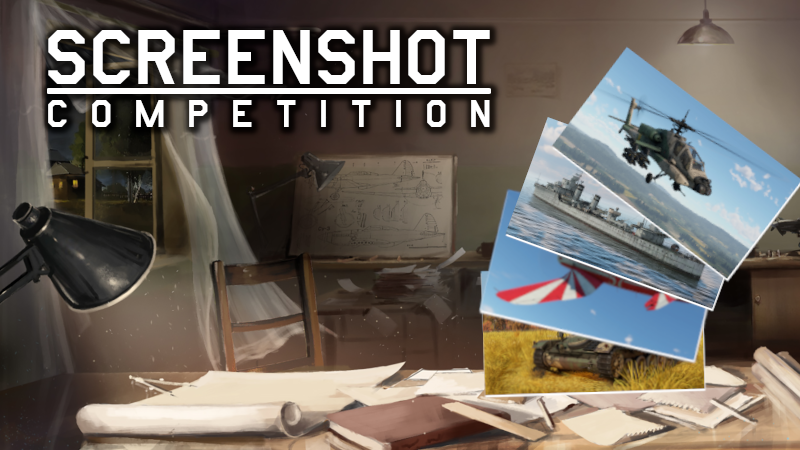
Screenshot Competition – Under Clouded Skies!


Welcome to the 212th War Thunder Steam Screenshot Competition!


Another week brought many great submissions from all of you! This time, we’re focusing on battles set in or beneath cloud cover. Whether your battles are on land, at sea, or in the air, capture a screenshot where the sky helps define the atmosphere! The three most popular and three selected by us will get 300 GE. See the winners down below!

[h2]Let’s begin the 212th edition of our competition![/h2]

Create a stunning screenshot and submit it on the War Thunder Steam Community Hub with the tag #WTscreen212. You have time until the 27th of February to submit your screenshot.

After that date, 6 winners will be selected (3 of which will be the highest rated by the community and 3 selected by our judges), each of which receive a reward of 300GE.


[h3]Terms:[/h3]
    Your screenshot must include a sky with clouds or cloudy weather.
    You must add the #WTscreen212 tag (title cannot have any other text in it).
    Artists may only win by popular vote once per four screenshot competitions.
  • Screenshots need to be compliant with the War Thunder rules.
  • You need to be the author of the screenshot.
  • Screenshot needs to be new. You cannot use those which have previously been published or used in other competitions.
  • We will only accept raw screenshots from the game. You cannot use any editing software nor any other visual enhancements (like Nvidia Ansel filters).
  • You can use filters and settings built into War Thunder.
  • You can use the replay functionality built into War Thunder.
  • Rewards will be delivered to the author's account within 14 working days.


[h2]And now, time for the winners of the competition’s 211th edition – Iron Giants![/h2]

[h3]Winners selected via community votes:[/h3]
https://steamcommunity.com/sharedfiles/filedetails/?id=3666341946
https://steamcommunity.com/sharedfiles/filedetails/?id=3665963374
https://steamcommunity.com/sharedfiles/filedetails/?id=3666756066

[h3]Winners selected by our judges:[/h3]
https://steamcommunity.com/sharedfiles/filedetails/?id=3668559657
https://steamcommunity.com/sharedfiles/filedetails/?id=3666862957
https://steamcommunity.com/sharedfiles/filedetails/?id=3668079502

Each winner will get 300GE! Congratulations and see you next week!

RAAF F/A-18F: Twin-Seat Superbug!

[p][/p][p][/p][p]The two-seater version of the famous Super Hornet arrives in War Thunder! This time, the F/A-18F from the Royal Australian Air Force with AIM-120D missiles and a huge arsenal against ground targets![/p][p][/p]
[p]F/A-18F: A Jet Fighter/Naval Aircraft for Great Britain (Australia) at Rank IX! [/p]
[p]At a glance:[/p]
  • [p]Twin-Seat layout[/p]
  • [p]Wide range of external hardpoints[/p]
  • [p]12 AIM-120D AMRAAMs[/p]
[p] [/p][h3]Vehicle History[/h3][p]Developed in tandem with the F/A-18E Super Hornet, the F model was the twin-seat variant much like the F/A-18B/D was to the A/C. Powered by the same Two F414-GE-400 turbofans as the E model, the F variant allowed for a variety of flexible mission roles operationally, as well as crew familiarisation and training. [/p][p] [/p][p]A Royal Australian Air Force requirement came into being with the need to replace the F-111 fleet before the F-35 would become operational. In 2007, it was announced that 24 Block II F/A-18F Super Hornets would be purchased for the RAAF. With the F/A-18A already in service, this was a natural step to take. The first aircraft would be delivered in 2010 to No.1 Squadron, with all deliveries completed and the type fully operational by 2012. The Australian variants include the AN/APG-79 AESA radar package and capabilities for most integrated Super Hornet Weaponry like the AIM-120, AIM-9, JDAM and LJDAM. The F/A-18F would later be complemented by the EA-18G Growler in RAAF service. [/p][p][/p][p][/p][h3]Introducing the Australian Super Hornet![/h3][p]G’day mates! Today, we’ll be taking a look at the Royal Australian Air Force’s F/A-18F Super Hornet, the twin-seat modification of the famous “Rhino” (or Superbug, depending on who you ask)! Armed to the teeth with a massive loadout of AMRAAMs for aerial engagements or suitably decked out for close air support with a plethora of guided ordinance, this aircraft provides a veritable toolbox for you to use within the British aviation tree![/p][p] [/p][p]Pilots already familiar with the F/A-18E won’t be too surprised to learn that its slightly more spacious counterpart retains the same air-to-air capabilities of 12 x AIM-120C-5 / D AMRAAMs as its maximum loadout. Coupled with the AN/APG-79 AESA radar, the F/A-18F is a significant step up from the previous AF/A-18A Late and Sea Harrier FA.2 you would be stepping up from in the British Naval line. Much like those aircraft however, the “Rhino” is not something you particularly want to be getting into any dogfights or close range engagements with. While you do have AIM-9M IR missiles and a 20 mm M61A2 cannon to fall back on, this aircraft is best kept at ranges where it can launch off its AMRAAM battery and keep a distance from enemy fighters. Make best use of your AESA radar from ranges where it provides the best situational awareness and targeting. [/p][p][/p][p][/p][p][/p][p][/p][p]Air-to-ground however is more where the F/A-18F shines. Complementing the existing British lineups, this Super Hornet offers a massive upgrade over the earlier Australian F/A-18A Late in terms of the sheer number of hardpoints and options. Everything from JDAM-ERs, GBU-10, 12, 16, 24, 31, 38 and 62, among many other guided options are available. Along with the stalwart options like AGM-65 and many conventional bombs for when the occasion calls for it.[/p][p] [/p][p]Naturally, the F/A-18F also comes with all the modern tools you would expect for a platform from this era. Great situational awareness thanks to its RWR system and good targeting capabilities with its helmet-mounted display. Much like its single seat counterpart, the F/A-18F comes with 120 countermeasures. A respectable amount, but by no means the most at this rank. So you’ll need to be selective about how you best configure and apply them in battles. [/p][p][/p][p][/p][p][/p][p]Well thats Hooroo for now! We hope you enjoyed a look at this new gem from down under. It will not be long before you can add the F/A-18F to your hangars and join your rosters within the British tree, coming in the next major update! Until the next one. [/p][p] [/p][p]Please note that this vehicle’s characteristics may be changed before it is added to the game.[/p]