1. Europa Universalis IV
  2. News

Europa Universalis IV News

Dev Diary: Brunei, Malacca, and Aceh

Click here to read on the forums

Good morning! In today’s dev diary we’ll be taking a look at three nations in Maritime South-East Asia: the Sultanates of Brunei, Malacca, and Aceh. Each of these nations founded successful empires during our period, and each has a unique set of national ideas and missions.

Mission trees for Malay nations other than Majapahit are split into 4 sections. In red are missions unique to that country, in this case Malacca. In green and blue are missions available to all Malay nations, and in purple are missions available only after forming Malaya.
The Malacca Sultanate is a descendent of the Srivijaya Kingdom which dominated Java, Sumatra, and the Malay Peninsula prior to the rise of Majapahit. Malacca won the favor of Ming China during the period of Zheng He’s voyages, which set the rising city-state up to be a serious contender to Majapahit’s hegemony. By 1444 Malacca is the richest city-state in the Malay world due to its maritime control over the straits. Malacca would go on expand further on the Malay Peninsula and even onto Sumatra, before ultimately succumbing to Portuguese invasion in 1511.

Malaccan missions reflect their expansion path and diplomatic ties. Some highlights:
  • Wherever appropriate, Subjugation CB’s are awarded instead of permanent claims
  • If you complete the Subjugate Pahang mission by vassalizing Pahang, they will get a ruler of your dynasty, reduced liberty desire, and their religion will be changed from Mahayana to your religion.
  • Malacca is no longer a Ming tributary in 1444. Though in theory they maintained their relations, in reality Ming had largely abandoned its interests in the region. The Emissary to the Emperor mission allows you to restore your special relationship with Ming China.
  • Befriend Champa ties in with one of Champa’s missions - Champa needs to make a Sunni friend in Maritime SEA which gives them the option to convert to Sunni. Completing this mission grants a Subjugation CB against Champa’s greatest enemy: Dai Viet.
  • The mission Make a Show of Force requires having a superior army to both Majaphit and Siak. By demonstrating your superiority over their old overlords, Siak will willingly become your vassal.
  • The Develop Malacca mission can upgrade Malacca’s Center of Trade to level 3 after you improve its development and construct buildings in the province - including a Fort to repel the pesky Portuguese.
  • Loyal subjects grants -10 Liberty Desire in all your subjects until the end of the game.
  • Destroy Majapahit, as you might imagine, requires Majapahit to entirely cease to exist as well as for Malacca to gain a foothold on Java. Completing this mission awards a version of Majapahit’s unlimited subjugation CB: the Malacca Campaigns CB can be used against any country in the Malay culture group and the warscore cost for vassalization is reduced by 25%.

Malaccan national ideas allow them to truly dominate the spice trade and get the most out of their vassals.
MLC_ideas = {
start = {
global_trade_power = 0.1
naval_forcelimit_modifier = 0.33
}
bonus = {
merchants = 1
}
trigger = {
tag = MLC
}
free = yes
mlc_vassal_princes = {
reduced_liberty_desire = 10
vassal_income = 0.25
}
mlc_maritime_laws = {
global_ship_trade_power = 0.2
}
mlc_new_hegemony = {
diplomatic_reputation = 1
}
mlc_islamic_sultanate = {
tolerance_own = 1
}
mlc_habor_masters = {
trade_steering = 0.2
num_accepted_cultures = 1
}
mlc_daulat = {
legitimacy = 1
}
mlc_jawi_script = {
idea_cost = -0.1
}
}

The Aceh Sultanate wouldn’t reach its apex until the reign of Iskandar Muda in 1583, but it’s available to play from 1444. Aceh’s missions and national ideas are also available to neighboring Pasai, which was richer and more dominant in our start date. Iskandar Muda’s conquests would gain Aceh an empire spanning most of the Sumatran coast as well as parts of the Malay Peninsula. Perhaps the most important contribution of the Aceh region to history is its status as the Porch of Mecca, the most prominent hub of Islam in Maritime SEA.

Aceh’s mission tree follows their historical conquests of Sumatra and the Malay Peninsula, but more interestingly it also encourages the player to spread Islam across the region. Some highlights:
  • Completing the Porch of Mecca mission allows you to use the Propagate religion trade policy with only 35% trade power in a node (down from 50%), and also unlocks the Sword of Islam CB, which allows the Force Religion peace treaty against nations with Sumatran primary culture. This CB evolves as you continue to spread your faith across the islands, gaining the ability to target Javanese, Sundanese, Moluccan, and Sulawesi cultures. Completing this branch of the mission tree allows you to use the Sword of Islam CB against any neighboring heathen country.
  • Hindus and Buddhists in the Malay culture group now have a decision to convert to Sunni Islam if it becomes their dominant religion. This gives Aceh the option to spread their faith through peaceful trade or by military force; the choice is yours.


Acehnese national ideas reflect the focus on trade, navy-driven conquest, and religious conversion:
ATJ_ideas = {
start = {
global_ship_cost = -0.1
global_missionary_strength = 0.02
}
bonus = {
production_efficiency = 0.1
}
trigger = {
OR = {
tag = PSA
tag = ATJ
}
}
free = yes
export_economy = {
global_trade_power = 0.1
}
islamise_sumatra = {
missionary_maintenance_cost = -0.25
}
rise_of_aceh = {
province_warscore_cost = -0.1
}
military_adventures = {
naval_morale = 0.15
}
porch_of_mecca = {
technology_cost = -0.10
}
acehnese_moneylending = {
interest = -1
}
settle_the_islands = { # same as malay ideas
global_colonial_growth = 20
}
}

Brunei is a renegade Sultanate, breaking away from Majapahit rule while also avoiding an uncomfortably close relationship with Ming China. The Bruneian Empire would grow to encompass the entire coast of Borneo as well as parts of the Philippines, and was able to resist repeated attempts at European domination long after many of its peers had fallen.

Brunei’s missions lead them to unite Borneo under their rule, and also on a campaign of conquest in the Philippines. The missions Impress Manilla and Impress Sulu vassalize those nations if you can maintain good relations with them, regardless of whether they’d normally accept vassalization. Many of Brunei’s missions also add a province modifier to uncolonized provinces that make them much faster to colonize, hastening their unification of the islands.

Brunei’s national ideas emphasize their dominant navy and diplomatic prowess:
BEI_ideas = {
start = {
land_morale = 0.1
global_ship_cost = -0.1
}
bonus = {
ship_durability = 0.1
}
trigger = {
tag = BEI
}
free = yes
bei_galleys = {
galley_power = 0.2
}
bei_sea_nomads = {
global_sailors_modifier = 0.2
}
bei_diplomacy = {
diplomatic_reputation = 1
}
bei_vassals = {
reduced_liberty_desire = 10
}
settle_the_islands = { # same as malay ideas
global_colonial_growth = 20
}
bei_naval_prowess = {
naval_morale = 0.15
}
bei_trade = {
trade_efficiency = 0.1
}
}

One last thing for today - last week I showed off some new Estate Privileges, but there is one I didn’t show that is exclusive to countries with their capital in the Malaya region. The Orang Laut were (and still are) groups of maritime nomads who extensively engaged in trade with the Malay kingdoms. They were often employed to divert trade to certain ports and to deter pirates, and would grant their allies lands and titles on the islands within their domain. This is in fact how the Malacca Sultanate got its start - Seri Teri Buana, a Srivijayan prince, was granted the small Kingdom of Singapura (modern Singapore) by the Orang Laut, a polity which would eventually become the Malacca Sultanate. Malacca begins with the Orang Laut Alliances estate privilege.

And that’s all for this week! Next week’s dev diary will be a focus on Vietnam, including the new mission trees for Dai Viet and Champa.

Dev Diary: Khmer Empire

Click here to read on Paradox Plaza

Good morning! Welcome to another South-East Asian themed dev diary. This week we’re focusing on the Khmer Empire.

Khmer was once the dominant power in Mainland South-East Asia. Ruling from the mighty capital of Angkor, the empire encompassed most of modern Cambodia, Laos, and Thailand. Due to a combination of factors which may have included plagues, ecological issues, and the decision to change the state religion from Hinduism to Theravada Buddhism the empire fell into decline starting from the 14th Century. Thai and Lao powers broke away from the periphery of the kingdom and established their own domains. In 1431, the killing blow was struck by Ayutthaya with the sack of Angkor. The Khmer empire would never recover from this final defeat. The period following the sack of Angkor has been called the Dark Age of Cambodia, and neatly corresponds to the EU4 timeframe.


Like Majapahit, Khmer begins the game in a Disaster. The Dark Age of Cambodia is a lot less punishing than Majapahit’s situation in that there are no additional events that break up the country or spawn rebellions, but you need to contend with a hefty 25% increase to all power costs (as always, numbers presented in dev diaries are not final). Your priorities will have to be on consolidation and reconstruction rather than expansionism.


Khmer can end their decline and restore the glory of their old empire through their new missions tree. They’ll need to restore their old capital of Angkor, achieve some degree of religious unity, and improve the development of their more rural provinces. When this is achieved the disaster ends and Khmer can truly begin restoring its empire.

Some additional highlights:

  • The Second Golden Age mission rewards -25% powers costs and -33% culture conversion cost for 20 years, compensating for the lost monarch points during the disaster.
  • The Enlightened Rule mission enacts the Chakravarti government reform discussed in previous dev diaries.
  • Around half of the mission tree is focused on military expansion, and like Ayutthaya’s mission tree these missions reward Subjugation CB’s against your targets.
  • The Restore the Empire mission increases your government rank to Empire.
  • The Invade Burma mission grants +0.5 Army Tradition for the rest of the game.
  • The Overseas Adventures mission has you invading Borneo and being rewarded with a permanent +1 Yearly Navy Tradition.


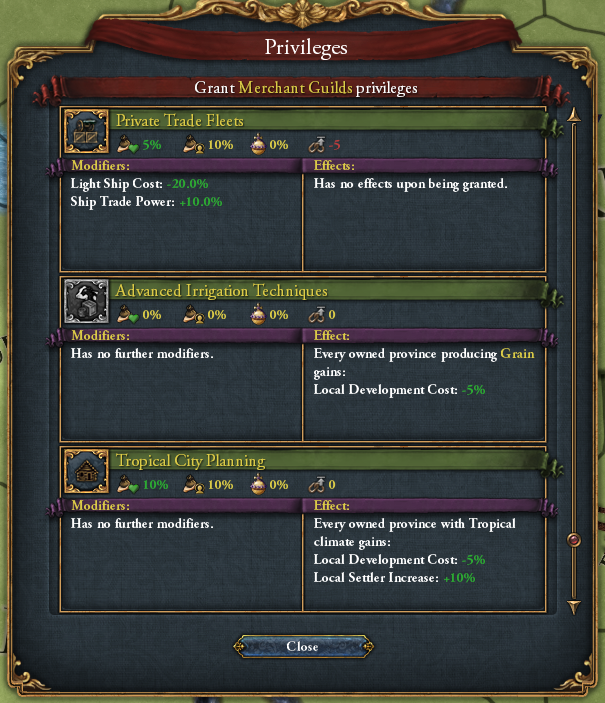
Above you can see four new estate privileges, with effects that should be fairly self-explanatory. Brahmins at Court functions essentially the same as the Brahmin privilege for Indian Muslims. This privilege as well as Advanced Irrigation Techniques are only available to specific nations, including Khmer, and are unlocked through their mission trees. Monastic Temples is available to all Buddhists and provides a new way to control your Karma, while Tropical City Planning is available to all countries in the Chinese or Indian tech groups and offsets the penalties for developing and colonizing in Tropical provinces.

That’s all for today! Next week we’ll take a look at the maritime Sultanates of Malacca, Brunei, and Aceh. And I think the week after that will be Vietnam. There's still plenty of content to show off, so make sure to catch up with weekly dev diaries.

Dev Diary: Java

Good morning! After last week’s dev diary on Ayutthaya, we’re taking a voyage across the sea to Java, home of what remains of the Majapahit Empire.

Majapahit once spanned nearly all of Maritime South-East Asia, ruling over countless vassal states and tributary kingdoms across the isles. The empire reached its golden age under the administration of Gajah Mada, a renowned statesman and military leader who vowed to conquer all of Nusantara for Majapahit.


It has been almost a century since Gajah Mada left office in disgrace after attempting to subjugate the Sunda kingdom against the wishes of both monarchies. The Chinese treasure fleet expeditions of Zheng He severely disrupted the balance of power in the region, with many kingdoms taking the opportunity to strike out on their own and the Chinese supporting the rival Sultanate of Malacca in the west. The Majapahit Empire in 1444 is in a state of severe decay. Only a few of its tributaries remain loyal, a series of bloody struggles over the succession are imminent, and religious tensions are rising. The last remaining tributary states are Blambangan, Bali, Banjar, and Palembang - for owners of Mandate of Heaven, all nations in the Chinese tech group can now have Tributaries regardless of religion.


At the very start of the game, Majapahit begins a unique Disaster that puts them on the road to total collapse if not managed carefully. This is intentionally one of the most difficult disasters in the game, immediately tanking your stability and legitimacy, while also adding a modifier that increases all power costs by 15%, reduces monarch lifespan by 50%, and increases the liberty desire of all subjects by 15%. As always, numbers are not final and I’ll need to play around with this to get the difficulty level right - navigating this Disaster should be a challenge but not an insurmountable one. In addition, every succession will be challenged by a Pretender and events will further increase the Liberty Desire of subjects, who will become independent if their Liberty Desire becomes too high. After dealing with these effects for a while, you’ll be approached with an offer of financial aid from a group of Muslim merchants who wish to trade in Majapahit. Accepting their offer will provide a much-needed influx of cash, but also causes the periodic conversion of your provinces to Sunni Islam. Rejecting this offer causes Majapahit to become diplomatically and economically isolated, with penalties to your diplomatic reputation and trade power.


Above is a worst case scenario. Successor states of Demak and Mataram vie for dominance of Java while the remnants of the Majapahit court helplessly watch their nation collapse. Muslim successor states spawn by event if a significant number of your provinces convert to Islam and you cannot maintain high Legitimacy.

But all is not yet lost! Through their new mission tree, Majapahit have the means to end the Disaster and restore the golden age of their empire:


The Majapahit mission tree is a little different to the traditional mission tree structure. It begins with 4 missions that guide you through the Disaster and alleviate its effects - putting an end to the succession crises, stabilizing the spread of Islam, disabling events that increase subject liberty desire, and preventing breakaway states from emerging. Completing the Prevent Collapse mission finally puts an end to the Disaster, and adds a permanent +1 diplomatic relation slot.

This mission tree does not award permanent claims (with one notable exception) or even Subjugation CB’s against specific countries. Instead, the Enforce Loyalty mission unlocks the unique Majapahit Campaigns CB, which functions similarly to the Subjugation CB but has no time limit, a warscore cost discount of only 25% (compared to Subjugation’s 50% discount), and can be used against any nation in the Malay culture group that you’ve discovered. This eliminates the need to award CB’s or claims preceding missions like Rein in Malacca or Subjugate Makassar. This CB is improved when you complete Gajah Mada’s Oath, which requires you to form Malaya, by unlocking use of the CB against all nations in the Chinese culture group. Completing the Subjugate the Mainland mission improves it for the final time, allowing the CB to be used without restrictions.

Some additional highlights:
  • Completing the Enforce Loyalty mission converts all of your current Tributaries into Vassals.
  • The Chakravarti mission, unsurprisingly, unlocks the Chakravarti tier 1 government reform described in the previous dev diary. It has all the (unrevealed) benefits of the Mandala reform without the penalties, plus a bonus to absolutism and monthly ADM power.
  • The Candi Shrines mission unlocks a new Hindu personal deity - the Buddha. Hindu-Buddhist syncretism was extremely common in South-East Asia, especially on Java. This personal deity increases your Tolerance of Heathen by 2 and decreases your Advisor Cost by 10%.
  • The Porch of Mecca mission requires controlling the Aceh area and spreading your religion through the region. As a reward, you unlock the Propagate Religion trade policy and your Hindu provinces become immune to its effects.
  • The Eastern Campaigns and its follow-up missions each add a permanent province modifier to various uncolonized provinces in Maritime South-East Asia that make them much easier for you to colonize. The final mission in that branch, Dominate the Moluccas, awards a permanent bonus to your Colonial Range and Trade Efficiency
  • Restore the Fleet begins a chain of missions that bring you into conflict with the Ming dynasty, which shattered Majapahit’s hegemony in decades past. Disrupting Chinese Trade adds a permanent modifier increasing your Naval Morale, Blockade Efficiency, and Blockade Impact on Siege - you’re going to need this because the Great Blockade mission tasks you with blockading the entire coast of Ming China. This then grants permanent claims on the Chinese coast.
  • The rightmost missions are part of a set of missions available to all countries in Maritime South-East Asia, and focus on provinces that were noteworthy for producing specific trade goods such as iron in Palopo.


Surprisingly Majapahit does not have its own set of National Ideas in 1.30, and shares the Javan idea set with Sunda and rarely-seen tags like Banten and Mataram. This will be rectified in the South-East Asia update. Below is Majapahit’s new set of National Ideas:

MAJ_ideas = {
start = {
ae_impact = -0.15
legitimacy = 1
}

bonus = {
diplomatic_annexation_cost = -0.15
}

free = yes #will be added at load.

trigger = {
tag = MAJ
}
maj_nusantara_tributaries = {
vassal_forcelimit_bonus = 1
reduced_liberty_desire = 10
}
maj_restore_candi = {
global_missionary_strength = 0.02
}
maj_maritime_silk_road = {
trade_efficiency = 0.1
}
maj_nusa_tenggara = {
colonists = 1
}
maj_gajah_madas_oath = {
land_morale = 0.1
}
maj_majapahit_armada = {
heavy_ship_power = 0.1
navy_tradition = 1
}
maj_reformed_bhattara_saptaprabhu = {
advisor_cost = -0.15
}
}

And that’s all for today. Next week we’ll return our focus to Mainland South-East Asia and take a look at another crumbling empire: Khmer.

Moderator note:

As a reminder, @neondt is a content designer, not a programmer, therefore cannot reply on the programming side of the patch.

This development diary is about content design. Remain on topic.

Fives Ideas for Europa Universalis 5


On the surface, Europa Universalis 4 may look like nothing more than a map and a cartographer's dream, but it has nevertheless exerted a powerful hold on our imaginations and further established grand strategy games as a strategy tour de force.

There are few strategy games in which every single decision has so much impact on the state of the world - a game of such bewildering complexity that it inspires countless inner historians - with so many rules and mechanics that the learning curve stretches into the hundreds of hours.

But EU4 is seven years old now, and is showing signs of age. With Crusader Kings 3 just around the corner ushering in a new era of grand-strategy titles, now is a good time to start thinking about Europa Universalis 5. I've put together several suggestions that could be incorporated into a sequel. Let's take a look...

Don't forget to check out our mod & dlc guides for Europa Universalis 4!

Estates

Historically, the tumultuous relationship between the crown and the estates was often the focus of internal conflict throughout much of the period. Even as late as the 18th century, these localised bodies intersected with the life of the citizens in a much more intimate manner than the monarchy or the state.


Read the rest of the story...


RELATED LINKS:


Deus Vult: Why I'm Excited for the Future of Crusader Kings II

Overview: Europa Universalis IV: Cradle of Civilization

Review: Stellaris: Synthetic Dawn


Dev Diary: Ayutthaya

Click here to read on the Forums

Hello again! Last week I asked you all what nation you’d like me to focus on today, and the two most popular answers were Ayutthaya and Majapahit. Today I’ll focus on Ayutthaya, with Majapahit coming up next week.


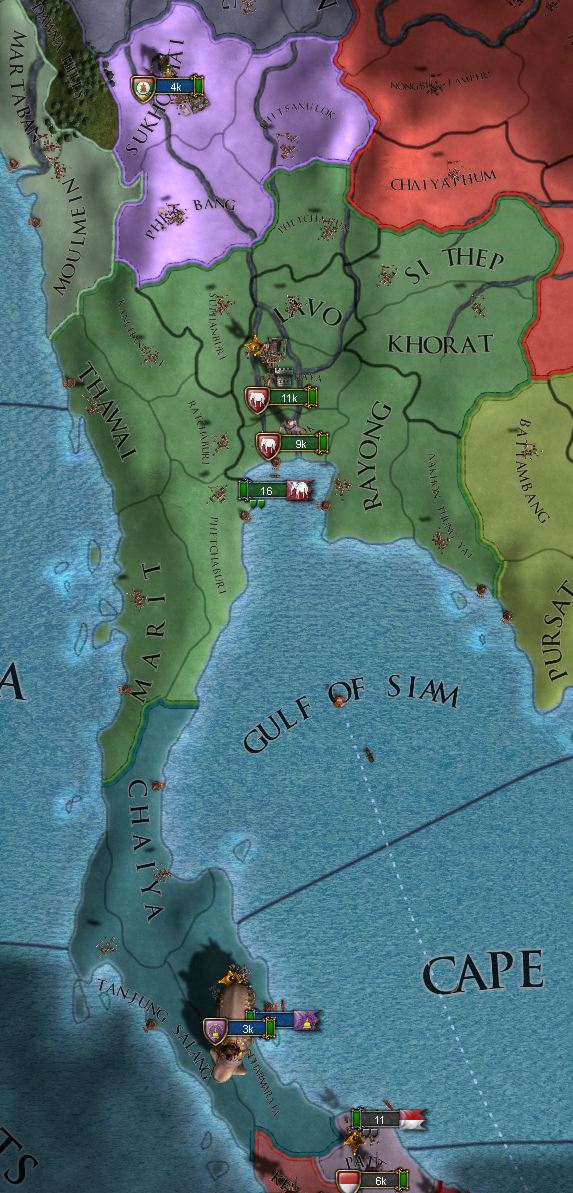
Ayutthaya is the nation that would eventually become known to the West as Siam. It is named after its massive capital city, so large and so bustling with activity that even its canals were filled with floating markets. By 1700 it may have had 1 million inhabitants, making it one of the largest cities on the planet. In 1444 Ayutthaya is a nation on the rise. In 1378 it subjugated Sukhothai, taking its place as the dominant Thai kingdom. In 1431, Ayutthaya sacked the great city of Angkor, capital of the Khmer Empire. The devastation wrought by the Thai armies was so great that the following centuries are known as the Dark Age of Cambodia - more on that in a later dev diary. Ayutthaya also rules the vassal kingdom of Ligor on the Malay Peninsula, and would go on to launch a narrowly unsuccessful invasion of Malacca and a more successful subjugation of its smaller kingdoms like Pattani.


By 1444 Sukhothai is barely even a subject kingdom. Taking advantage of the political situation, Ayutthaya appointed Prince Trailok as King of Sukhothai. Upon the death of his father, Trailok would inherit both kingdoms and rule from Ayutthaya. This will now happen in EU4.

In 1.30 Ayutthaya’s national ideas are both a little on the weak side and not especially supportive of a South-East Asian playstyle. I’ve made some changes to their national ideas to better reflect the flavor of the nation, focusing on vassal-play and diplomacy:

AYU_ideas = {
start = {
cavalry_power = 0.15
liberty_desire_from_subject_development = -0.2
}

bonus = {
diplomatic_annexation_cost = -0.15
}

trigger = {
tag = AYU
}
free = yes

white_elephant = {
vassal_income = 0.2
}
corvee_system = {
global_manpower_modifier = 0.25
}
trading_links = {
diplomatic_reputation = 1
}
ayu_foreign_mercenaries = {
merc_maintenance_modifier = -0.15
}
ayu_embassies = {
improve_relation_modifier = 0.3
}
phrai_luang = {
development_cost = -0.1
}
personal_executions = {
harsh_treatment_cost = -0.2
}
}

Of course it wouldn't be a South-East Asia update without new mission trees. Below is the new mission tree for Ayutthaya, which it shares with the formable nation of Siam:


Ayutthaya’s mission tree rewards very few permanent claims. Instead, many missions award Subjugation CB’s, allowing Ayutthaya to vassalize large nations in a single war. Originally it was enough to simply have the required states owned by you or your subjects, but after some playtesting in both single player and multiplayer I judged these missions a little too powerful. So most subjugation missions additionally require reducing the liberty desire of relevant subjects. It’s not enough to have vassals in name, your subjects must be truly loyal to your will. Your National Ideas have an opportunity to shine here, but it certainly doesn’t hurt to complement them with Influence Ideas.

Some other interesting highlights:
  • Completing the Embassy to Japan mission rewards you with the renowned Japanese adventurer Yamada Nagamasa as a general, as well as access to the Japanese Volunteers mercenary company (highly disciplined soldiers) based in Ayutthaya itself.
  • Completing the Devaraja mission grants a new estate privilege that causes Dharmic faith provinces to have no Religious Unity penalty. We’ll talk about Estate Privileges in more depth in a later dev diary, probably one focussing on the Khmer Empire.
  • Completing the Royal Absolutism mission awards the Chakravarti tier 1 government reform, which will have the (as yet unrevealed) new features of the Mandala reform without the penalties, as well as +10 Maximum Absolutism and +1 Monarch Administrative Power. It also raises your government rank to Empire. If you are playing as Ayutthaya, completing this mission is the only way to form Siam.
  • There are several elements of the leftmost branch of the mission tree that I can’t talk about yet, but the general idea is that you’re using various means to develop your nation, especially your capital, and ultimately making your capital into the most glorious city on earth.
  • The rightmost branch deals with Ayutthaya’s ambitions in Maritime SEA. Preparing an invasion of Malacca can severely harm Malacca’s relationship with the Ming, resulting in the loss of their tributary status. Further missions grant claims only on Centers of Trade in the region and require establishing trade power in the node.
  • The final missions of the central branch (not pictured) have you taking on East Asia’s only superpower - the mighty Ming dynasty - and claiming the Mandate of Heaven.


Ayutthaya can now experience a new Disaster, the Siamese Revolution. In 1688 a rebellion broke out in reaction to the increased European (especially French) imperial presence in Siam and the King’s perceived complicity in the influence these powers were exerting over the country. The stage is set for this Disaster when Ayutthaya has decent (~50) relations with a European power active in South-East Asia. When the Disaster begins, a series of events lead you towards either Openness or Reactionary options each with their own benefits and drawbacks. These events deal with the military, religious, commercial, and diplomatic power that Europeans attempted to impose on Ayutthaya. The disaster can end once you pursue one path to its conclusion.


There are two possible endings to the Siamese Revolution, depending on whether you choose the Openness or Reactionary paths. The historical Reactionary path ends with the Siamese noble Phetracha launching a palace coup and seizing the throne, which historically led to an isolationist period for Ayutthaya - and was perhaps also a factor in Siam becoming the only power in SEA to avoid becoming part of a European colonial empire. This grants a permanent Foreign Spy Detection and Tolerance of the True Faith bonus, but will also destroy your relations with all European powers active in SEA. Following the alt history Openness path results in Phetracha’s arrest and execution, and instead instantly adds a large amount of institution progress in the capital for any institution that is not fully present in your capital but which have been embraced by any European power active in SEA. You’ll also get a permanent bonus to Institution Spread, but a permanent penalty to Foreign Spy Detection.

That’s all for today! Next week by popular demand we’ll focus on Majapahit and the disastrous situation they’ve found themselves in by 1444. Until then, have a good week!

edit: I just noticed the typo in the title. Well, too late. It's the twenty-firth now. :D

Moderator note:

As a reminder, @neondt is a content designer, not a programmer, therefore cannot reply on the programming side of the patch.

This development diary is about content design. Remain on topic.