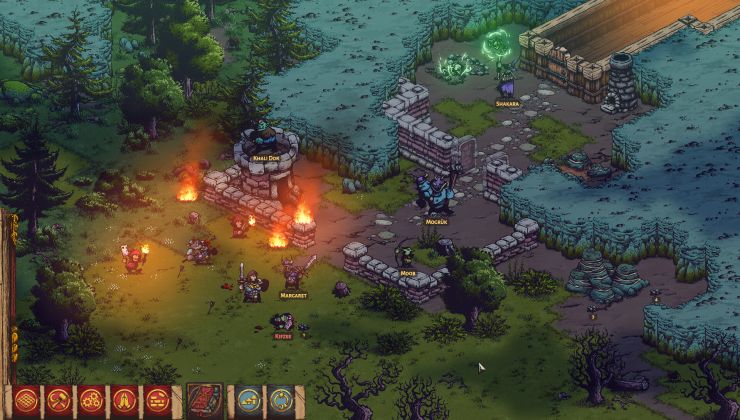
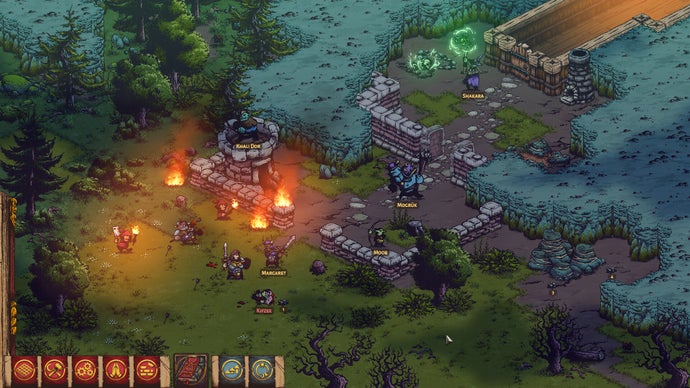
[p]If you've seen any older screenshots or concepts of our game from a few years ago, you might notice a substantial change: the game is now dimetric! This wasn't a decision we made lightly. It represents one of the most significant technical overhauls we've undertaken.[/p][p]Our original orthonormal tilemap approach was hitting its limits. We kept running into frustrating gameplay issues like goblins disappearing behind walls and ogres clipping awkwardly through narrow north-south corridors. The strict grid system put hard constraints on how we could design environments vertically. We were fighting against the perspective instead of working with it.[/p][p][/p][p]
![]()
[/p][p]Looking back at this development screenshot from May, you can see how the scene is completely squared off, except for the wagon is already dimetric. We'd created the wagon long before actually changing the game's perspective, revealing our internal confusion about how to represent complex objects in the scene.[/p][p]When Ulrick, our lead artist, suggested trying a dimetric perspective, we knew we were looking at a massive undertaking. Every asset would need to be repainted. Shaders would need to be rewritten. The entire internal coordinate system would need to be rebuilt from scratch, impacting every gameplay system.[/p][h2]So what's dimetric?[/h2][p]For those unfamiliar with the term,
dimetric perspective is a type of axonometric projection that creates an illusion of 3D depth. While the original XCOM uses isometric projection (giving it an overhead feel),
Space Haven uses dimetric, with wider tiles and a more head-on angle.[/p][p]
![]()
[/p][p]You can see how the green line that defines the outer edge of XCOM's tiles diverges from the red line of Space Haven's dimetric perspective. In my mind, both of these are completely valid approaches and picking one over the other is mostly a matter of appeal.[/p][h2]Putting in a 10% Effort[/h2][p]Before diving into weeks or months of work, we follow what we call a "
10% Effort" rule. We spend 10% of our time exploring whether the other 90% is worth investing. We've used this approach several times before. Once to early prototype the game concept. Once when we decided to integrate Spine as our animation system and again when we decided to switch from the
Bevy engine to Unity.[/p][p]The process is straightforward:[/p]
- [p]Create a cost-benefit analysis. (A glorified pro-con list.)[/p]
- [p]Design a modest experiment that only takes a day or two.[/p]
- [p]Evaluate whether the potential returns justify the full investment.[/p]
[p]For this experiment, I stripped out every feature in the game and rewrote the tilemap shader from scratch. No bells, no whistles, just the bare minimum to test viability.[/p][p]It only took a few minutes to get promising results.[/p][p][/p][p]
![]()
[/p][h2]The Camera Rotation Challenge[/h2][p]Of course, Blake and Ulrick immediately asked "Can we rotate the camera?"[/p][p]This was tricker than it sounds. Our game isn't truly 3D or even 2.5D, it's completely 2D with clever perspective tricks. Rotating the camera wouldn't actually rotate anything.[/p][p]Instead we'd need to:[/p]
- [p]Draw the map completely from the new rotated perspective.[/p]
- [p]Reposition each asset at a new "rotated view position."[/p]
- [p]Recalculate the auto-tiling of things like hills and walls.[/p]
- [p]Author many assets at four different angles.[/p]
[p]Against my better judgment, I gave it a try and it worked![/p][p]Here is an example of a simple scene from the current build of the game rotated by 90 degrees. You can rotate to four different angles.[/p][p]
![]()
[/p][p]
![]()
[/p][h2]Rebuilding Feature by Feature[/h2][p]With the technical concept proven, we began the painstaking process of adapting every system to the new perspective.[/p][p][/p][p]
![]()
[/p][p]The grey-boxed hills in this shot demonstrates our development process. We create new assets at low conceptual resolution first, then replace them with final artwork once the bugs are fixed.[/p][p]One challenge with the new perspective has been sorting multi-tile sprites. Take the Covered Wagon, for example. We had to dynamically split it into half-tile-wide strips that could be drawn at different depths. This allows one character to stand in front of the wagon's left side while another stands behind the same section. Since every asset uses translucency, efficient scene sorting remains a source of technical effort.[/p][p][/p][p]
![]()
[/p][p][/p][p]Above: A shot of the wagon, sliced at runtime during actual gameplay. Below: The wagon drawn at four angles to support camera rotation.[/p][p][/p][p]
![]()
[/p][p][/p][h2]Cutaways and Dynamic Lights[/h2][p]Two major technical improvements came with the transition: cutaways and enhanced lighting.[/p][p]Cutaways solve a fundamental problem with base construction—how to add detail without cluttering the gameplay view. If a wall blocks your work, you can cut it away to make everything visible. Alternatively, you can simply rotate the scene to bring occluded items into view.[/p][p][/p][p]
![]()
[/p][p]The lighting system also received significant upgrades. We added light portals to the dynamic lighting, allowing firelight to spill through open doorways and illuminate exteriors. While our progress shots show some early bugs with smoke particle blending, the system was really taking shape. All lighting is fully dynamic, enabling effects like flaming arrows and illuminated spells to cast their own light.[/p][p][/p][p]
![]()
[/p][h2]Looking Forward[/h2][p]This transition to dimetric perspective represents a lot of work, but the results speak for themselves. The game feels more immersive, gameplay is clearer, and we have far more flexibility in how we design environments and interactions. We think that base building will be a lot more interesting, with the ability to create more detailed wall sections and attach things like tapestries and decorations to walls.[/p][p]While we still have refinements to make, the foundation is solid. Most importantly, we're no longer fighting against our own perspective system. Instead, we're working with it to create something even better than we originally envisioned.[/p][p][/p][p]
Wishlist Architect of Ruin![/p]