1. Armored Warfare
  2. News

Armored Warfare News

Maintenance - November 11

On the 11th of November, starting from 8:00 CEST (10th of November, 11 PM PST), the server will not be available for 5 hours due to the application of Update 0.33.7478


[h2]List of Update 0.33.7478 Changes[/h2] 

Challenger and PTZ-89 HESH Changes

These vehicles received the following changes to their HESH shells:
  • Shells renamed from L31A5 to L31A4
  • Challenger 1 HESH damage reduced from 510 to 460
  • PTZ-89 HESH damage reduced from 510 to 430
  • PTZ-89 HESH shell now has the same penetration and velocity as the one of the Challenger 1 MBT
Leopard 2 Changes

All Tier 7 to Tier 10 Leopard MBTs were adjusted as such:
  • Added the Improved Propellant module to all of them, reducing the kinetic shell penetration loss over distance by 10 percent
  • Improved the thickness of mid- and rear-part of its flanks by 20mm
  • Reload time improved by 0.4s
2T Stalker
  • ATGM minimum damage dealt upon non-penetration changed to take armor thickness more into account (thick armor hits now do less damage)
AFT-10
  • ATGM penetration increased from 1400mm to 1450mm
  • ATGM damage increased from 1200 to 1300
  • ATGM minimum damage dealt upon non-penetration changed to take armor thickness more into account (thick armor hits now do less damage)
  • ATGMs now accelerate to their maximum flight speed faster
  • ATGMs are now a bit less agile but also less affected by soft-kill APS
Altay
  • Fixed this vehicle’s UI armor values to correspond to the actual ones
BMP-3 and BMP-3M
  • Updated the armor of these vehicles (their frontal armor is now able to withstand the fire of 30mm autocannons at certain distance)
BMPT Mod.2000
  • 30mm AP shell penetration loss over distance brought to the same value as for other vehicles
  • ATGM minimum damage dealt upon non-penetration changed to take armor thickness more into account (thick armor hits now do less damage)
  • ATGMs are now a bit less agile but also less affected by soft-kill APS
  • ATGM damage increased from 920 to 1000
BMPT Mod.2017
  • 30mm AP shell penetration loss over distance brought to the same value as for other vehicles
  • Delay between ATGM launches increased from 3s to 4s
  • ATGM minimum damage dealt upon non-penetration changed to take armor thickness more into account (thick armor hits now do less damage)
  • The vehicle no longer fires from both autocannon barrels at once
  • ATGM penetration increased from 1000mm to 1100mm
  • ATGM damage increased from 850 to 900
BMPT-72
  • ATGM damage increased from 850 to 900
  • Delay between ATGM launches reduced from 4s to 3s
  • ATGM minimum damage dealt upon non-penetration changed to take armor thickness more into account (thick armor hits now do less damage)
  • The vehicle no longer fires from both autocannon barrels at once
Bradley FV
  • ATGM minimum damage dealt upon non-penetration changed to take armor thickness more into account (thick armor hits now do less damage)
  • 30mm AP shell damage increased from 23 to 32
  • Autocannon rate of fire increased from 400 to 450 RPM for 30mm shells
  • 40mm AP shell penetration increased from 210mm to 230mm
  • Delay between ATGM launches reduced from 3s to 2s
  • Tandem HEAT ATGM damage increased from 850 to 900
  • Tandem HEAT ATGM penetration increased from 950mm to 1000mm
CRAB
  • Delay between ATGM launches reduced from 3s to 2s
  • ATGM minimum damage dealt upon non-penetration changed to take armor thickness more into account (thick armor hits now do less damage)
  • ATGMs now accelerate to their maximum flight speed faster
  • Somewhat reduced the camouflage penalty for ATGM launches
Hunter AFV
  • ATGM minimum damage dealt upon non-penetration changed to take armor thickness more into account (thick armor hits now do less damage)
  • 40mm AP shell damage increased from 38 to 44
  • 40mm AP shell penetration increased from 192mm to 210mm
  • 40mm AP shell rate of fire reduced from 450 to 400
K-153C Raybolt
  • Viewrange increased from 425m to 440m
  • Somewhat reduced the camouflage penalty for ATGM launches
  • Target lock time reduced from 1.7s to 1.6s
  • Magazine reload time reduced from 17s to 15s
K21
  • 40mm AP shell penetration increased from 210mm to 230mm
K21 XC-8
  • This vehicle now has a 4-round Ready Rack with 3.5s between shots within the Rack and 5s reload time once it’s empty
Kornet-EM
  • ATGM damage increased from 900 to 1100
  • ATGM minimum damage dealt upon non-penetration changed to take armor thickness more into account (thick armor hits now do less damage)
  • ATGMs now accelerate to their maximum flight speed faster
  • ATGMs are now a bit less agile but also less affected by soft-kill APS
  • Fixed an issue where this vehicle wasn’t dealing the correct damage when firing in the single launcher mode
Leclerc T-40
  • 40mm AP shell penetration increased from 210mm to 230mm
M1128 Stryker
  • Stock gun reload time reduced from 6.2s to 4.5s
M113 Hellfire
  • ATGM minimum damage dealt upon non-penetration changed to take armor thickness more into account (thick armor hits now do less damage)
M1134
  • ATGM minimum damage dealt upon non-penetration changed to take armor thickness more into account (thick armor hits now do less damage)
  • Tandem HEAT ATGM damage increased from 850 to 900
  • Tandem HEAT ATGM penetration increased from 950mm to 1000mm
  • Removed the restriction on the amount of ATGMs simultaneously in flight
NM142
  • Tandem HEAT ATGM damage increased from 850 to 900
  • Tandem HEAT ATGM penetration increased from 950mm to 1000mm
  • Delay between ATGM launches reduced from 3s to 2s
  • ATGMs now accelerate to their maximum flight speed faster
  • Somewhat reduced the camouflage penalty for ATGM launches
  • ATGM minimum damage dealt upon non-penetration changed to take armor thickness more into account (thick armor hits now do less damage)
Ramka-99
  • 30mm AP shell penetration loss over distance brought to the same value as for other vehicles
  • Delay between ATGM launches reduced from 4.5s to 3.5s
  • ATGM minimum damage dealt upon non-penetration changed to take armor thickness more into account (thick armor hits now do less damage)
  • The vehicle no longer fires from both autocannon barrels at once
Rosomak
  • 30mm AP shell damage increased from 23 to 32
  • Autocannon rate of fire increased from 400 to 450 RPM
Rosomak M1
  • ATGM minimum damage dealt upon non-penetration changed to take armor thickness more into account (thick armor hits now do less damage)
  • 30mm AP shell damage increased from 23 to 32
  • Autocannon rate of fire increased from 400 to 450 RPM
Sphinx
  • ATGM damage increased from 750 to 850
  • ATGM minimum damage dealt upon non-penetration changed to take armor thickness more into account (thick armor hits now do less damage)
  • ATGMs now accelerate to their maximum flight speed faster
  • ATGMs are now a bit less agile but also less affected by soft-kill APS
  • Stock 40mm AP shell penetration increased from 210mm to 230mm
  • Upgraded 40mm AP shell penetration increased from 252mm to 260mm
T-72 Ural
  • Rebalanced this vehicle’s armor and improved its visual model quality
T-15 Armata
  • ATGM penetration increased from 1200mm to 1300mm
  • ATGM damage increased from 900 to 1100
  • ATGM minimum damage dealt upon non-penetration changed to take armor thickness more into account (thick armor hits now do less damage)
  • ATGMs now accelerate to their maximum flight speed faster
  • ATGMs are now a bit less agile but also less affected by soft-kill APS
T-90MS
  • Fixed this vehicle’s smoke deployment location
Type 89
  • Fixed an issue where Mechanized Infantry would sometimes die upon disembarkation
VCAC Mephisto
  • ATGM minimum damage dealt upon non-penetration changed to take armor thickness more into account (thick armor hits now do less damage)
VBR
  • Viewrange increased from 410m to 430m
  • Upgraded ATGM damage increased from 600 to 650
  • ATGM minimum damage dealt upon non-penetration changed to take armor thickness more into account (thick armor hits now do less damage)
  • ATGMs now accelerate to their maximum flight speed faster
  • ATGMs are now a bit less agile but also less affected by soft-kill APS
  • Somewhat reduced the camouflage penalty for ATGM launches
Warrior
  • ATGM minimum damage dealt upon non-penetration changed to take armor thickness more into account (thick armor hits now do less damage)
  • ATGMs now accelerate to their maximum flight speed faster
  • ATGMs are now a bit less agile but also less affected by soft-kill APS
  • Autocannon rate of fire increased from 400 to 450 RPM
  • Stock ATGM damage increased from 500 to 550
  • Upgraded ATGM damage increased from 560 to 600
  • 30mm AP shell penetration loss over distance brought to the same value as for other vehicles
Wiesel HOT
  • ATGM minimum damage dealt upon non-penetration changed to take armor thickness more into account (thick armor hits now do less damage)
Wilk XC-8
  • PELE shell damage increased from 550 to 600
  • Missile reload time reduced from 4s to 3.5s
ZTQ-15
  • Simplified the ERA and spaced armor layout in order to reduce the number of unintended weakspots
  • Fixed the issue that caused this vehicle’s machinegun blast to appear in an incorrect spot
ZUBR PSP
  • Tandem HEAT ATGM damage increased from 850 to 900
  • Tandem HEAT ATGM penetration increased from 950mm to 1000mm
  • Delay between ATGM launches reduced from 3s to 2s
  • Missile reload time reduced from 4s to 3.5s
  • ATGMs now accelerate to their maximum flight speed faster
  • Somewhat reduced the camouflage penalty for ATGM launches
  • ATGM minimum damage dealt upon non-penetration changed to take armor thickness more into account (thick armor hits now do less damage)
General Changes
  • Fixed the issue that allowed for an incorrect full magazine reload when switching shells during the reloading process
  • Fixed the issue that broke some HE shells (the “violet HE rounds with broken description” bug)
  • Fixed an issue with the Defense active ability, which incorrectly reduced the hull traverse rate value
  • WPB Anders, PL-01 and Draco: Removed the module that improves these vehicles’ time to switch between different shell types since these vehicles already have this ability by default
  • Fixed the XM1A3 Archangel gun collision model
  • Fixed an issue where the Leopard 2 MBT would keep the name Leopard 2A4HU even after the 2A4HU skin was disabled
  • Port Storm: Fixed the textures on several buildings
  • Fixed a rare issue where some AI vehicles would not fire at players
  • Fixed an issue that arose in Update 0.33, where the PCs with their GPUs significantly more powerful than their CPUs would suffer from performance losses
  • Fixed an issue that caused vehicle shadows to remain even when the vehicles were no longer spotted
  • Fixed an issue where the HQ PvE mission change timer did not correspond to the actual server timer
  • Fixed a number of smaller visual model issues
  • Fixed some smaller UI issues
  • Added a number of assets for future events
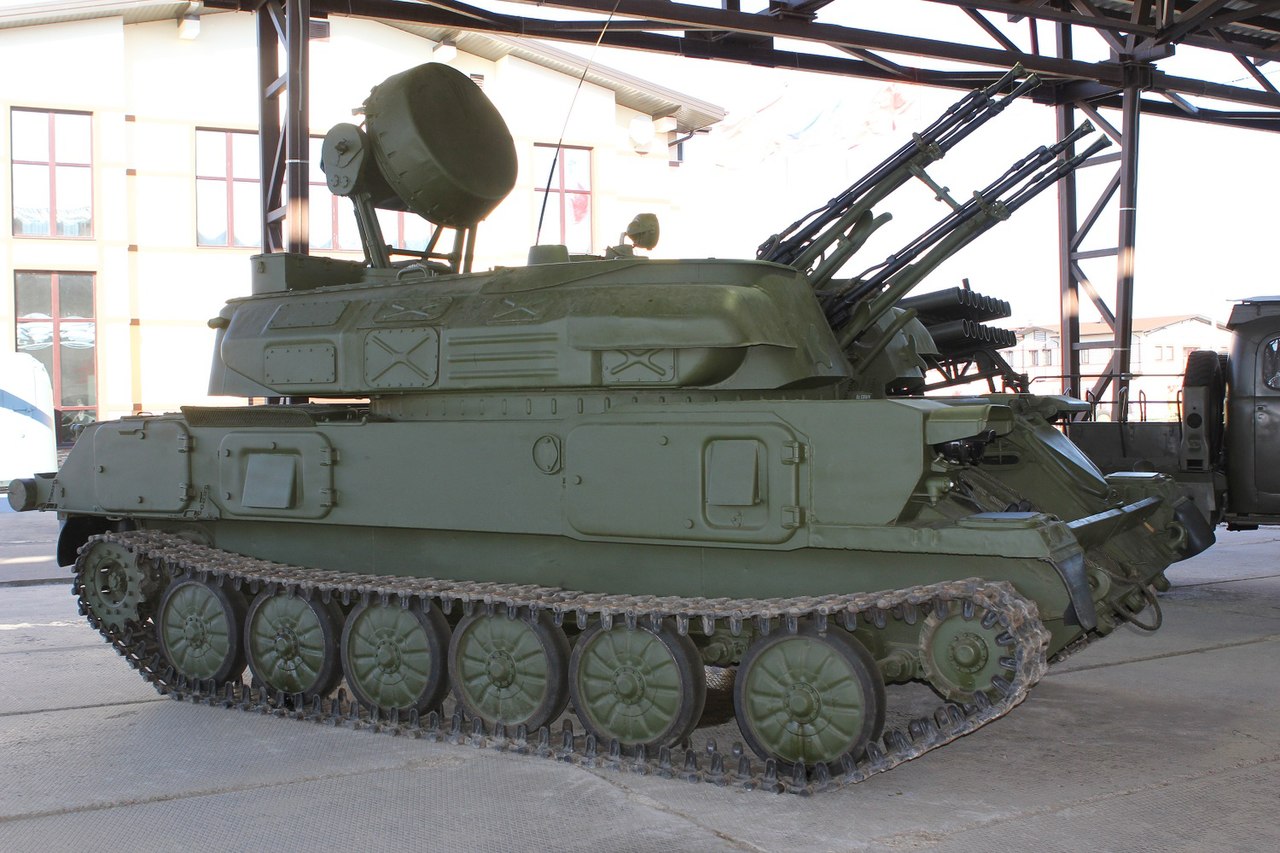
In Development: ZSU-23-4 Shilka

Commanders!

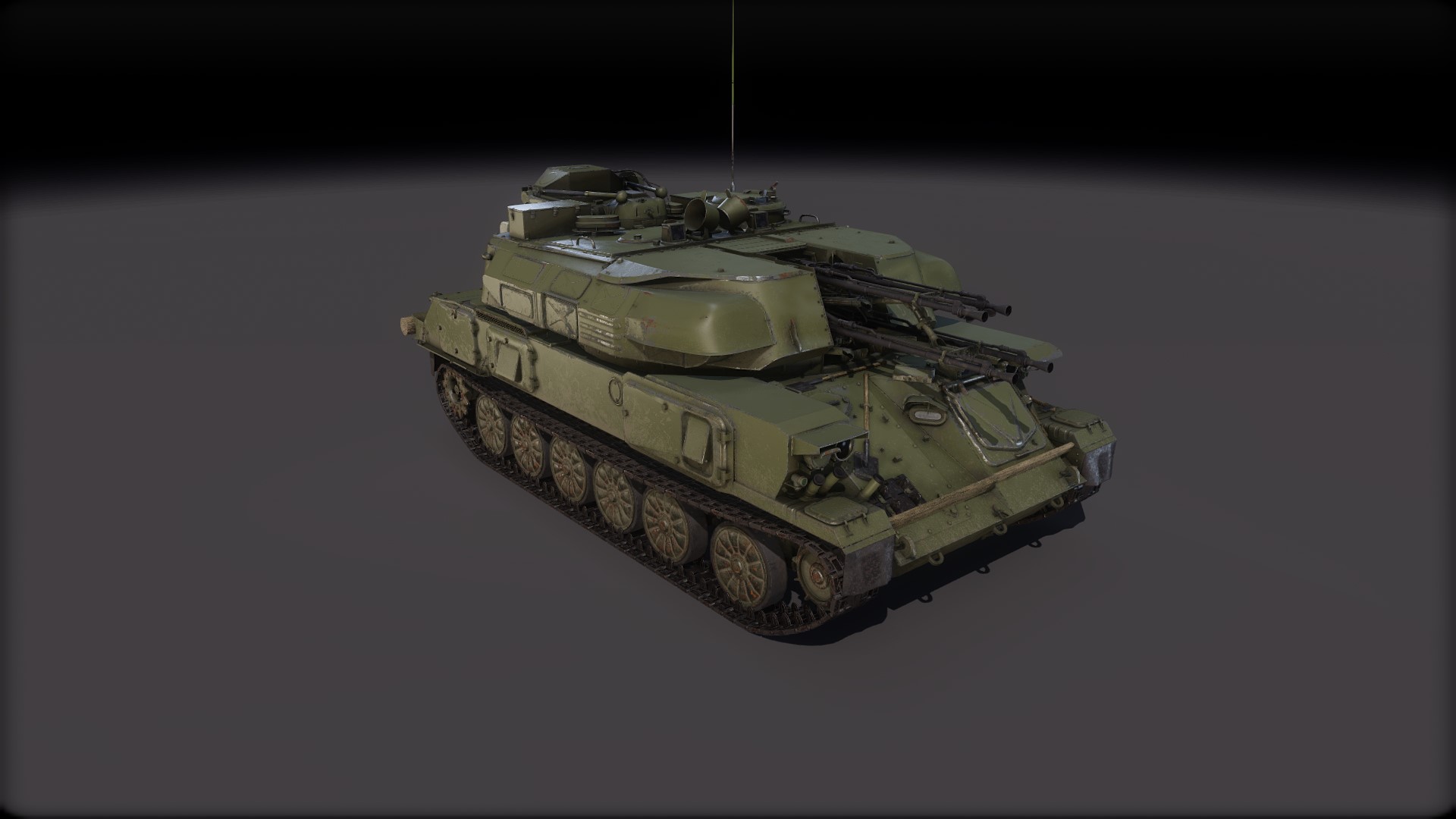
The first reward vehicle that you’ll be able to obtain in the Echoes of War Battle Path campaign will be none other than one of the symbols of the Soviet military, the legendary ZSU-23-4 Shilka.


The Shilka (named after a Siberian river) came to be in the early 1960s as an attempt to provide Soviet mechanized forces with a short-range highly mobile anti-air platform that would also feature some basic protection. The designation itself, ZSU-23-4, stands for “self-propelled anti-aircraft gun” with the number signifying its gun caliber (23mm) and the amount of barrels (4).

Of course, Shilka wasn’t the first such design in the Red Army – ever since the 1950s, the Soviet Union had been operating a vehicle called ZSU-57-2, which, as you might have guessed from the abovementioned nomenclature, was armed with two large 57mm cannons on a heavily modified T-54 chassis – in an enclosed turret. The Soviets adopted this vehicle after witnessing (and later exploiting) the power of close support aircraft and ground troop cooperation.

While offering a lot of firepower, the ZSU-57-2 was still a design from the WW2 era, intended to be used against propeller-driven (and therefore slow) aircraft. It had a rudimentary fire control system and by the time it entered service in 1955, it was effectively obsolete because after the Korean War, everyone saw that the future would belong to jet planes.

As a result, the work on its replacement therefore began practically immediately after it entered service. There were two basic directions of development – a twin 37mm autocannon project called Enisey (built to be a rough equivalent to the American M42 Duster) and a quad 23mm autocannon project called Shilka. The prototypes of both vehicles were ready by 1960 with the trials taking place until 1961. During various joint exercises, the Shilka would ultimately turn out to be considerably more effective than the Enisey (despite Enisey’s good performance) and would enter service in 1962.


The defining characteristics of the Shilka would be its low weight (mere 19 tons), light armor and high firepower of its quad water-cooled 23mm guns. Thanks to its excellent cooling system, the vehicle was able to fire as many as 3400 rounds per minute. The system was guided by rather advanced radar and was therefore capable of engaging even fast-flying targets.

The Shilka would turn out to be a very successful design. Roughly 6500 were built between 1964 and 1982 (the original production run ended in 1968) with some 2500 of them exported all over the world. They participated in pretty much every major conflict of the 20th century, including the Soviet-Afghan War, the Vietnam War, the Yom Kippur War, the Gulf War and many others, sometimes even appearing on both sides. The brutal volume of fire it offered in combination with HE shells would often be used against soft ground targets with excellent results. Several modernized variants exist, more than two dozen countries or organizations still operate it and it is even now being used in several conflicts, including the Donbass War or the Syrian Civil War.


In Armored Warfare, the Shilka will be a Tier 4 Premium Armored Fighting Vehicle. Once again, just by taking one look at it, it is not difficult to determine this AFV’s main feature – it is not long-range accuracy or heavy armor, but its sheer, uncompromising volume of fire.

But before we get into any details, the usual disclaimer:

The numbers below are very preliminary as the vehicle has not been properly tested. They are sure to change and should only be discussed as an indicator of how we’d like to set the vehicle up. With that being said:

In order to imagine how the Shilka will perform in the game, you can start with the XM247 that sits one Tier higher.


The Shilka will have very light armor only (protecting it against machinegun fire) and average mobility due to the fact that its 21 tons will be propelled forward by a diesel engine producing just 280hp. Its maximum speed will therefore be limited (50 km/h), as will its agility and acceleration. As you can also see from its size, its camouflage levels won’t be great either. This will not be an agile, stealthy, fast scout.

However, these downsides are more than compensated by its weapons and viewrange. Let’s talk about the firepower first.

The Shilka is armed with four 23mm guns with the combined rate of fire of 3400 rounds per minute. This is achieved by using overheat mechanics similar to those utilized by the M48 GAU-8 Tier 10 TD. Simply put, the guns do not utilize magazines, but instead heat up when being fired. If you fire them too much, they overheat and need several seconds to cool down. Much like in real life, the weapon system will offer excellent elevation (+85 degrees) but only mediocre gun depression.

There will be three types of rounds available:
  • Basic AP (100mm of penetration, 18 damage)
  • APDS (150mm of penetration, 15 damage), available via additional progression
  • PELE (70mm of penetration, 20 damage with non-penetration PELE damage mechanics), available via additional progression

Additionally, all these rounds will also deal reduced damage upon non-penetration automatically, much like those of the M48 GAU-8. This will not allow the vehicle to destroy MBTs from frontal angles, but anything lighter is pretty much fair game.


The already excellent viewrange for its Tier (440m) will be possible to improve even further by activating the Radar ability, which will trade some of your (already low) camouflage for extra spotting abilities.

In summation, the Shilka will be the undisputed king of damage output on lower Tiers, balancing its firepower by its low survivability. This will make the vehicle highly suitable for PvE but, at the same time, any PvP mode will require careful gameplay and staying behind your team’s MBTs.

We hope that you will enjoy this vehicle and, as always:

See you on the battlefield!

DCOT "Monster Munch" PvE Tournament

Commanders!

It's time to challenge other teams in this exciting PvE tournament organized by DCOT!


[h2]Where does the event take place?[/h2]
 
  • Language: German/English (My.com clients only)
  • Date: 14.11.2020
  • Time: from 16:00 to 23:59 CET (all results must be from within 3 hours)
  • Mode: PvE Hard
  • Format: 5 Player-Platoons, the best 5 XP results count
  • Tier: 7 (Premium vehicles permitted)

 
[h2]How to sign up?[/h2]
 

The registration is open until 13.11.2020, 23:59 CET.

[h2]Prizes[/h2]

The best five teams will obtain the following prizes:
  • First place: Spinx Monster Tier 10 Premium AFV for each member of the team
  • Second place: Sucuri II Monster Tier 6 Premium TD for each member of the team
  • Third place: Jarmila II Monster Tier 4 Premium AFV for each member of the team
  • Fourth place: 14 days of Premium Time for each member of the team
  • Fifth place: 7 days of Premium Time for each member of the team

 
[h2]Rules and Organizer[/h2]

The host of this Event is the DCOT (Deutsche Community Organisations-Team). You can find the list of rules following this link. We'll see you on the battlefield!

Historical Skins – T-72M LWP

Commanders!

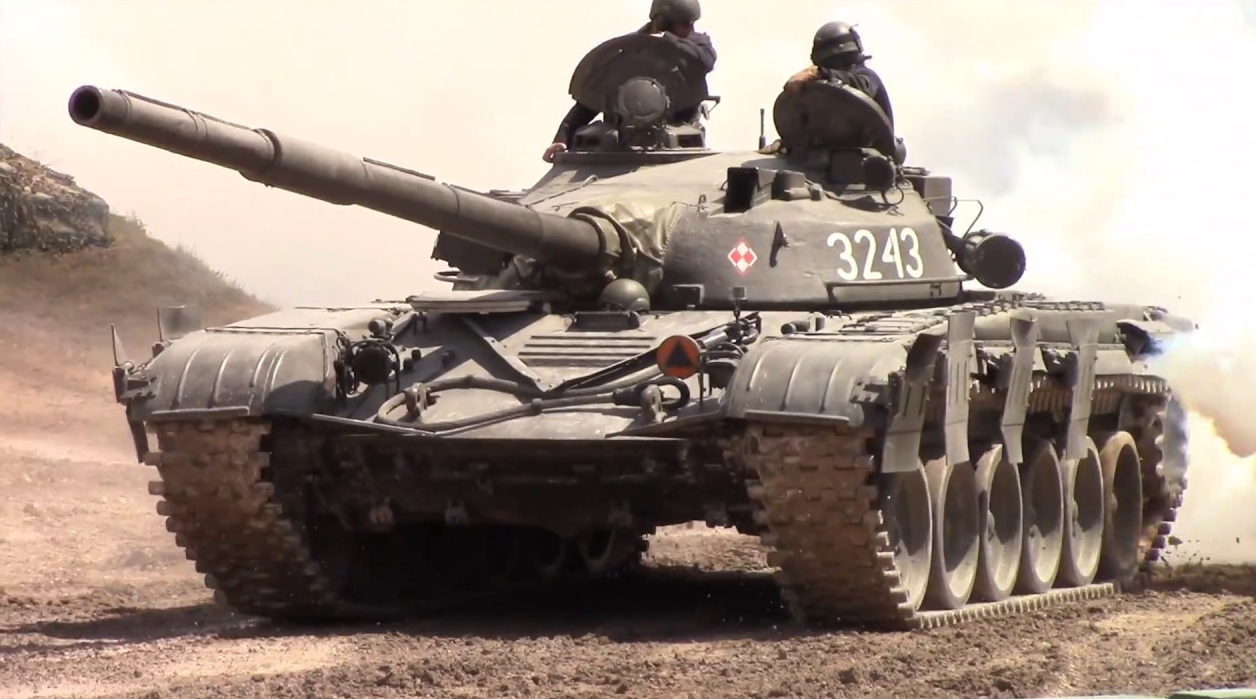
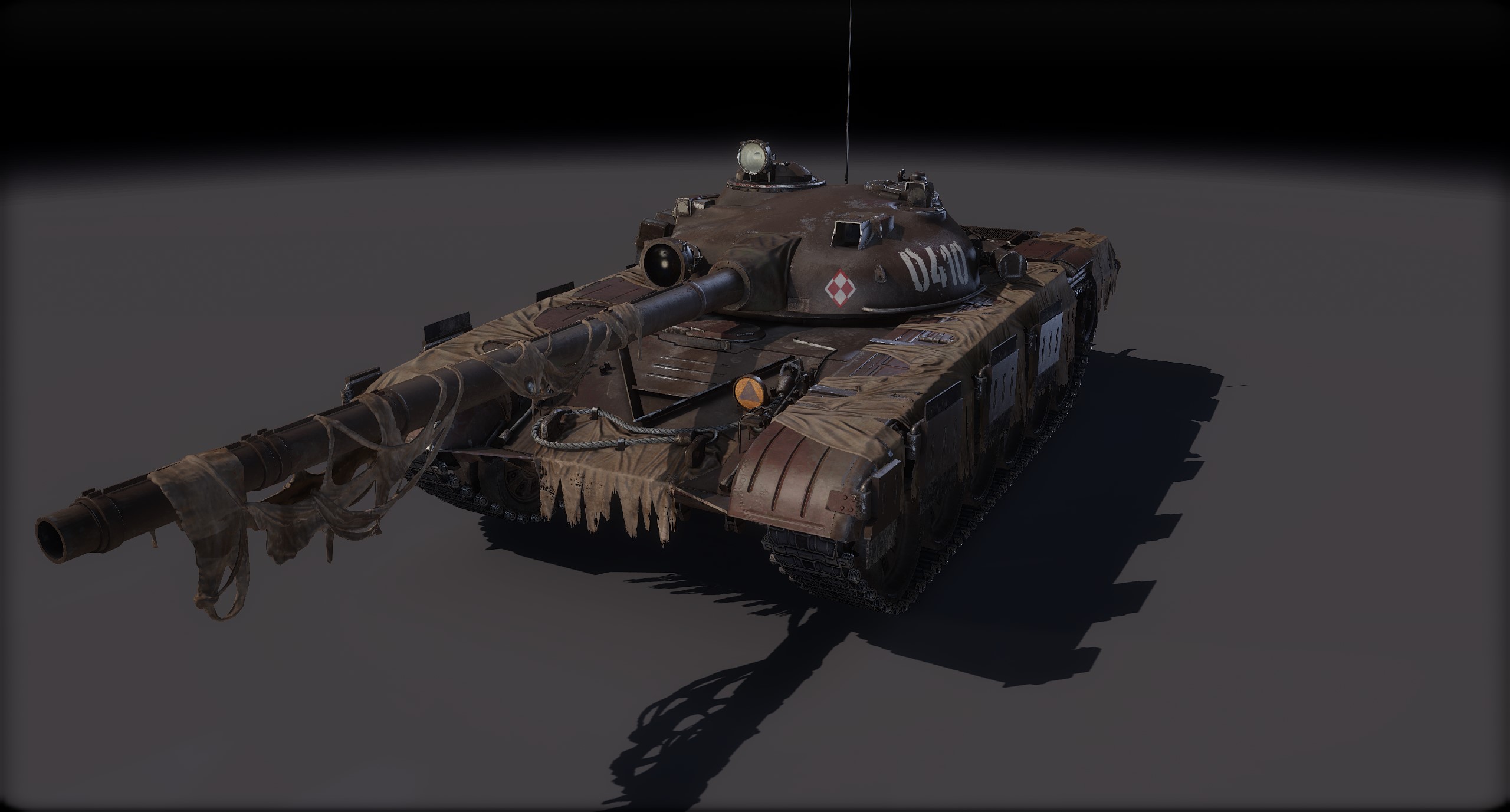
Today, we’d like to show you another historical skin that we are working on – the Polish-themed T-72M LWP.


LWP stands for “Ludowe Wojsko Polskie” (People’s Polish Army), which is the name of the Polish military between 1945 and 1989. It was actually formed during the war (as early as in 1943 as a Polish armed unit in the east, working alongside the Red Army) and the name was subsequently kept during the communist era. Like many other armies of the Soviet satellite countries, it was:
  • Conscription-based (this actually lasted until 2008)
  • Modeled after the Soviet military using the same tactics and weapons
  • Disproportionately large compared to Poland’s economy and population

Most of the tanks used by the LWP were various types of domestically produced T-54s (produced 1956-1964, 1998 built) and T-55s (produced 1964-1979, cca 5000 built). However, in the late 1970s, everyone realized that these tanks were completely obsolete and Poland attempted to acquire a production license for the T-72 MBT (technically it was classified still as a Medium Tank).


They finally succeeded in 1979 and by 1981, the first ten dismantled T-72M tanks were sent from Nizhny Tagil. They were reassembled in Poland and underwent rigorous trials. They officially entered service on July 19, 1982.

The T-72M tank is, as you probably know, an export version of the T-72A. In fact, it’s a hybrid of sorts between the original T-72 Ural and the T-72A in the sense that, while it retains T-72A’s 125mm 2A46 gun, composite hull armor and equipment (contrary to popular belief, these were not downgraded), the turret is made of steel only and is therefore nowhere near as resistant to ATGMs and HEAT shells as the later T-72 models.

Despite being inferior in protection to the T-72A, the T-72M was nevertheless a major upgrade over the old T-54/55 series. The T-72M production in Poland began in 1982 and in 1986 it was switched over to the upgraded T-72M1 model (effectively the actual T-72A). Between 1982 and 1990, 1610 T-72M and T-72M1 tanks were built. Over a half of them were sold abroad, mostly to East Germany, Hungary, Iraq, Iran, Yemen and Syria.


As for this skin, since:
  • T-72M has its turret armor in common with the original T-72 Ural
  • Poland did not use the Kontakt-1 ERA available to T-72A
  • There’s just one actual T-72 skin available

We decided that our T-72 would be a great choice as a basis for a “cosplay” of sorts of a Polish T-72M. There were export versions of the original T-72 Ural as well (Object 172M-E and M-E1) but these never got to Poland, at least to our knowledge.


The skin is painted in a brown color used by the Polish military on some occasions (most vehicles were painted in dark khaki, but we already have this color represented in the game). The tank will bear the Polish tactical insignia and a combat number in white.

The hull will be covered in a “scraps” cloth camouflage. We borrowed this particular model from a Hungarian T-72 but this type of improvised camo was used all over the Warsaw Pact.


Last but not least, the vehicle’s color will also be available separately as a Polish brown base paint in the game.

We hope that you will enjoy this skin as much as we enjoyed creating it for you and, as always:

See you on the battlefield!

In Development: Khrizantema-S

Commanders!

Last week, we’ve unveiled the Kurganets-25 as one of the prizes of the upcoming Echoes of War Battle Path. This week, we’d like to tell you a bit more about another of these prizes, a Russian ATGM Tank Destroyer called Khrizantema-S.


A little history first, as usual.

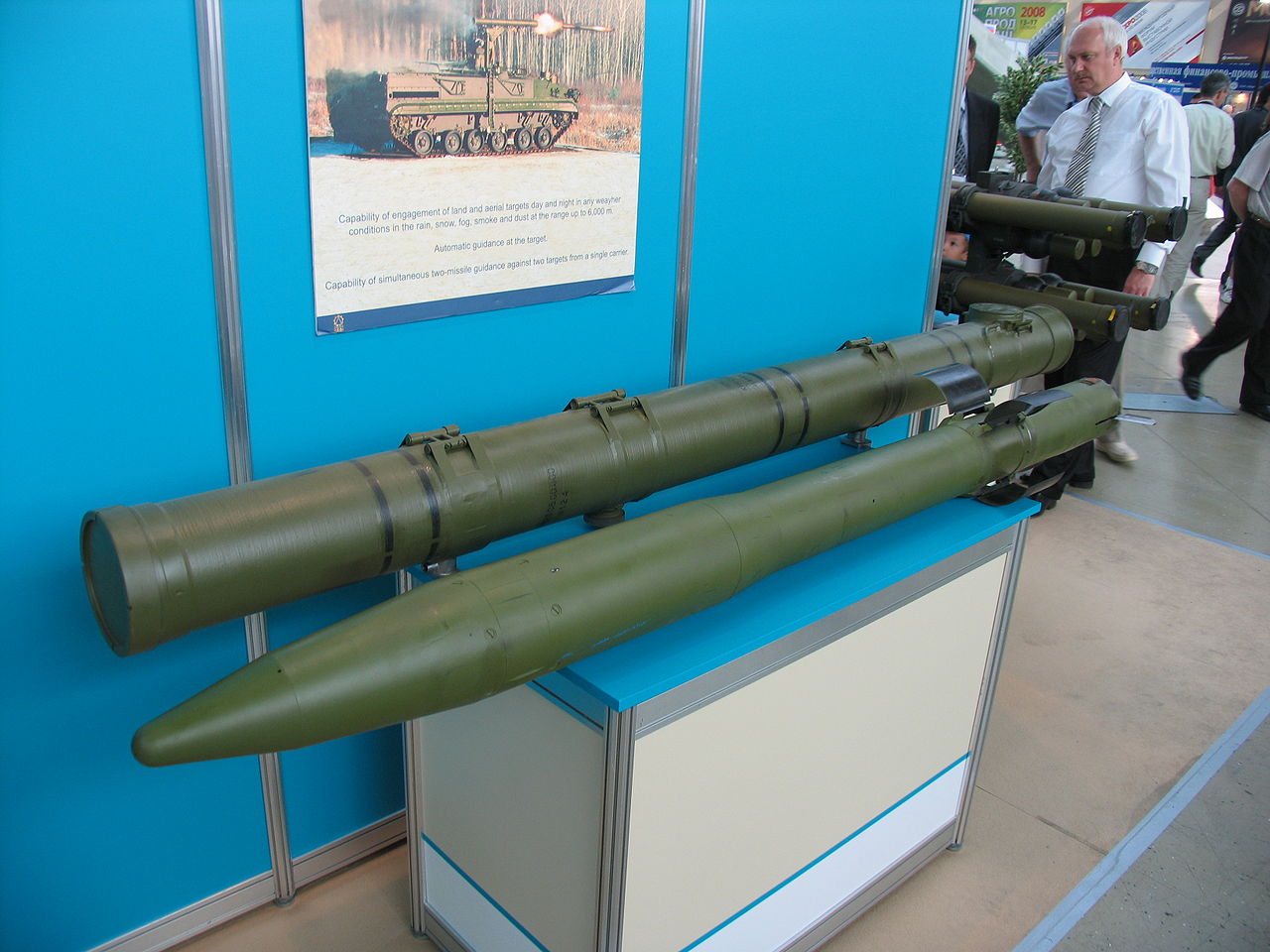
The development of a next generation anti-tank guided missile for the Soviet Union started as early as the 1980s, but the first Khrizantema (“Chrysanthemum”) ATGMs became available only after its fall, in 1996. These laser-guided missiles were very advanced for their time, but also quite expensive, preventing its proliferation. They come with two warhead types – tandem HEAT (9M123 and 9M123-2) and thermobaric (9M123F and 9M123F-2).

The 9M123 Khrizantema ATGMs are relatively large (they are 2.04m long) with their caliber being 152mm. Their parameters are as follows:
  • Minimum range: 500m
  • Maximum range: 5km (later improved to 6km, but reduced to 3.5km at night)
  • Missile weight: 46kg (8kg falls to the HEAT warhead)
  • Flight speed: cca 400 m/s (note how this is considerably faster than some other missiles)
  • Tandem HEAT warhead penetration: cca 1250mm after defeating ERA

They are fairly universal and can be launched from the Mi-28 Havoc attack helicopter and a launching platform called Khrizantema-S.


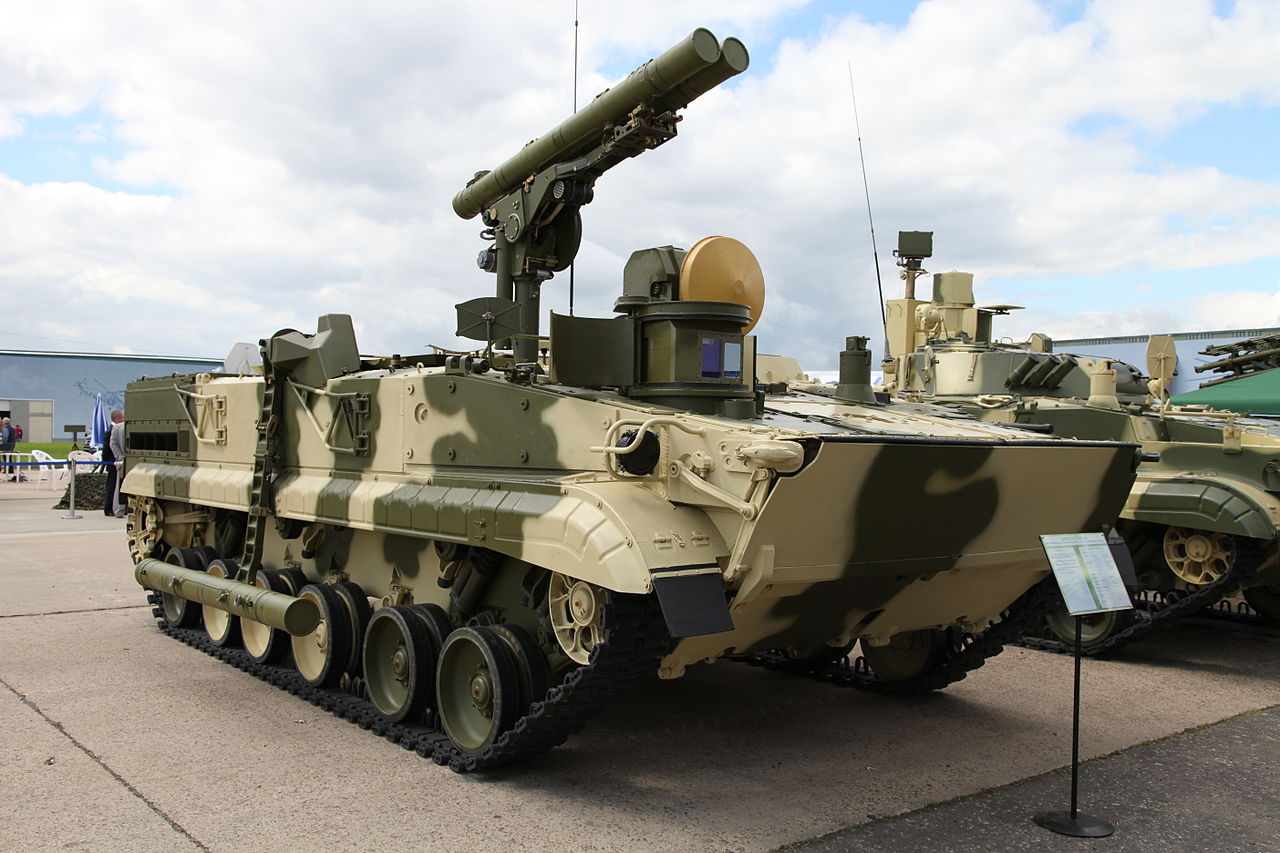
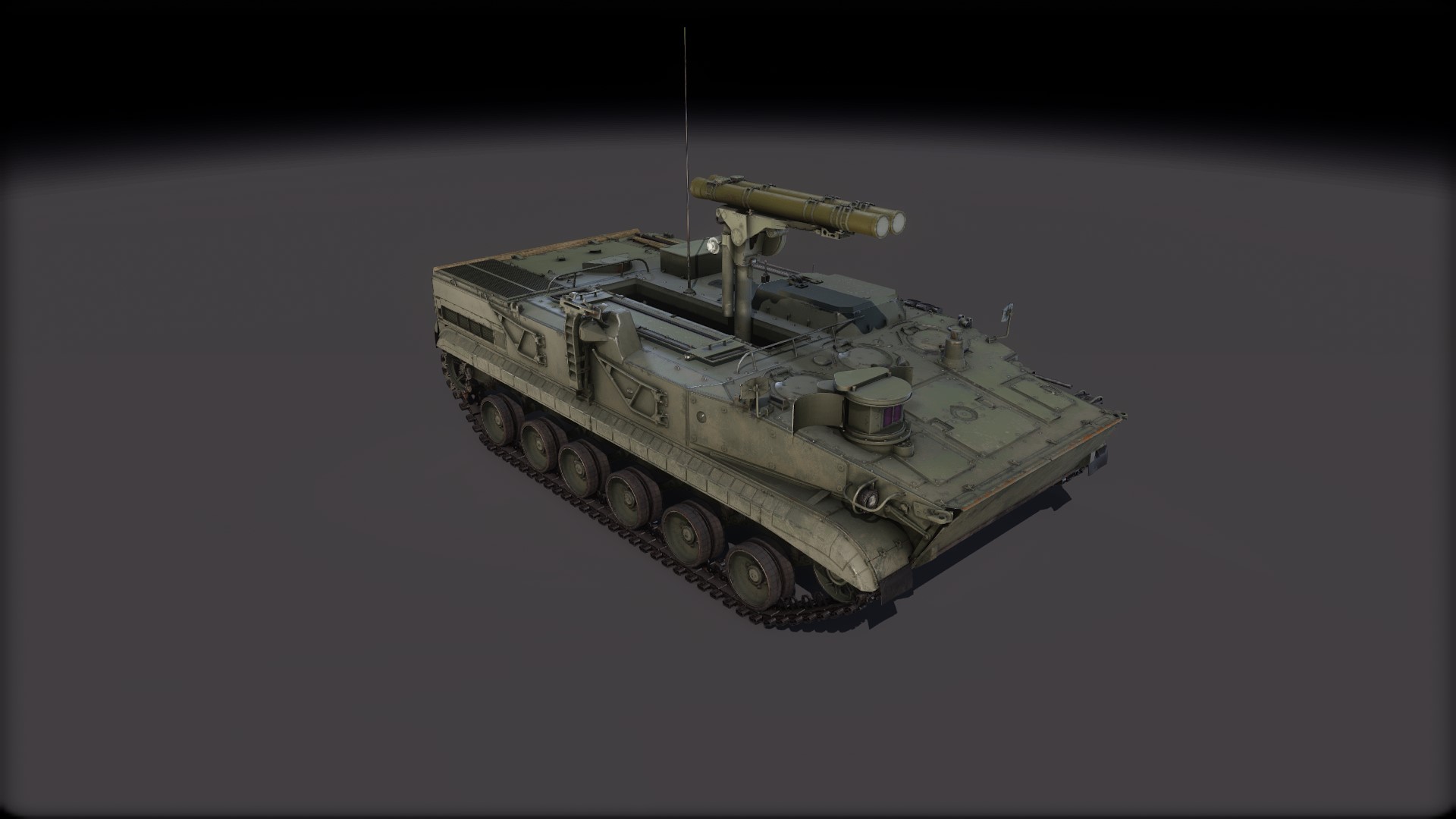
The Khrizatema-S is a dedicated tank killer with advanced optics and electronics and a dual launcher that extends from its BMP-3-based hull (the vehicle even retains BMP-3’s ability to swim). It can track several targets at once and devastate it at long distances while the main body can safely stay behind cover.

The hull is made of aluminum, much like the one of the BMP-3 IFV. It is, however, reinforced with steel plates at the most exposed places, which does not make the vehicle lose its amphibious capability. It weighs roughly 18.7 tons and has a crew of two – one driver and one weapon system operator.

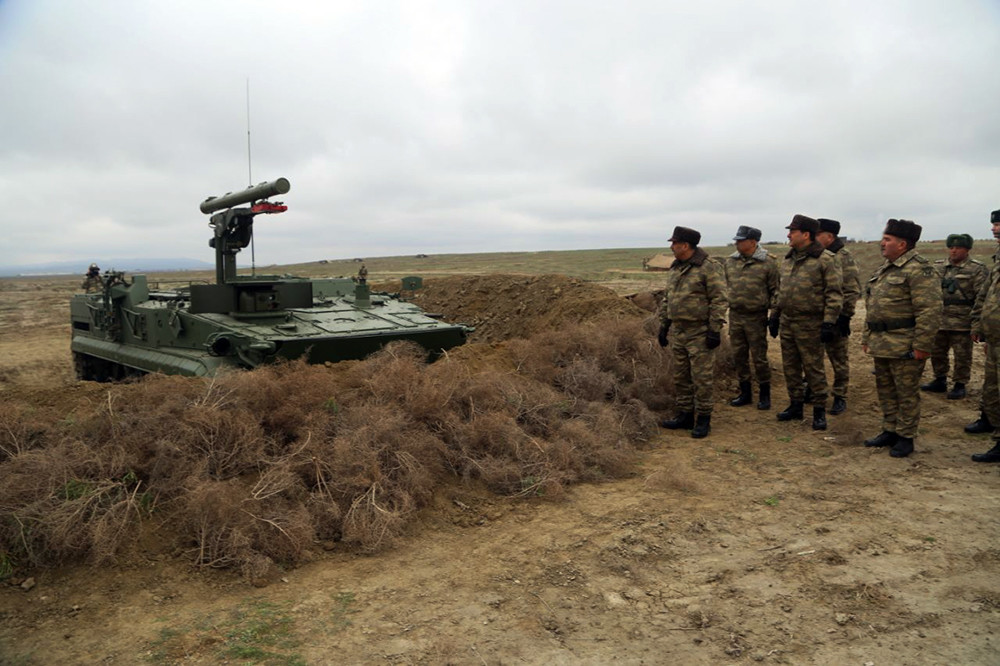
The first Khrizantema-S prototype appeared in public as early as 1996 (during the EUROSATORY expo in Paris) with the initial production variant (9P157) entering service in 2005. Around 2010, an upgraded variant called 9P157-2 appeared with a modernized Ukrainian optics system and a hull machinegun the original model lacked. This variant was in use until 2017.

Recently, another modernized 9P157-2 variant appeared, featuring a new Belarusian optics system, a thermal imager, improved missiles and electronics. It went through the state trials and was accepted in service around 2017-2018. Additionally, the original 9P157 Khrizantemas were (or are being) upgraded to the same optics system in order to increase their combat value.


In battle, Khrizantema-S units operate as long-range tank hunters both in offense and defense. According to Russian sources, they are capable of destroying any western tank at 6km or so. 79 vehicles of this type were built to date, with:
  • 28 9P157 in Russian service (upgraded with the Belarusian optics)
  • 37 vehicles used by Azerbaijan (9P157-2 with Ukrainian optics, 3 of these may be 9P-157-3 command vehicles)
  • 14 vehicles were sold to Libya between 2010 and 2013

The Libyan vehicles have definitely seen some combat during the Libyan Civil War, although the results of their deployment and their losses are unclear.


In Armored Warfare, the Khrizantema-S will be a Tier 8 Premium Tank Destroyer. As you can probably see from its design, this will be a long-range missile tank destroyer with a twin ATGM launcher.

But before we get into any details, the usual disclaimer:

The numbers below are very preliminary as the vehicle has not been properly tested. They are sure to change and should only be discussed as an indicator of how we’d like to set the vehicle up. With that being said:

Protection-wise, we’re looking at aluminum armor reinforced with steel with the front of the vehicle being able to withstand roughly 30mm autocannons. The other sides of the hull are protected against machineguns. The Khrizantema-S does not have an APS.


Mobility-wise, the vehicle will be pretty well-off with its tracked suspension performing better off-road than, for example, the Mephisto. Much like the BMP-3, whose chassis it borrows, the Khrizantema will be quite agile and will accelerate well thanks to the combination of its low weight (19 tons) and a powerful engine (500hp UTD-29) – its maximum speed will be somewhere around 70 km/h.


But, much like the other missile Tank Destroyers, the Khrizantema will be all about long-range firepower. It will feature an extended twin missile launcher (the similar idea was utilized in the design of the Stalker AFV) that will allow it to fire over obstacles. Two ATGM types will be available:
  • Tandem HEAT (1200mm penetration, 900 damage per shot)
  • Thermobaric (80mm blast wave penetration, 1200 damage)

It will be possible to fire two of these missiles in rapid succession (2 seconds between launches) with the magazine then taking 12 to 15 seconds to reload. The launcher will have a limited arc of fire (85 degrees to each side from the vehicle’s axis), will depress to -5 degrees and elevate to +15 degrees. You’ll be able to select one of two firing modes – each missile separately or both being launched at once. It’s also worth noting that, compared to the Mephisto, the missiles will fly much faster.


This firepower will be complemented by a decent camouflage factor (26%) and adequate viewrange (380m). The vehicle will also feature the Radar Active Ability, trading its camouflage for more viewrange.

As the abovementioned pieces of data suggest, the key to achieving excellent results with this machine will be long-range ATGM sniping followed by rapid relocation. The missiles will be quite powerful and will make hits easy thanks to their excellent performance. On the other hand, you will only have two of them loaded, which means you have to make the launch count. Using terrain to cover your hull will be essential. As such, the vehicle will require solid knowledge of in-game maps, making it more suitable for experienced players.

We hope that you will enjoy this vehicle and, as always:

See you on the battlefield!