Below & Beyond Dev Diary #2 - Underground
Welcome back, Commander!
We've prepared another update for you on how we developed the new Below and Beyond project. My name is Bart Vossen, design lead on the Below and Beyond planning and development team. Nice to meet you! As my colleague already informed you about what lies beyond, today's tour is all about exploring what's below; the Underground!

Let me give you a quick overview before we dive deeper. Our RC Explorers recently started running into surprisingly deep holes, which, after some further inspection, uncovered an entire underground network of tunnels beneath our colony. You should be able to drop an RC Explorer down there for initial reconnaissance. We've also developed a new building, the Elevator, which will be able to transport everything we need between our surface colony and the underground. Reports tell us the underground contains more resources and should provide protection against all hazards from the surface. Though the darkness and any local quakes, caused by our expansion efforts, may pose their own challenges. To this end, we've developed several buildings to keep our colonists safe. Lastly, those who came back also rambled on about something they called buried wonders, which we'd advise you to investigate further.
Now you might be wondering, why the underground? Well, 99.9% of Mars's mass lies underground, and it gives us a network of tunnels to explore and expand into with completely new challenges. But mostly because Mars's underground has eluded us for centuries. As we got closer and closer to Mars, we were still only looking at its surface. Even after we landed, we were only able to scan the top layer. Now, we have an opportunity to fully discover what secrets Mars has been hiding from us.
Expansion into the underground will get us closer to resource veins and provide shelter from meteors, dust storms, and even cold waves. Though it may destabilize the area and cause local, underground quakes with occasional cave-ins. To better protect our buildings, our scientists came up with a nifty solution involving Exotic Minerals. This should make exploring and expanding into the underground a worthwhile endeavor to do while our surface colony is gradually expanding.

To realize this vision of an enigmatic yet dangerous underground, we started development on an explorable network of underground lava tubes. They should feel dark, cramped, and mysterious while you're exploring, but also have enough room to build and expand your colony. We created a network of interconnected tunnels, with rooms spread around to provide building space. But we left it in darkness to give the underground a real cramped and mysterious feel to it as if you're spelunking and placing lights along the way. Don't worry, we also equipped all buildings, RC Vehicles, and drones with plenty of lights and some emergency lights in case they break down. To really emphasize the exploration, we equipped our RC vehicles with scanning technology that will reveal any anomalies or resources they pass by. Unfortunately, these tunnels are placed at depths our orbital scanning technology is not yet able to analyze at any meaningful level.
Our goal is for players to explore the underground in parallel with expanding their colony on Mars. So we did some early simulations with test commanders to see if our underground maps worked with this goal in mind. Unfortunately, we found them going through the underground at lightning speed, losing the sense of exploration and discovery. To this end, we sprinkled some cave-ins and blocked tunnels throughout the underground. These give commanders natural moments to check up on their surface colony and Asteroid outposts. Blocked tunnels can be cleared with a new landscaping tool and unlock access to new rooms and tunnels. Cave-ins require a better understanding of the underground to remove, as the area is clearly unstable. But once you obtain that technology, you'll be able to clear cave-ins to find shortcuts between chambers and many discoveries hidden by the darkness.
The real treasure hidden in these depths are the buried wonders; ancient natural, and some unnatural, features long covered up by Mars's soil. Each with its own secrets to reveal and benefits to acquire. Once fully unlocked with Exotic Minerals, they are just as powerful as the wonders our technology can accomplish. Though not all of Mars is equal, besides different tunnel layouts and entrance locations, not all wonders can be found on each landing site. It will always be a surprise what we will find down there in the darkness.
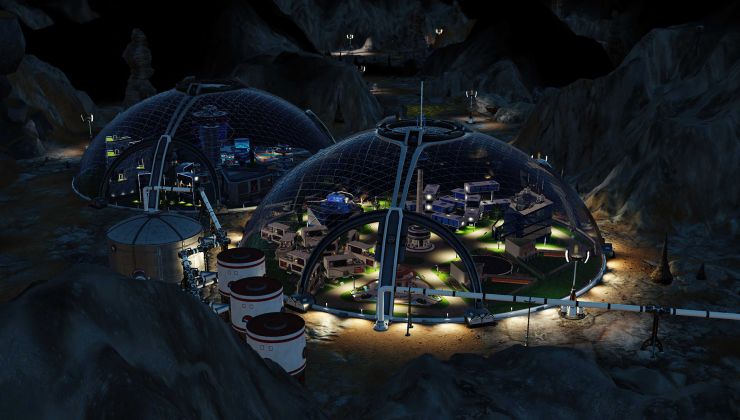
Most buildings from the surface are still buildable in the underground, while we also have a few new ones to deal with the unique challenges found down there. While they're protected from the hazards of the surface, underground marsquakes, caused by our elevators and expansion, pose a real risk of burying our buildings beneath cave-ins. We've engineered support struts that should be able to take the bulk of the impact, and reinforced domes to at least keep our colonists safe in the underground.

Once we had this up and running, we had a series of test commanders run various simulations. This gave us many different results that allowed us to better adjust the underground layouts and risks and rewards. Though the biggest problem proved to be drone command. Our simulations showed placing a drone hub within a larger room worked perfectly, however connecting it required several drone hubs within the tunnels. To solve this problem, our engineers went playing with some Exotic Minerals and came up with Drone Hub Extenders. These buildings are able to extend a Drone Hub's signal through the entire tunnel. And theoretically, it should also work on the surface and on Asteroids.
My favourite part of the underground? After a long day, I like to just sit on the back of an RC Explorer and look around as it drives through the underground. Or maybe an RC Safari, if the tourists aren't making too much noise. There's something about the calm darkness as if you'll find a new treasure any second.
That should cover everything, so I'm going to find myself an RC Explorer right now and I'll see you around. Do make sure you come back, there'll be another tour soon. The next one will dive into our new tech tree that will make all this possible and look at a few ways we managed to improve your life. Still here? Then you might as well watch our instructional video on underground exploration. It might help give you a better bearing once you start exploring the underground yourself.
Until next time Commander, and I hope I'll see you exploring down here soon!
[previewyoutube][/previewyoutube]
We've prepared another update for you on how we developed the new Below and Beyond project. My name is Bart Vossen, design lead on the Below and Beyond planning and development team. Nice to meet you! As my colleague already informed you about what lies beyond, today's tour is all about exploring what's below; the Underground!
Let me give you a quick overview before we dive deeper. Our RC Explorers recently started running into surprisingly deep holes, which, after some further inspection, uncovered an entire underground network of tunnels beneath our colony. You should be able to drop an RC Explorer down there for initial reconnaissance. We've also developed a new building, the Elevator, which will be able to transport everything we need between our surface colony and the underground. Reports tell us the underground contains more resources and should provide protection against all hazards from the surface. Though the darkness and any local quakes, caused by our expansion efforts, may pose their own challenges. To this end, we've developed several buildings to keep our colonists safe. Lastly, those who came back also rambled on about something they called buried wonders, which we'd advise you to investigate further.
Now you might be wondering, why the underground? Well, 99.9% of Mars's mass lies underground, and it gives us a network of tunnels to explore and expand into with completely new challenges. But mostly because Mars's underground has eluded us for centuries. As we got closer and closer to Mars, we were still only looking at its surface. Even after we landed, we were only able to scan the top layer. Now, we have an opportunity to fully discover what secrets Mars has been hiding from us.
Expansion into the underground will get us closer to resource veins and provide shelter from meteors, dust storms, and even cold waves. Though it may destabilize the area and cause local, underground quakes with occasional cave-ins. To better protect our buildings, our scientists came up with a nifty solution involving Exotic Minerals. This should make exploring and expanding into the underground a worthwhile endeavor to do while our surface colony is gradually expanding.
To realize this vision of an enigmatic yet dangerous underground, we started development on an explorable network of underground lava tubes. They should feel dark, cramped, and mysterious while you're exploring, but also have enough room to build and expand your colony. We created a network of interconnected tunnels, with rooms spread around to provide building space. But we left it in darkness to give the underground a real cramped and mysterious feel to it as if you're spelunking and placing lights along the way. Don't worry, we also equipped all buildings, RC Vehicles, and drones with plenty of lights and some emergency lights in case they break down. To really emphasize the exploration, we equipped our RC vehicles with scanning technology that will reveal any anomalies or resources they pass by. Unfortunately, these tunnels are placed at depths our orbital scanning technology is not yet able to analyze at any meaningful level.
Our goal is for players to explore the underground in parallel with expanding their colony on Mars. So we did some early simulations with test commanders to see if our underground maps worked with this goal in mind. Unfortunately, we found them going through the underground at lightning speed, losing the sense of exploration and discovery. To this end, we sprinkled some cave-ins and blocked tunnels throughout the underground. These give commanders natural moments to check up on their surface colony and Asteroid outposts. Blocked tunnels can be cleared with a new landscaping tool and unlock access to new rooms and tunnels. Cave-ins require a better understanding of the underground to remove, as the area is clearly unstable. But once you obtain that technology, you'll be able to clear cave-ins to find shortcuts between chambers and many discoveries hidden by the darkness.
The real treasure hidden in these depths are the buried wonders; ancient natural, and some unnatural, features long covered up by Mars's soil. Each with its own secrets to reveal and benefits to acquire. Once fully unlocked with Exotic Minerals, they are just as powerful as the wonders our technology can accomplish. Though not all of Mars is equal, besides different tunnel layouts and entrance locations, not all wonders can be found on each landing site. It will always be a surprise what we will find down there in the darkness.
Most buildings from the surface are still buildable in the underground, while we also have a few new ones to deal with the unique challenges found down there. While they're protected from the hazards of the surface, underground marsquakes, caused by our elevators and expansion, pose a real risk of burying our buildings beneath cave-ins. We've engineered support struts that should be able to take the bulk of the impact, and reinforced domes to at least keep our colonists safe in the underground.
Once we had this up and running, we had a series of test commanders run various simulations. This gave us many different results that allowed us to better adjust the underground layouts and risks and rewards. Though the biggest problem proved to be drone command. Our simulations showed placing a drone hub within a larger room worked perfectly, however connecting it required several drone hubs within the tunnels. To solve this problem, our engineers went playing with some Exotic Minerals and came up with Drone Hub Extenders. These buildings are able to extend a Drone Hub's signal through the entire tunnel. And theoretically, it should also work on the surface and on Asteroids.
My favourite part of the underground? After a long day, I like to just sit on the back of an RC Explorer and look around as it drives through the underground. Or maybe an RC Safari, if the tourists aren't making too much noise. There's something about the calm darkness as if you'll find a new treasure any second.
That should cover everything, so I'm going to find myself an RC Explorer right now and I'll see you around. Do make sure you come back, there'll be another tour soon. The next one will dive into our new tech tree that will make all this possible and look at a few ways we managed to improve your life. Still here? Then you might as well watch our instructional video on underground exploration. It might help give you a better bearing once you start exploring the underground yourself.
Until next time Commander, and I hope I'll see you exploring down here soon!
[previewyoutube][/previewyoutube]