1. Espiocracy
  2. News

Espiocracy News

Dev Diary #35 - The Map 🗺️

What's happening / TLDR: Developer diaries introduce details of Espiocracy - Cold War strategy game in which you play as an intelligence agency. You can catch up with the most important dev diary (The Vision) and find out more on Steam page.

---

Welcome back after holiday break! As the tradition (of 34 installments...) suggests, we'll start with a lighter dev diary: this time, about the map in the map game.

[h2]Background Map[/h2]


Espiocracy implements old school 2.5D approach - player moves the camera in 3D at an angle, but all elements are 2D. In a classic trick, detailed 3D model of Earth was rendered into 248 two-dimensional textures. Not only the computation is done once and for all of the terrain (= better performance, lower requirements, easier development), we also get rather unique relief map of the world at resolution of 43x21 thousand pixels.

From day one, CIA maps were primary inspiration, which contributed to the choice of Robinson projection for the map. In a very topical accident frozen in time, the game actually uses... a CIA variant of Robinson projection, used in The World Factbook, which means that it's probably literally unique game map.

A few examples of zoomed in camera, starting with Indonesian labyrinth:


Korean Peninsula:


The Great Lakes region:


Tasmania:


And here's practical demonstration of the resolution, max zoom into Galápagos Islands:


These are more of an unintended harvest. Relief map remains always in the background and players preferring calm screen can switch to even more old school paper background:


Ultimately, they all serve the king of map types...

[h2]Political Map[/h2]


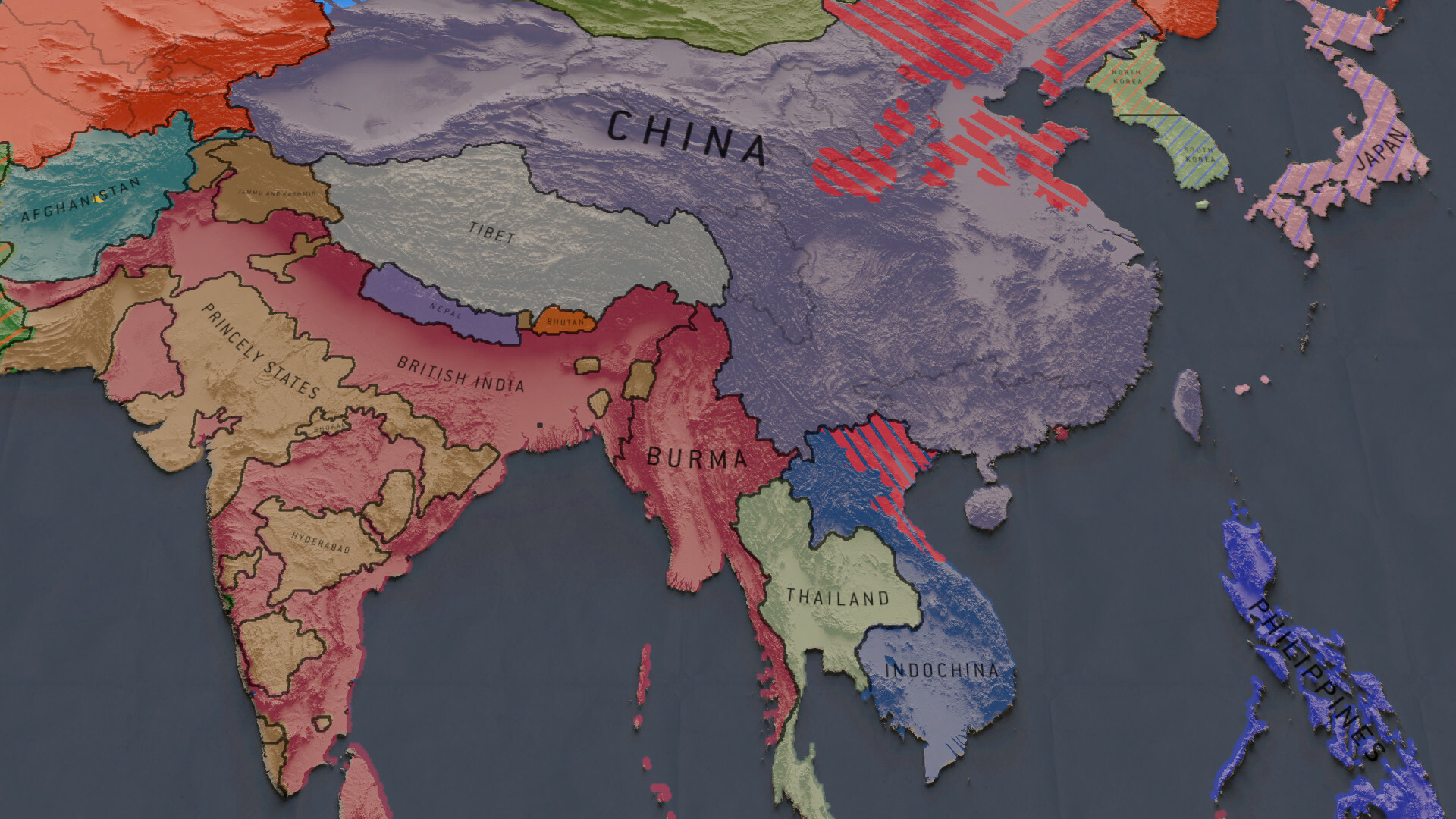
(This is the political map for the start date of March 5th, 1946. Protectorates and colonies share color with controlling countries. Thin west-facing stripes denote occupation (stripes have color of occupying state or states). Thick east-facing stripes denote territory controlled by subnational militant organization.)

Political map features de facto states. Following statehood criteria of Montevideo Convention...

  1. Permanent population
  2. Defined territory
  3. Government
  4. Capacity to enter into relations with the other states

...and gameplay criteria (every independent state is a player, has its own intelligence community, set of actors, available international actions etc), enriched by historical foresight, I made the following decisions:

  • Occupation zones - were consolidated where possible (eg. Allied-occupied Austria) or featured as separate states when setting up a conflict (eg. West and East Germany)
  • Ephemeral states around 1946 which were protected by another country - featured (eg. Newfoundland and Labrador)
  • Ephemeral states abandoned by other countries - represented below state level (eg. Second East Turkestan Republic)
  • Participants of civil wars with fluid territory - represented below state level (eg. Viet Minh)
  • De facto states with defined territory, invaded soon after 1946 - featured (eg. Tibet, Oman separated from Muscat, India divided into British India, Travancore, Hyderabad, Bhopal, Jammu and Kashmir, other princely states)
  • Excessive number of small nearby states that acted or will soon act together - consolidated (eg. Trucial States, British West Indies, 500+ princely states except for the four above)

A few closer glances:


While inclusion of states is a careful process, the game includes as many territories, enclaves, and islands as possible in the limited development time. Currently, there are 193 islands in Espiocracy. These provide very palpable geographical approach to the Cold War, from SIGINT installations to Argentina invading the Falklands or USA invading Grenada.

[h2]Gameplay[/h2]

High resolution of the map is not really an aesthetic choice - it is motivated by the gameplay and simulation. Instead of provinces, the world in the game is represented as 5100x2650 grid (with higher precision when needed). Operatives and actors travel in this coordinate system, cities or battles have precise points, rebel or armed conflict territory expands point by point, and most importantly: borders can be drawn in myriad of ways.

To assist alternate history and avoid bordergore, determination of borders (eg. in peace treaty) is supported by database of historical and natural borders. Here's an example of multiple layers of suggested borders in Germany (work in progress):


You can see here Weimar Republic states, administrative units of Nazi Germany, forward positions on V-Day, Anglo-French-American division, mountains, and rivers. The database will slightly evolve over the course of a campaign (eg. less significant & older borders will be forgotten - who remembers V-Day positions in 1995? - while new conquest or rebellions will leave new traces), although lines with the highest weight will remain unchanged (natural borders).

[h2]Final Remarks[/h2]

That was brief, visual, and light as promised. We'll certainly return to the map in the future - perhaps even two times more, since there's a lot more to talk about, from map modes to special hover UI or keyboard-based map traversal.

If you're not already wishlisting Espiocracy, consider doing it:

https://store.steampowered.com/app/1670650/Espiocracy/

There is also a small community around Espiocracy:


---
"One Soviet general, looking at a map of the territory Russia had acquired on the Karelian Isthmus, is said to have remarked: we have won just about enough ground to bury our dead" - William R. Trotter

Dev Diary #34 - Operations 2.0 💥

What's happening / TLDR: Developer diaries introduce details of Espiocracy - Cold War strategy game in which you play as an intelligence agency. You can catch up with the most important dev diary (The Vision) and find out more on Steam page.

---

This is probably the most frequently asked question about Espiocracy: is the game more about espionage or more about the Cold War?

Although the or is not exclusive, this question often is asked in a less suggestive way, lined with the fear that it's "just a spy game" instead of a sufficiently complex Cold War grand strategy game. My answer - which did evolve over almost two years of development - is usually along the lines of: it's a game about the Cold War from the perspective of espionage. This point of view, instead of subverting gameplay, enriches it in many fantastic ways and is in my opinion critical step in actually capturing the essence of the Cold War ([1], [2], [3]...).

However, deep down in my heart, I'm fine with Espiocracy being (viewed as) just a spy game. The very best craftsmanship is dedicated to espionage mechanics - to make them stand out on their own, to provide strategic and immersive gameplay like no other game. In today's dev diary, we'll return to that part of the game, exploring the core mechanic of espionage: intelligence operations.

(As always, a "2.0" dev diary is not a patch note, you don't have to be familiar with the previous one. Enjoy!)

[h2]The Big Picture[/h2]

In the full UX flowchart of the game, operations occupy large and central area:


There are currently 8 (!) entry points leading into this world - eight distinct ways to launch an operation, from selecting actors to approving recommendations. By design, it follows a hierarchy of attention: the player can designate just a general operation category (eg. "eliminate X, I don't care how"), choose a particular operation type (eg. "murder would cause too much fuss, X should be expelled"), or go into nitty gritty of tactical approaches (eg. "burn agent Y to distance ourselves from the manufactured evidence").


In the spirit of Wittgenstein, operations in the game are defined by shared properties, not only inside categories but also in general. All operations have a target - influential actors, or any human, organization, or object (which means for instance that you can assassinate a witness, and then silence a witness of the previous witness' assassination). Among other universal properties of operations, all of them use prospective outcome which is a 0-10 score summarizing complex factors in one easily understood number. In the previous dev diary, it was tied to probabilities but this is no longer the case (more on that in the next section), as the current prospective outcome is more of a guidance that is both descriptive (takes into account factors that may become important in the simulation) and causal (influences paths taken by the simulation, especially the final attempt at achieving the objective). Here's the combination of targets, scores, categories, and types in the wild:


Once an operation is launched, it can be handled autonomously by operatives but it (again, by the same design principle) oozes with optional player agency. Available decisions include:

  • Meaningful temporal dynamics - operational pause means staying low for some time and losing the tail, whereas aborting the operation may require a daring escape
  • Reactions - operatives asking the player to choose one of the few approaches, options, spend resources, or resolve issues
  • Calls (example below, note that they aren't fixed and evolve during operations) - modifying the operation, covers, priorities, or choosing A over B in trade-offs


As Mark Rosewater, a veteran designer of Magic the Gathering said: "Be more afraid of boring your players than challenging them!".

[h2]Simulations Upon Simulations[/h2]

Hairy dev diary about simulations already spilled the beans about the new shape of operations. To recap in a more literate manner, every operation spawns its own simulation, characteristic for the category and type, which proceeds step-by-step towards the final attempt at achieving the objective, which is usually resolved by at least one other (sub-)simulation. For instance, a recruitment operation progresses day-by-day through preparation, intelligence gathering, preceding meetings, all the way to the final recruitment pitch which is simulated minute-by-minute (beware, radioactive work-in-progress interface):


Practically, the availability and quality of the operational culmination depend on parameters such as tactical intelligence or trust, so operatives increase them through continuous (eg. surveillance) and discrete (eg. breaking in) actions.

That's it. This simple idea, however, contains the entire universe of emergent simulations - hundreds of possible steps and events, actions depending on anything from operative's traits to carried gear, conversation simulation flowing into car chase simulation flowing into shootout simulation, operation A launching operation B, involvement and interactions between many types of participants (journalists, police officers, or even third-party actors)...

[h2]A Game of Information[/h2]

Espionage is about information - who's who, what's happening, why it happens. Espiocracy tries to capture this angle in many mechanics (such as secrets or coup plots) but one of the most, I have to use this word, brazen implementations lies at the heart of operations.

Sticking with the word "participant" introduced in the previous section (unofficial term, that's just how these variables are called in the code), classic operations have three participants: attacking intelligence agency, target, and defending (counterintelligence) agency. However, participants may not know about each other, identity, motivations, or even about particular actions!


Each participant has the parameter of situational intelligence, increased via actions much like other parameters. Zero means no knowledge of the operation - targets and counterintelligence start with 0. First suspicions or rumors slightly increase it, then passive and active probing, acquisition of evidence or even direct contacts raise it further. As with any other parameter, it can be also changed externally in both directions, for instance leaving a false trace may decrease the intelligence of other participants, whereas poor tradecraft or reckless behavior might up it for others.

The strength of the cover and analogous factors determine how much situational intelligence is required to uncover a particular participant's what, who, and how:

  • What - knowledge about the existence of a participant of a particular type
  • Who - identification of the participant
  • How - methods, objectives, and progress toward them

Furthermore, every action has an inherent requirement for situational intelligence, with half of this number required to see the existence of (blacked out) action at all, and values below that hiding completely the action.

Now, on to much-needed practical examples. Three primary perspectives:

  1. As an attacking agency (eg. you try to recruit the target), you start with minimal but steadily increasing situational intelligence. Logically, you don't need situational intelligence to know the details of your operation but it will be useful in spotting (and reacting to) the actions of the target. Moreover, as the counterintelligence service starts sniffing, the higher the situational intelligence, the faster you'll know they're on to you. Although the "who" level here is irrelevant (usually a country has a single CI agency), it's critical to get to the "how" level and get a look into their progress (race with time on many levels) and objectives (eg. huge difference between interception that may just lead to silent expulsion vs ambush with possible casualties, arrests, long-term loss of operatives, diplomatic scandal, etc). Moreover, the full what-who-how path applies to other participants, for instance, press or police forces getting involved.
  2. As a counterintelligence agency (eg. someone tries to recruit an actor in your country), you start with no knowledge of the operation. Usually, in the course of regular surveillance, you get a wind that something is brewing - an operation category, a target, or an agency, depending on calculated required levels of situational intelligence, which is communicated in appropriate notification. Then, counterintelligence operatives pursuing leads increase the situational intelligence to uncover any of the following: target's what (eg. a political leader), who (eg. actor X), and how (their stance and actions); attacking agency's what (eg. from country Y), who (eg. agency X; may be irrelevant), and how (their objectives, methods, progress, actions); other participants. All of these also directly contribute to available decisions and methods, sometimes like dominoes, for instance discovering the involvement of the press allows the player to pressure them into revealing situational intelligence collected by them which in turn reveals details on other participants.
  3. As a target (eg. someone tries to recruit your operative; the targeted player also controls counterintelligence so you can pull off an operational game with two entities simultaneously), you also start with no knowledge about the operation. Generally, targets remain more or less clueless until the final approach (or until a major slip-up of the attacking agency), during which situational intelligence is immediately boosted above what-who-how levels, with the exception of active covers.

For the sake of readability, I omitted active covers in the examples up to the last sentence. Active cover is false what-who-how which overrides required levels of situational intelligence. It's an expensive approach to an operation, where a participant (usually an attacking agency) can hide under the cover of another why, another who, or even another what such as the press, with the entourage of false actions, false objectives, and decisions (eg. change objective for a false-cover-agency while pursuing another real objective).

[h2]Behind The Scenes[/h2]

► At some point in development, operations were also launchable against any process in the game world but it was a tad too abstract, especially with the activity and what-who-how of participants. The UX option remains ("fund a coup") but mechanically it's always about entities engaged in the process, in this case, funding coup plotters.

► Among other tested & shelved ideas, I temporarily implemented the use of situational intelligence even for operations launched by the player. Instead of inherently knowing what our operatives did, they would first have to communicate that to the player - with the ability to manipulate the communication (a.k.a. lie). This was mainly tested in the context of conversations, where contents would be generally hidden from the player, except for the parts revealed by the operative during debriefing. It turned out to be too much of a balancing & debugging pain in comparison to gameplay gain, at least for now - and redundant to better mechanics that handle operatives going rogue.

► "Infiltration" is not the best word to describe break-ins or wiretaps but alternatives ("penetration", "intrusion") work even worse as nouns and verbs in the UI...

► Operations, in a way, are at the forefront of Espiocracy's game design. They are prone to difficult bugs, degenerate strategies, poor UX, or beautifully collapsing simulations. In some cases they resemble a Rubik's cube - the entire game has to be slightly shifted to solve operational issues. As an example of such a case, early prototypes evoked strong fear of missing out on opportunities to launch interesting operations. This was mitigated not only by the improvement of UX and introducing new features (such as, literally, "opportunity" mechanic) but also by shifting code architecture to allow efficient & automatic & regular calculations for all possible prospective outcomes, both for the human player and for the AI. This in turn, initially created an obvious degenerate strategy (regularly launch all the ops with top scores), so new features and shifts followed here. Then, this strategic complexity proved to be challenging for a standard approach to AI, so I started working on an unusual AI system that can handle such operations. Then... you get the picture.

[h2]Final Remarks[/h2]

Operations will definitely receive "3.0" DD in the future, not only because I'm constantly working on them but also because I still didn't mention quite a few interesting angles (such as operatives traveling on the map, operations with evolving objectives, or post-operational fallout).

If you're not already wishlisting Espiocracy, consider doing it:

https://store.steampowered.com/app/1670650/Espiocracy/

There is also a small community around Espiocracy:


---
"Challenge between intelligent people on both sides" - Aleksander Makowski, a spy who tracked UBL, on what makes intelligence operations thrilling

Dev Diary #33 - National Assets 🏭

What's happening / TLDR: Developer diaries introduce details of Espiocracy - Cold War strategy game in which you play as an intelligence agency. You can catch up with the most important dev diary (The Vision) and find out more on Steam page.

---

"Elephant in the room" is one of my favorite English idioms. Game development seems to be filled to the brink with such elephants - important features that should be addressed but were pushed to the side. I've been using this phrase frequently enough to coin the abbreviation "EITR" in the design notes.

After addressing significant EITR two weeks ago (precise gameplay progression), it's time to meet its sister EITR: the economy. This dev diary, however, is not titled The Economy because the system developed to flexibly represent economic factors turned out to be a fantastic framework for a much wider game world. Now, the economy is just one of the 8 sectors of national assets.

Assets in Espiocracy represent infrastructure and objects of national importance. They are passive (non-actors!), exist on the map, provide local effects, can be developed or destroyed, sometimes even stolen. The player, an intelligence agency, has a few modes of interaction with them, but assets primarily are an orchestra in the background, playing a symphony of differences between countries.

Let's jump straight into examples to get the gist of the system.

[h2]Examples of Assets[/h2]

Deposits are the prime type of national asset. There are three types of deposits: fossil fuel, strategic minerals, and uranium ore. Originally (unless the 1946 situation was different), these assets are dormant, located in predetermined areas on the map, and have defined depth/size of 1 to X, relative to other deposits around the world. A state or private entities can invest into upgrading them to extraction facilities, which then enable internal effects such as driving the expansion of civilian infrastructure, and international tools such as an ability to sign trade agreements or enact embargoes.

As a part of mentioned civilian infrastructure, we can look into electricity. It's an asset measured in national coverage from 0% to 100%+, representing popular access to the electric grid (with a surplus over 100 generating international income). Its effects are a not-yet-refined web of influences on other assets and aspects of the game world, including for instance changing the spread of dissent, following the example of North Korea literally keeping people in the dark.

For a more unusual national asset, let's discuss significant works of art. The game features internationally known pieces as physical objects, which are protected, can change hands, or be destroyed. Some of them can be even a matter of diplomatic dispute - for instance, collections of the British Museum. These assets are represented both as concrete named entities (eg. the bust of Nefertiti in Berlin) and in abstract numbers (eg. 2,000 historical paintings). Instead of passive effects, they have intrinsic value (can be stolen by actors, including the player, and sold on the black market), also in terms of the status quo (eg. loss of a significant piece after a break-in can lead to changes in police forces).

[h2]Full Landscape[/h2]

Current full landscape of assets, subject to change:


This system combines in a simple leap quite a few interesting contexts:

  • Postwar damage and theft (eg. many European countries start with severely damaged cities, airports, etc)
  • International control (eg. Czechoslovak and East German uranium deposits are de facto controlled by the USSR)
  • Economic ownership (a subtle attempt at modeling differences between a command economy and capitalism, we'll see how detailed it will be)
  • Development over the course of the 20th century and beyond (eg. electrification)
  • True motivation for destruction (eg. terrorists targeting concrete significant buildings)
  • Famines, shortages, and other crises
  • War targets and spoils of war
  • Counterintelligence of critical infrastructure
  • Actors originating from non-acting sectors (eg. an inventor from strong academia or a political leader from local government structures)
  • Pretty wide modding opportunities

Development of some assets is driven by the population (eg. changes in the city size). Others need a direct investment of the government (eg. new seaport) which is handled by a mass negotiation mechanic: government members, including the player, propose upgrades, developments, rebuilding, and establishment. These propositions make it to a single list, where they are backed by the influence of proposing actors divided by the magnitude of expenses. In alignment with interests and other views, some actors may vouch for expanding housing whereas others may push for funding economic incentives. Top propositions inside the spending scope are then implemented.

[h2]Behind The Scenes[/h2]

► The sheet with asset types includes only somewhat tested and implemented ones. I'm experiment with a few other interesting types such as average kcal intake, riverine transport, or currency strength.

► Technically, national assets evolved from actors. For a long time, I struggled with representing anything close to an economic system based on the very limited number of actors (eg. two top companies in the country). What's worse, these actors didn't meaningfully act, taking the place of more interesting actors. That doesn't mean however that economic entities are completely inactive - they are now represented by more personal actors, such as business leaders, who have more logical & interesting actions, and even expand decision space (eg. business leaders may be subverted by affecting their economic assets).

► The system, in its simplicity, explores an interesting gamedev riddle. Where should we place the boundary between hardcoding and flexibility? The former is much faster to develop (at least in a complex strategy game) but it's not only a matter of making mechanics as flexible as time allows - as I've seen in a few iterations, mechanics can be too flexible, become bland, interchangeable, throw the player into the Euro-gaming pit of the same ten games with slightly different themes. At the moment, national assets are implemented by highly flexible code (modders can basically replace all data points, including all sectors) but for the purposes of interconnected gameplay, it slowly contracts into less flexible form (eg. requiring the transport sector to build transport graph). It's like a live experiment in approximating the most optimal position of hardcoded-flexible boundary.

► Some features were directly inspired by high-quality discussions on our discord server. Thanks, folks!

[h2]Final Remarks[/h2]

Naturally, all national assets can be targeted in intelligence operations such as infiltration, subversion, sabotage, or even cooperation (for instance with foreign underworld!). Moreover, they create a very palpable environment for all indirect actions, where for instance operatives land in a newly built airport, use a reconstructed seaport in a smuggling network, or utilize a denser road network to exfiltrate an agent by car. This will be the topic of the next dev diary - Operations 2.0 on December 9th.

If you're not already wishlisting Espiocracy, consider doing it:

https://store.steampowered.com/app/1670650/Espiocracy/

There is also a small community around Espiocracy:


---
"Germany's war potential should be reduced by elimination and removal of her war industries and the reduction and removal of heavy industrial plants. (...) The plants so to be removed were to be delivered as reparations to the Allies" - J.F. Byrnes, US Secretary of State, 1946

Dev Diary #32 - Intelligence Agencies 2.0 👁️

What's happening / TLDR: Developer diaries introduce details of Espiocracy - Cold War strategy game in which you play as an intelligence agency. You can catch up with the most important dev diary (The Vision) and find out more on Steam page.

---

(This dev diary is more dev and more diary than usual)

How do you precisely achieve progress in a game of Cold War intrigue?

Better yet, to invoke a one-liner decorating walls of my office: in a full psychological Cold War intrigue maturely exploring espionage, nuclear strategy, ideologies, politics, and conflicts. How do you measure goals in that, what are the main resources, how do you weave feedback loops, and what's the tick-to-tick strategizing in the game?

This should be probably the topic of the first or the second dev diary. Instead, it was described briefly a year ago in the 8th DD, and then mentioned only between the lines. The reason is simple: elemental progression and basic resources are so fundamental to the game that I was in the middle of the endless cycle of implementations, playtests, and course corrections. Reconnaissance-in-force. We could follow Mozilla versioning scheme and discuss Intelligence Agencies 52.0 instead of 2.0.


The answer, on the surface, is surprisingly simple: as the player in Espiocracy, you're the master of people and funds.


These are further divided into a set of 6-18+ basic resources used by every player.

[h2]Money[/h2]

Espiocracy leans into the plethora of interesting contexts - from origin to legality - around money. While this aspect is kept mathematically simple (make no mistake, it's far from a money-heavy management game!), the game world, much like our real world, essentially revolves around cash.

The player, as an intelligence community of a single country, has a set of contributors who monthly subsidize the intelligence enterprise in exchange for access to intelligence reports. In a typical case, these are Department of Defense, Ministry of Foreign Affairs, and Department of Justice. The extent of funding depends on the departmental budget (stemming from the total state budget which in turn is extrapolated from SPI) multiplied by an unorthodox parameter of "trust and need", separately tracked for every contributor.

SPI (State Power Index) is a purely competitive parameter, increased by overtaking other nations in almost any measurable aspect of the game world, be it quality of the military or shape of the economy. The player has limited indirect influence on SPI (for instance by conducting military or economic espionage) - it's more of an asymmetric landscape between nations than a basic vehicle of progression.

In contrast, trust and need are directly controlled by the player. Trust, naturally, is gained through operational successes and lost after failures. Stealing blueprints of strategic weapons increases the trust of military circles, whereas failure to prevent a terrorist attack decreases trust across the board. Here's also where things get interesting - the same parameter tracks also the need for intelligence. Terrorist attacks definitely increase the need, as do regional wars, international tension, or hostile activities. By combining these two aspects into the same coin, Espiocracy explores the uneasy inflection point between real fear and fear-mongering, between failing upwards and making yourself obsolete by being too good. This paradox was the bane of worldwide intelligence funding which peaked around 1989 and was dramatically slashed just a few years later, rendering many intelligence professionals no longer needed... Find what you love and let it kill you.

Contributions, counted in millions of dollars (usually with an accuracy of $0.1M), are divided into three pools: operational, restricted, and illicit. An operational account accumulates the main legal resource - money that can be spent on expansion, improvements, agents, bribes, special operations, and so on. Restricted funds are dedicated to particular areas, for instance American player receives restricted funds from the Department of Justice which can be spent only on the expansion of the FBI. Illicit money comes from breaking the law on the ground, shady contributors, and covert governmental programs along the lines of Iran-Contra. The last kind of pool can be spent only on already covert activities (eg. bribes), more overt expenses (such as hiring staff) first require laundering illicit funds into an operational account.

At the heart of spending money in Espiocracy sits a radical solution: upkeep is abstracted away, all expenses are one-time expenses. Players don't babysit monthly changes in account balance because there is no maintenance cost. Instead of worrying about salaries, you spend money on a hiring campaign that brings in X new operatives. Lore-wise, salaries and other upkeep costs are handled by contributors (you're a part of state apparatus, not a business, after all) but fuzzy explanations aside, it makes for very fluent gameplay with swift feedback loops, skipping straight to the fun, and moving anti-snowballing mechanics into the vicinity of competitive challenges (eg. more operatives means larger attack surface for foreign infiltration).

Speaking of which, contributors form a kind of contributor economy which takes the role of (also) a negative feedback loop, traditionally implemented by upkeep costs. Symmetrically to large successes rewarded with an injection of money, large failures may require covering the damages (eg. of a diplomatic incident). Further significant loss of trust and need leads also to discrete "downsizing" events, where the player has to single out scapegoats, cut down the staff and sprawl in general, to regain the trust. If that fails (or the loss of trust is dramatic), it may lead to the reform (large changes in the structure of the intelligence community, along with purges and downsizing in general), or even loss of contributors. Changes in the composition of contributors can also happen along political changes - for instance authoritarian one-party systems may feature The Party as the main contributor, some totalitarian countries love overarching Ministries of Internal Affairs that heavily depend on the intelligence community, and small democratic states may almost completely do not care about intelligence, leaving it to a single governmental body such as President's Office.

[h2]Staff[/h2]

People form the second half of resources in the game. Almost all tasks are implemented directly by the staff. You can get by (temporarily) without money but falling to 0 operatives is a game-over condition.

The bulk of staff consists of regular operatives - working mechanically as a currency with internal dynamics. Regular operatives are divided into agencies (eg. for British player there are three separate pools of regular operatives: MI6, MI5, GCHQ), hired with funds, and then (somewhat cynically) thrown in numbers at issues, operations, expansion, and other actions. Each pool is characterized by an average tradecraft level which is increased by training, improvements, engagements on the ground, cooperation with more skillful players, and allows classic quantity vs quality decisions. In addition, regular operatives have limited but impactful office life that includes spontaneous factions forming around views and ideologies, even up to said faction potentially refusing actions, pressing demands, going rogue, or defecting.

Beyond regular intelligence officers, players develop specialized operatives in cycles similar to classic technology trees of other strategy games, with the addition of irregular mandatory investments. Currently (subject to change) there are 12 capabilities - optional specializations:

  • Social Engineering
  • Politics and Diplomacy
  • Science and Technology
  • Business and Economy
  • Media and Culture
  • Digital Devices
  • Guerrilla Warfare
  • Military
  • Direct Combat
  • Criminal Investigations
  • Philosophy
  • Deep State

They are tied to many contexts in the game world: directly contributing to operations (eg. securing better evidence for espionage trial), unlocking available structures and tools (eg. paramilitary training camps tied to guerrilla warfare), influencing events encountered by the player (eg. leaning more into politics or more into military), feeding into asymmetric positions (eg. British player starting with highly developed direct combat thanks to commando experiences in WW2), mirroring the population (eg. less literate countries having a hard time expanding more sophisticated capabilities), and so on.

And then we have top operatives who already received larger separate dev diary. In this, close to the final, iteration of basic resources, top operatives are slightly more impactful operatives who can be both proficient at tradecraft and specialized in a few capabilities. They are definitely not hero units, their main role still belongs to the storytelling layer, but they are embedded in the progression with rather an unconventional mix of mechanics. Instead of the standard choose one out of three random character cards known from many other strategy games involving characters, new operatives are created by the player from a set of positive and negative traits that use a pool of points, not far from character creation in C:DDA. You can increase the number of available points by choosing an alcoholism trait and spending the excess on higher specific skills - or invent a candidate less skilled at the moment but having cheap large potential for the future. As with all other resources, these points will be tied to local contexts and the game world, namely by different weights of the traits. Although it is a departure from the usual realism-first approach, this mode of player agency and flavorful strategic decisions that influence the next decades of storytelling is too good to not feature in the game.

[h2]Behind The Scenes[/h2]

► Implemented, tested, and dropped ideas included various mana pools (from political influence to approvals in blanco), realistic fiscal years (yearly popup with budget negotiation, yay), worktime of operatives as the primary currency (sort of action points but in real-time), full bookkeeping experience along the lines of Football Manager, and even RPG-like progression in levels from 1 to 100 based on Fallout: New Vegas. Some were bad, some were acceptable, and some contributed features or themes to the current system.

► What about intelligence? Is there an information economy? Yes, it exists but not globally - it has ephemeral, local, discrete value. Experiments on resources included many different approaches to the quantification of intelligence, from counting the number of produced reports to chasing numerical requirements posed by the government, but they all reduced the game to euro-gamish manager of an intelligence mill (and as a bonus, were biased, confusing, and too often broke immersion). In later iterations, I consciously replaced quantity of intelligence with quality. It's a wider question of what this game is about and the answer was never about production chains or chasing green numbers. A smaller or larger number of infiltrated actors doesn't matter when you rewrite history by stealing Khruschev's "Secret Speech", procuring uranium for your nuclear program, and pulling off a coup d'etat on your eternal enemy.

► Note on the realism: IRL state funding of intelligence agencies is diverse, murky, and full of contradictions. Aside from the riddle of representing state funding at all in a game (which is somewhat immersively solved by the simple equation of SPI x Trust and Need), there's an entire ordeal of policies, authorizations, approved items, programs, oversight, competition between departments, red tape, and so on. Some of that made to a game in the form of contributors but I cut off most of these to avoid developing a bureaucracy simulator. Yes, in some parts of the modern world spending money without all these points is a big no-no (until you scroll to the "Controversies" section on Wikipedia), but I'm not too subtle about players playing less as 2022 state enterprises and more as the middle of the Cold War, "we lost accounting books and this sum was spent to weed out traitors who tried to sabotage moon landing", espiocracies!

[h2]Final Remarks[/h2]

Next up, National Assets on November 25th.

If you're not already wishlisting Espiocracy, consider doing it:

https://store.steampowered.com/app/1670650/Espiocracy/

There is also a small community around Espiocracy:


---
"Victor spent the money, mostly in West Germany, to bolster labor unions there. He tried undercover techniques to keep me from finding out how he spent it. But I had my own undercover techniques" - Thomas W. Braden, 1967

Dev Diary #31 - Biological & Chemical Weapons 🦠

What's happening / TLDR: Developer diaries introduce details of Espiocracy - Cold War strategy game in which you play as an intelligence agency. You can catch up with the most important dev diary (The Vision) and find out more on Steam page.

---

Biological and chemical weapons (BCW) are sometimes called poor man's atom bomb. According to a comparative analysis, BCW can inflict similar casualties as a nuclear bomb at 1/800 cost per square kilometer. This crude calculus pushed unorthodox nations - Canada, Rhodesia, Iraq - to develop their own programs and devise insane plans, such as Chile poisoning the water supply of Buenos Aires in case of an Argentinian invasion.

BCW integrate surprisingly many walks of geopolitical life - military, diplomacy, treaties, and political opinions. Usually, they are handled also more or less covertly and near intelligence agencies. Espiocracy utilizes the unusual player persona, an intelligence community, to allow direct engagement with BCW in the game world:


Their development will be one of the viable strategies for some countries and situations. Their existence, a forgotten threat that was taken seriously during the Cold War. Their cruelty, known but not condemned until treaties of the 70s and 90s arrived. Their proliferation, always problematic for both state and non-state actors up to the modern times.

[h2]Postwar Stockpiles and Progress[/h2]

WW2 has seen the production of BCW in enormous quantities. The game, starting in 1946, will feature these stockpiles as standard world entities on the map - they can be found, moved, stolen, used, or destroyed.

Most of these are already protected by the military and, following the history, soon to be destroyed (by dumping them in the sea). However, their proliferation can become an issue right at the start of the game, with some players even starting the game with active counterintelligence operations. Numerous armed organizations can try to solicit BCW and use them in devastating attacks, with the prime example of Nakam's operation to poison a camp for German prisoners of war in April 1946, which can be intercepted by American intelligence community operating in the occupied zone. (Starting historical positions can be randomized in the initial configuration, allowing the player to avoid the benefit of modern hindsight. Here, gradual randomization can change positions and size of stockpiles, the timing of Nakam operation, target, extent, or even various chances of dropping it and/or replacing it with a different operation.)

In a slight stretch of history, player's intelligence agency is responsible for the further eventual development of new BCW. As suggested by the screenshot, BCW reuse spy gear mechanics (in the meantime spy gear evolved into a more general inventory-like system):

  • Modeled weapons include mustard gas, tabun, sarin, novichok, ricin, botulinum, anthrax
  • Availability depends on developed capabilities (skill-like parameters and specialized staff of player's intelligence community)
  • Development program requires budget, staff, and time - to research, test, create strategic materials such as blueprints, and establish production lines; after the initial phase, stockpile can be produced at much lower costs
  • Engagement with BCW universally constitutes a secret (breach of policies/ethics/etc by the player that has to be protected, actively solicited by other players/journalists/actors, causing backlash if revealed), more severe late in the game when counterproliferation treaties are signed
  • Blueprints and stockpiles can be used not only on the ground (next section) but also as a currency, following the historical case of British services trading VX chemical weapon for US thermonuclear blueprints


[h2]Use of Biological and Chemical Weapons[/h2]

BCW slightly expand player agency in intelligence operations. Minimal quantities of stockpiled agents can be used during assassinations, with the classic example of an almost perfect crime utilizing ricin-tipped umbrella. However, the cost of development is still substantial and these operations on their own would hardly justify it as a viable strategic choice.

The main potential use of BCW lies in military operations - especially in defensive plans. BCW are one more building block of the stalemate in the Cold War, prompting the other side to always take into account possible biological and chemical retaliation. Even before 1946, the UK already developed plans to "use sprayed mustard gas on the beaches" in case of an invasion The following decades have seen similar plans, even among the superpowers, with the primary example of the Soviet Union developing robust chemical and biological programs as an important part of deterrence. Actual use of BCW in the game world follows a no-nonsense approach similar to nuclear weapons, where all living entities - operatives, actors, and population - in the targeted areas are directly affected.

Cold War madness: warhead carrying 356 bomblets, each with 500g of sarin. Median lethal dose for a human being is close to 1g.

BCW can also make it to the hands of terrorists. As the staple of the late-game challenges, terrorism will be described in an extensive dev diary in the future - here, it's worth mentioning that from the diplomatic POV, significant terrorist attack utilizing BCW can push the world to rapid counterproliferation actions.

Speaking of which, game world starts with poorly enforced Geneva Protocol from 1925 - prohibition of chemical and biological warfare. The UN and politicians over decades will tend towards proposing a treaty that prohibits not only warfare but also the production of BCW (IRL 1970s), and then further extension to establishing a new special actor for proper enforcement, possibly extended also to destruction of extensive stockpiles (IRL 2000s). Players can try to evade these prohibitions by more extensive counterintelligence protection, infiltrating the actor (as did Russia a few years ago), limiting the actual use of BCW, and other tools of espionage.

[h2]Final Remarks[/h2]

The next few dev diaries will revisit some of the previously described (already year old!) features near the core gameplay. We'll start with Intelligence Agencies 2.0 - to be posted on November 11th.

If you're not already wishlisting Espiocracy, consider doing it:

https://store.steampowered.com/app/1670650/Espiocracy/

There is also a small community around Espiocracy:


---
"Forms of chemical and allied warfare are more humane than existing weapons. For example, certain types of 'psychochemicals' would make it possible to paralyze temporarily entire population centers without damage to homes and other structures" - U.S. Department of Defense in the 1950s