1. Norland
  2. News

Norland News

#7 Norland Devlog: Religion

[h3]Hello and welcome to our devlog in which we're talking more about the aspect of religion in Norland.

Have a good read![/h3]

The temples you see in the screenshots belong to the cult of Mother Sophia.

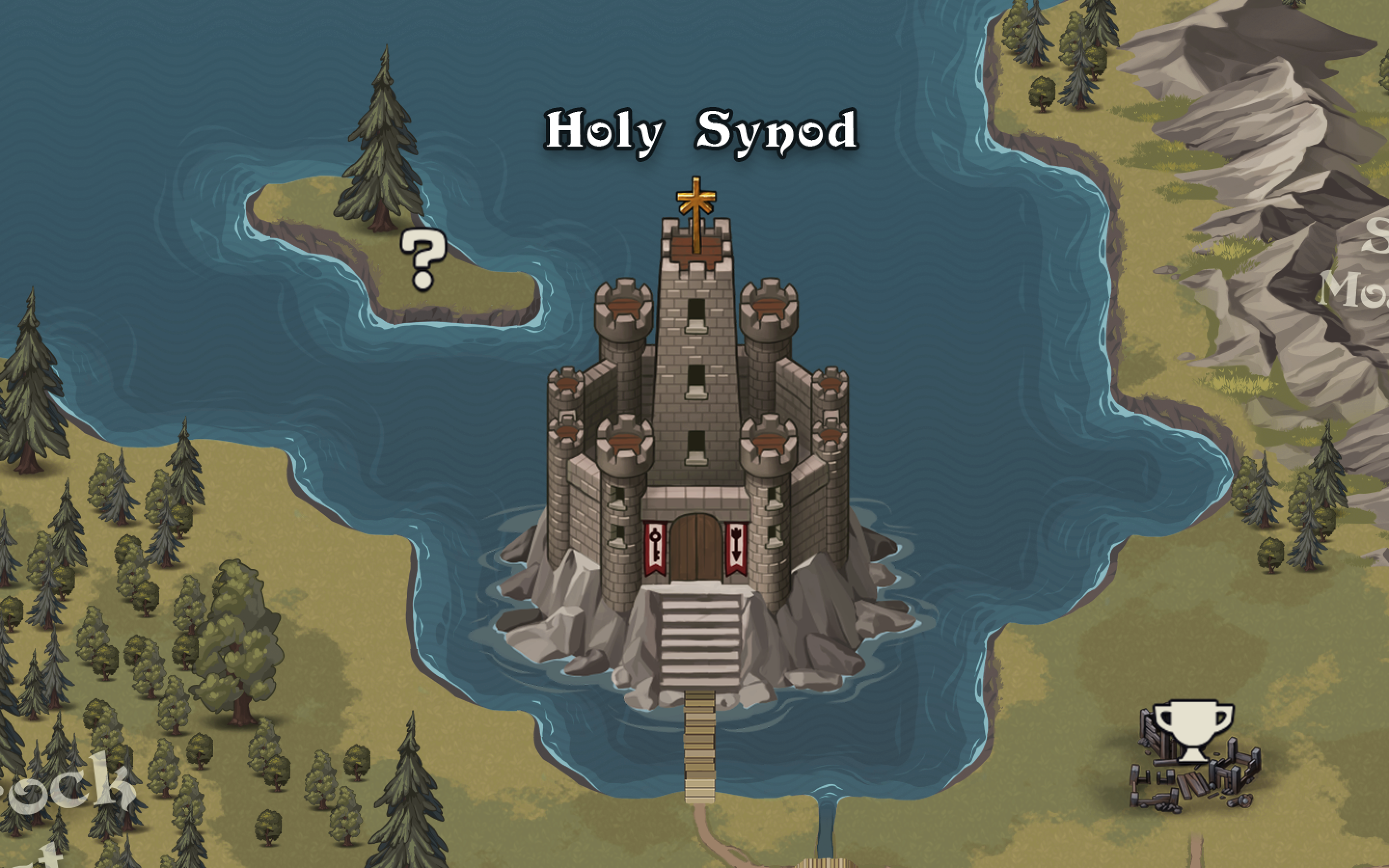
It is the dominant religion with great power. The supreme body of the cult is the Holy Synod.


The dogma of the cult is described in the sacred books Revelations of Sophia and Testimony of Truth. You can read excerpts from them here:
https://telegra.ph/Mother-Sophia-sacred-textes-03-31

Another book, "The Hidden Knowledge", which contains knowledge of the technologies and calculations of the date of the Great Purification, is accessible only to the highest members of the Holy Synod.

In the temples of Sophia is her statue with the face of the sun; her right hand wields lightning – the element of destruction, through which Sophia sends fires on sinners– and in the other hand a key, the symbol of access to rebirth, which is awarded to anyone who observed the commandments during life and whose soul is pure.

The bodies of the dead are burned on the two altars, the souls go out through the smoke and return to heaven – to the Mother.


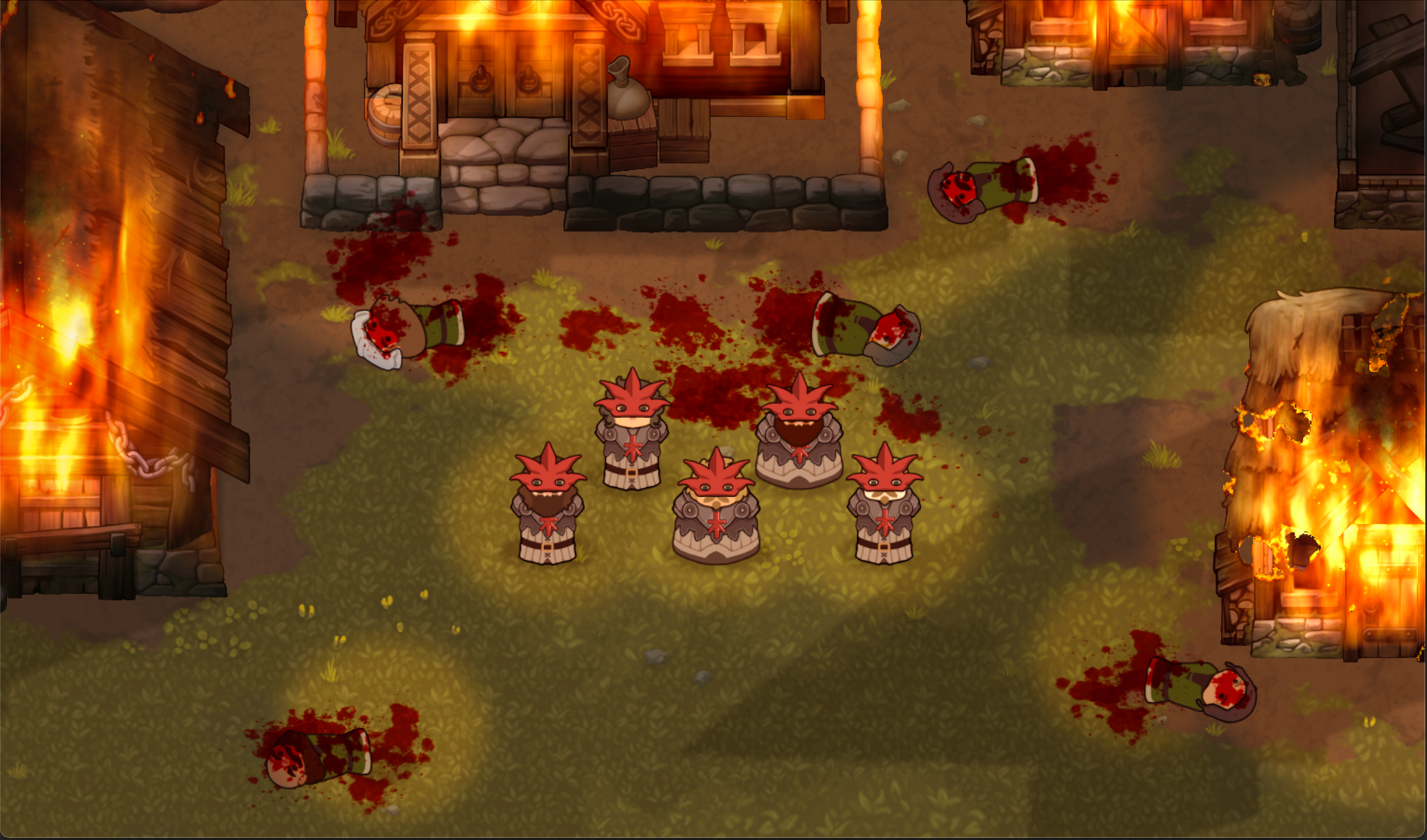
Through preaching in the temples, the player can increase or decrease the number of fanatical believers, which can be recognized by the Sophia cross on their bodies. They have a strong mood bonus and tend to take pleasure in pain, but they are also more prone to conflict, and in greater numbers can start a religious pogrom which can result in the slaying of all unbelievers or agnostics in their path, including the player's lords.

The city's accepted tenets determine which actions are sinful and lower the Piety parameter, and which will raise it. For example, these can be dice, confession, and sacrifice. However, having learned new dogmas from books or from revelation (which happens to lords after a nervous breakdown or an epilepsy attack), a player can try to implement them into the culture of his settlement, making, for example, walking naked at night a godly thing.

However, each modified dogma increases the hereticism of the local culture, and the Holy Synod does not like it. At some point, it may send an army of inquisitors who will burn your Scriptorium with all the books, and try to kill all the carriers of heretical dogma, thereby resetting the religious settings to their original ones. Maybe you yourself will ask the Synod to do this if heresy goes too far (such as arms and violence becoming forbidden).


The Holy Synod does not only watch over heresy. It is governed by the five Children of Sophia, and is located within the impregnable stone castle of the Stone of Faith, where the player can send his emissaries for intrigue.

Only the Holy Synod has the ability to build stone structures, to trade through Holy Caravans, to issue gold coins and Holy Rings. Thus, it has in its hands the most powerful instruments of economic control. But this is for the greater good – someone has to prepare humanity for salvation during the Great Purification.

But we’ll talk about that another time.

Wishlisht Norland to stay up to date!
https://store.steampowered.com/app/1857090/Norland/

#6 Norland Devlog: Daily life

[h3]Hello all,
are you wondering how a life of a Norland citizen looks like?
Well, wonder no more, as this devlog will take you on a journey through a typical day in our town! [/h3]

Despite the fact that the game takes place in real-time, life in the city is subject to a certain daily routine. Everyone works during working hours, and everyone rests and socializes in the evening. This rhythm creates pseudo-turn-based activities, which allows you to better keep things under control, since you don't have to do "everything at once." Along with the characters in the game, the player deals with economics during the day, then with planning and social life in the evening.

Characters wake up at 7 am. They have an hour to eat breakfast and chat a bit. At 8 a.m. the bell strikes - it's time for morning service in the temple, where everyone restores the parameter of Piety.


Morning service is also a time when one of the player's lords can give an inspirational speech to the congregation to influence people's beliefs (if, of course, the player assigns them such a task).

At 9, the workday begins. Farmers go to weed the beds, miners go to the mines, foresters and herbalists go to the forest, artisans go to the storehouse to get resources, which are then taken to the workshops and get to work, and executioners start looking for criminals to punish them. You get the idea.


Here the player has different management tasks: constructing buildings, producing goods, assigning workers and soldiers. Alongside this, they’ll also have to give tasks to their aristocrats. Each of them can manage one building. Also, they can be assigned to train fighters, study books, teach, or issue global edicts.

In addition, guests and news from the global map arrive at 11am. Players will have time to pay attention and assign tasks to troops & envoys in the outside world.

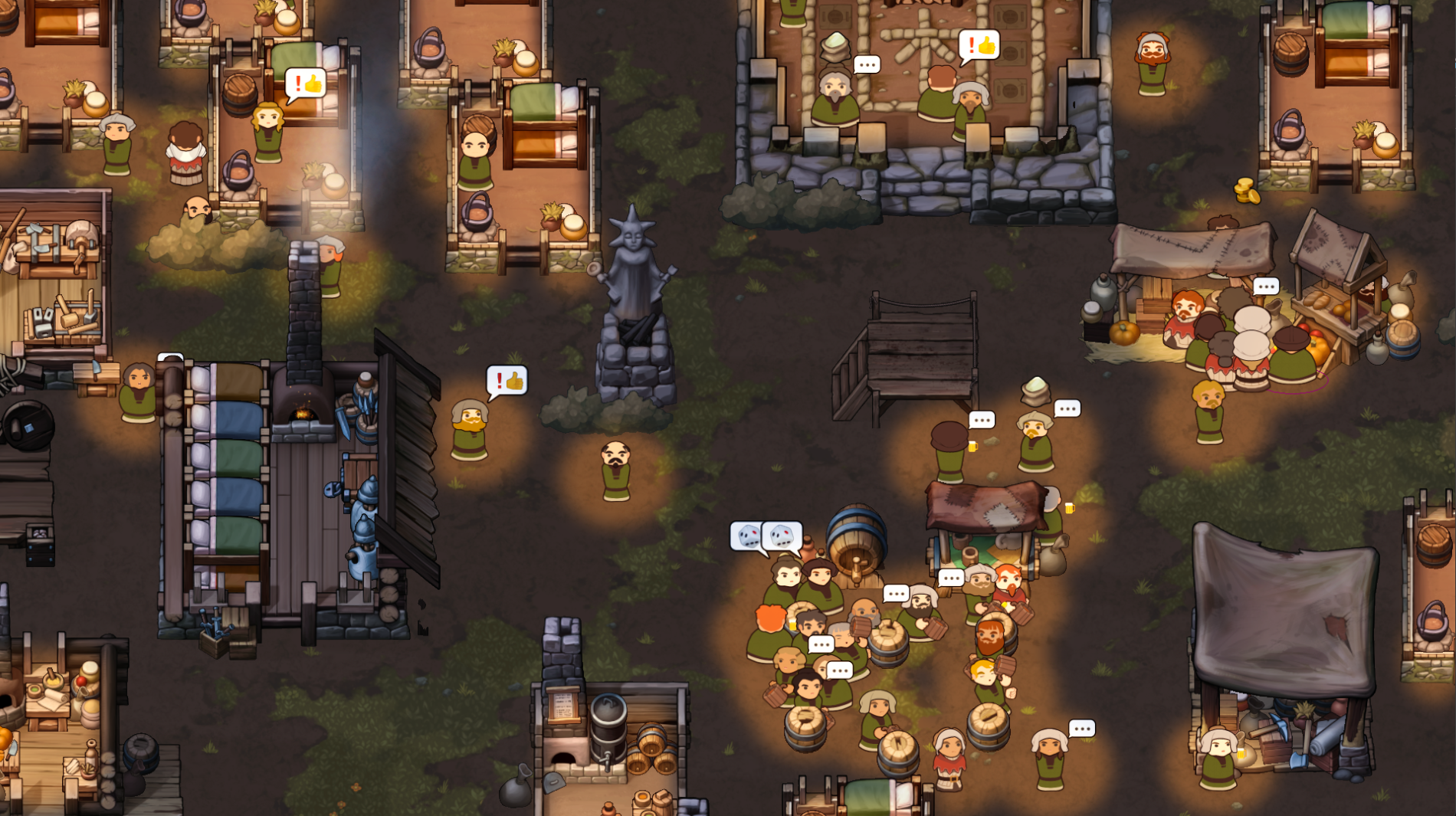
At 6 pm, the workday ends - the workers take the goods produced and the resources extracted, and take them to get paid. After that, they have a free evening. They can go to the tavern, drink beer and play dice. They can visit the central square to discuss rumors, or they can go to the market and buy food, medicine, and weapons.


In the evening this is the time when the Holy Caravan, migrants and aristocratic guests from the neighboring kingdoms, will arrive. This is a time for the player to plan the next day: to change wages, regulate the local market, outline construction projects and plans for the production of goods. Of course, it’s also a time for players to trade with the Holy Caravan itself.

Aristocrats also drink beer in the evening (which relieves production fatigue and increases sociability, but makes the character more conflicted and less moral), play music and talk amongst themselves, so the evening is a perfect time to intrigue with guests.

As darkness falls, it's a time of dark business from the town’s underbelly. Criminals take to the streets to plan robberies and attack passersby. Of course, they can be countered by player-appointed patrols. As for the lords, it is a time for sinful deeds: visiting a lover, or even attempting murder. Not even lords are above despicable acts.

Eventually, around 2 am, the lights go out and the town falls asleep, ready to begin again tomorrow.


[h3]Hey, there's a wishlisht button to click! [/h3]
https://store.steampowered.com/app/1857090/Norland/

#5 Norland Devlog: Story Generation

[h3]Hello fellow citizens,

today you can learn a bit more about how we've handled the story generation in Norland, which brings plenty of emotions, drama, and unique gameplay.[/h3]

Story generators are unique game systems that can create a much wider range of emotions than traditional video games ever could. In addition to the joy of victory, the bitterness of defeat, the wonder of exploration, and the pleasure of harmony, the semi-autonomous creatures in story generators can give players complex feelings related to empathy toward other creatures. These can be pride in successes, fear of loss, empathy for grief, sentimentality, and so on.


For the emotions to become more alive and vibrant, the events that evoke them must surprise the player. This is achieved through unexpected combinations and interactions, which can be accomplished if semi-autonomous actors function in curious and unpredictable ways. In other words, you need chaos, and you need complexity. We can say that story generators are complex, deterministic, and chaotic systems.

That's why we tried to include a lot of different systems in the game: crime and punishment, personal property (you can't take away aristocrats' jewelry, but they can donate it to a church, for example, or give it to a loved one), the institution of religion, social classes, rituals, and so on. There are many different factors at play here in Norland that make up vital aspects to the game.

Since we’ll play as a family of aristocrats, they have the opportunity to work a few hours a day (or not at all), rather than constantly as in other colony simulations. This way, they have the opportunity to build relationships among themselves more visibly, engage in intrigue, learn, and have fun. In this respect, their interaction is closer to the Sims. But the Sims lacks what makes Rimworld's stories so compelling: drama.


Drama is realized through the pressures of the systems at hand: the conflicts, the scarcity of resources, the danger of a sudden and unexpected death. To put it bluntly: drama is realized through survival.

But what can add drama to the lives of aristocrats? Death by starvation or fatigue does not threaten them. The solution is logical - their lives are threatened by other actors. This could be the same aristocrats but from other families, intra-family competition, or a threat from characters of other classes, such as a slave revolt.

The social mechanics we mentioned above also work for conflicts: the reason for killing one character by another can be envy (originating from the mechanics of property or inheritance of power), religious differences, criminal impunity, etc. There are many different ways that these stories could end in conflict and death, and it’s the unpredictability of these reasons that make Norland’s storytelling powers so engaging.

Thus, the dramatic survival of a family of aristocrats in an aggressive, complex social environment makes for a potent and compelling generator.

[h3]Until next time! [/h3]
https://store.steampowered.com/app/1857090/Norland/
#4 Norland Devlog: Social interactions & crime

[h3]Hello and welcome to our fourth Devlog, in which you can have a closer look at the interactions, social groups, and crime presented in Norland.[/h3]

As you already know, in Norland, there is an elite family of lords that you can directly manage as a player. You can give them tasks, and like the colonists or The Sims characters, they will try to complete them, albeit not immediately. The loss of this family means the end of the game. In addition, there are workers, soldiers, and enslaved people. These social groups work in the economy and protect the player's group, bringing him income and security.

Another group is as old as urban civilization — these are criminals, people who for some reason (most often economic) choose to break the rules.

A transition between all groups is possible. Workers become criminals out of desperation, and you can recruit unemployed workers into the military. Soldiers who have developed a disability leave the ranks and join the army of unemployed, sleeping in the temple. The foreign soldiers, who are not initially involved with your city, can be taken to prison and then turned into slaves. Slaves can be sold or bought. They can also be freed, or they can run away to the woods by themselves and, eventually, become criminals. In turn, a convicted criminal can not only be executed, but can also be turned into a slave.

So what are the criminals? Alas, they always appear where the rules are the same for everyone, and everyone's life situation is different.

In our case, miserable workers become criminals. For example, a former miner who has lost their arm in the mine and can no longer earn money honestly might end up on the criminal path. To survive, they will try to get money by any means: robbing drunken passers-by on the street or breaking into homes, and the especially ruthless ones will try to infringe on your treasury.


These are more dangerous criminals; they’re armed with daggers, they know how to fight, and they gather in groups to break into your lords' houses. If a lord wakes up in the process, he will grab his sword and try to protect his goods. But since he won't be wearing armor, instead wearing whatever his mother gave birth to and up against several thugs, the outcome of the battle is not clear. That's why in the world of Norland, all of your lords should preferably boost their combat skills to at least the medium level.

Means of protection from the criminals are traditional: assigning some of the soldiers to patrol the city is one option, but they do not like it too much. You can also pay the unemployed to do it — even if you pay them the minimum wage, they will finally find employment and have no reason to become criminals. There is also a justice system. The executioners find criminals and take them to the scaffold. If they are guilty of a crime, they will be executed or enslaved, and if they're not, they will be released.


The type of punishment will be determined by the player: it might be execution, enslavement, cutting off a hand or a disgraceful mask. In the latter case, the culprit will walk around town with their head chained in an iron mask, and any peasant in a bad mood can beat them up with impunity.


If the player grabs and executes random innocent townspeople, others will perceive this as terror. This drastically reduces their desire to become criminals, but the frightened townspeople will try to leave the city at the first opportunity. Such a measure can be effective when there’s a combination of excess population and out-of-control crime.


Another obvious way to reduce tensions is to recruit unemployed people into the militia in order to use them for conflicts with neighbors. This is one of the historically credible causes of constant military conflicts in agrarian societies. We will examine this point (or more precisely the implementation of the Malthusian trap in the game) in more detail later.

[h3]Stay tuned for our next devlogs, and leave us a wishlist to never miss any of them! [/h3]
https://store.steampowered.com/app/1857090/Norland/

#3 Norland Devlog: City Dynamics

[h3]Hey, it's me again - Dmitry,

and I'm bringing you a fresh devlog in which I will talk about the Norland city dynamics. [/h3]

The basic unit of the story generator genre is the automaton character with their needs, desires, and the ability to fulfill them through interaction with objects. The first time such automata were created and widely recognized was probably by Will Wright in The Sims. Then, a crucial stage of how the concept has grown was the ultra-hardcore Dwarf Fortress and the magnificent Rimworld.

Playing these games, I was always interested in the level of complexity of the structure. In The Sims, it is on the family level, while in Rimworld, we're dealing with a tribe. At the same time, colonies have a natural tendency to grow, which works against the drama of survival. When you have 15 characters, losing one of them stops being a tragedy and doesn't carry the danger of near-loss, thus becoming a statistic.

[h3] We have games about a family, we have games about a tribe living in a village. So what happens if you complicate things further?[/h3]

If you look at the history of humankind, the next stage after the tribe, which came as a consequence of the agricultural revolution, was the city-state. In the early Middle Ages, because of the destruction of the Roman state superstructures, humanity in Western Europe was brought to live mostly on this level once again.

We chose to play the earlier Middle Ages because it is chronologically closer to our time than the ancient city-states, but this is not the only nor the main reason. We also chose it as this is the stage to which (but not lower) our civilization could degenerate if we destroyed the nation-states. In a sense, we see such city-states in the modern world, in parts of Africa or the former Soviet Union.


Whereas in a tribe, almost everyone is equal, but in a city, social division is unavoidable. There are workers; there are military elites, and there are educated bureaucrats-priests. So we can play as one group (obviously the elites) and make the others autonomous.

This separation of characters helps to keep the drama of the survival story alive — the size of the elite group naturally stays at the family level. If the loss of such a group would mean the end of the game, then the problem is solved. In this way, we can increase the number of characters in other groups as much as we like, always keeping the danger of losing.


However, it is wrong to increase the numbers indefinitely. Historically, the population of the first cities was small. This was regulated both naturally - by diseases afflicting crowded groups of people in the absence of sewage - and by more complex personal choices between freedom and security. This is reflected in the game by such mechanisms as migration, control at city gates, and fertility.

In the next devlog, we'll talk about what social groups are in the game and how they interact with each other. Stay updated!

Make sure to hit the wishlist button!
https://store.steampowered.com/app/1857090/Norland/