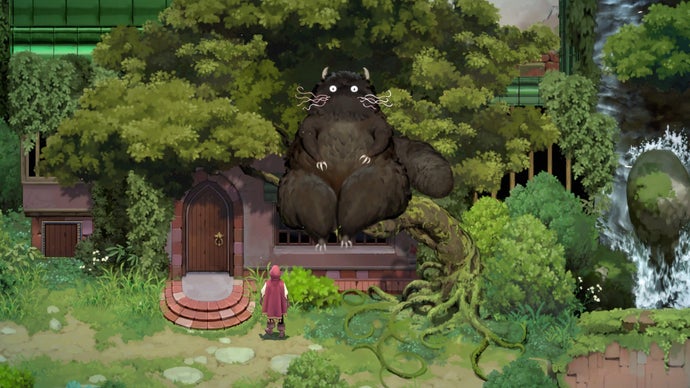
The Living and the Dead
[p]After so many years with Fallen London, one of the pleasures of working on Mandrake is getting to explore things that are barred by the lore of that setting. The first thing that comes to mind there is weather – Mandrake can have real rain, and snow that is not (usually) supernaturally menacing.[/p][p]But at this darkest time of year, it's another example I'd like to talk about – specifically death, and undeath. Although the boundary between life and death is more porous and negotiable in Fallen London than reality, its lore compels us: there can be no true ghosts or hauntings.[/p][p][/p][h2]Killing the Dead[/h2][p]In video games, the unquiet dead tend to be numerous, anonymous, unrelentingly violent. And in turn, violence is the answer. If it doesn't work, probably your weapon just isn't magical enough.[/p][p]This is, of course, because video game mechanics are commonly focused on violence, and they require a large (and often unlimited) number of foes for us to practise violence upon.[/p][p]![]() This is rather more undead than we'll have in Mandrake[/p][p]That isn't something we think ill of, but it does push games towards certain tropes over others – zombie hordes, necromantic minions, infernal legions. We don't have anything against those tropes, either.[/p][p]But since Mandrake is not centrally concerned with violence (although not entirely bereft of it, either, and I suppose the local fish may find you rather fearsome), it felt like an opportunity to look to some rather different sources.[/p][p]Above all, what we've been looking at are the medieval sagas that have come to us from the Norse world, and in particular, from Iceland. A number of these tell of revenants – specific corpses which, for one reason or another, have returned to trouble the living.[/p][p]
This is rather more undead than we'll have in Mandrake[/p][p]That isn't something we think ill of, but it does push games towards certain tropes over others – zombie hordes, necromantic minions, infernal legions. We don't have anything against those tropes, either.[/p][p]But since Mandrake is not centrally concerned with violence (although not entirely bereft of it, either, and I suppose the local fish may find you rather fearsome), it felt like an opportunity to look to some rather different sources.[/p][p]Above all, what we've been looking at are the medieval sagas that have come to us from the Norse world, and in particular, from Iceland. A number of these tell of revenants – specific corpses which, for one reason or another, have returned to trouble the living.[/p][p]![]() This book is not about Iceland, but also very good (at least if you'd like to know about the strange things bodies can do as they decompose, and how that shows up in folklore)[/p][p]In the sagas, a single revenant is a great terror. And as in video games, sometimes the eventual solution is violence. Such victories, though, are often bitter.[/p][p]One saga tells of Grettir, who learns of a farm haunted by Glam, a former shepherd. Grettir is an able warrior who already slew one revenant, and he prevails again against Glam. But Glam curses him with its last breath, and from that point on he is plagued with misfortune. He accidentally burns several people to death, and is outlawed. He dies 19 years into the sentence, just before it would have been lifted.[/p][p]
This book is not about Iceland, but also very good (at least if you'd like to know about the strange things bodies can do as they decompose, and how that shows up in folklore)[/p][p]In the sagas, a single revenant is a great terror. And as in video games, sometimes the eventual solution is violence. Such victories, though, are often bitter.[/p][p]One saga tells of Grettir, who learns of a farm haunted by Glam, a former shepherd. Grettir is an able warrior who already slew one revenant, and he prevails again against Glam. But Glam curses him with its last breath, and from that point on he is plagued with misfortune. He accidentally burns several people to death, and is outlawed. He dies 19 years into the sentence, just before it would have been lifted.[/p][p]![]() [/p][p]Glam sat astride a roof beating it furiously with his hands, an illustration by John Vernon Lord from the 'Grettir's Saga' in Icelandic Sagas, Volume 2, The Folio Society, 2002.[/p][p]In another instance, a revenant is disinterred by Thorodd, who has his body rolled to the shore and then prudently cremated on a great pyre. He hopes to throw the ashes in the sea, but the winds pick up and some make it into the belly of one of Thorodd's cows. It gives birth to a calf, which grows into a bull; it slays Thorodd, then disappears.[/p][p]In the Saga of the People of Eyri, Kjartan resolves a haunting rather more successfully. In this case the farmstead is troubled by not one but several revenants. Rather than steel or fire, his weapon is a lawsuit, conducted with all proper observances and a jury. It is found that the dead have trespassed; they respect the finding of the court and depart peacefully.[/p][p]Mandrake takes place in a small rural community, at a time when humans are far from the peak of their power. There are limits to the violence that the people of Chandley can bring to bear. If they faced a revenant like those of the sagas, we think it would not be their first or best choice, and we're looking forward to exploring what they might try, instead.[/p][p]With undead as with disease, of course, prevention is better than cure. And the sagas suggest some things about that, too.[/p][p]
[/p][p]Glam sat astride a roof beating it furiously with his hands, an illustration by John Vernon Lord from the 'Grettir's Saga' in Icelandic Sagas, Volume 2, The Folio Society, 2002.[/p][p]In another instance, a revenant is disinterred by Thorodd, who has his body rolled to the shore and then prudently cremated on a great pyre. He hopes to throw the ashes in the sea, but the winds pick up and some make it into the belly of one of Thorodd's cows. It gives birth to a calf, which grows into a bull; it slays Thorodd, then disappears.[/p][p]In the Saga of the People of Eyri, Kjartan resolves a haunting rather more successfully. In this case the farmstead is troubled by not one but several revenants. Rather than steel or fire, his weapon is a lawsuit, conducted with all proper observances and a jury. It is found that the dead have trespassed; they respect the finding of the court and depart peacefully.[/p][p]Mandrake takes place in a small rural community, at a time when humans are far from the peak of their power. There are limits to the violence that the people of Chandley can bring to bear. If they faced a revenant like those of the sagas, we think it would not be their first or best choice, and we're looking forward to exploring what they might try, instead.[/p][p]With undead as with disease, of course, prevention is better than cure. And the sagas suggest some things about that, too.[/p][p]
[/p][h2]The Making of a Revenant[/h2][p]Why do the dead return to trouble us? There isn't one universal answer, but often, it's because something has been handled improperly in the aftermath of the death.[/p][p]The shepherd Glam, who cursed Grimmir, died in the mountains in the dark of a winter blizzard. By the time they find him, his body has swollen to a monstrous size. They try three times to drag it to the churchyard, but it has grown too heavy to move, even with oxen. So they must resort to building a cairn on the spot. It is not enough.[/p][p]The troubles of the people of Eyri begin when they fail to honour the wishes of the deceased in relation to the disposal of her property. She warns them that they must burn her bedsheets; not, she says, because she begrudges anyone the use of them, but because she foresees things will go very poorly, otherwise. But the bedsheets are beautiful and of foreign make; despite misgivings, they go unburned, and thus the revenant comes among them.[/p][p]I've read that Attila was buried in a casket of gold, inside a casket of silver, which was itself placed in a casket of iron. I like to think of it as two polite requests and one firm suggestion: we have interred you with much finery. Please lie still and enjoy it; do not rise up and kill our animals, or spread disease, or turn indecorously into a seal; do not haunt us in the long winter nights, or speak grim prophecies, or bang your heels upon the sod roofs until we are driven to madness; for these are but some of the things the dead have been known to do in Iceland to trouble the living, and might, perhaps, do elsewhere.[/p][p]
[/p]
[/p][h2]The Making of a Revenant[/h2][p]Why do the dead return to trouble us? There isn't one universal answer, but often, it's because something has been handled improperly in the aftermath of the death.[/p][p]The shepherd Glam, who cursed Grimmir, died in the mountains in the dark of a winter blizzard. By the time they find him, his body has swollen to a monstrous size. They try three times to drag it to the churchyard, but it has grown too heavy to move, even with oxen. So they must resort to building a cairn on the spot. It is not enough.[/p][p]The troubles of the people of Eyri begin when they fail to honour the wishes of the deceased in relation to the disposal of her property. She warns them that they must burn her bedsheets; not, she says, because she begrudges anyone the use of them, but because she foresees things will go very poorly, otherwise. But the bedsheets are beautiful and of foreign make; despite misgivings, they go unburned, and thus the revenant comes among them.[/p][p]I've read that Attila was buried in a casket of gold, inside a casket of silver, which was itself placed in a casket of iron. I like to think of it as two polite requests and one firm suggestion: we have interred you with much finery. Please lie still and enjoy it; do not rise up and kill our animals, or spread disease, or turn indecorously into a seal; do not haunt us in the long winter nights, or speak grim prophecies, or bang your heels upon the sod roofs until we are driven to madness; for these are but some of the things the dead have been known to do in Iceland to trouble the living, and might, perhaps, do elsewhere.[/p][p]
[/p]